
Industry Context
The Critical Transition from Glass to High-Performance Plastics
For decades, laboratories and chemical plants relied on glass due to its chemical inertness. However, the catastrophic risks of breakage—leading to toxic spills, biohazard exposure, and ruined expensive samples—have driven a massive shift toward high-performance plastics. But substituting glass with cheap, commodity plastics introduces new problems: leaching, poor optical clarity for visual inspection, and weak sealing that allows volatile organic compounds (VOCs) to escape.
Traditional Extrusion Blow Molding (EBM) produces bottles with a “pinch-off” seam at the base—a notorious weak point that can split under pressure or impact. Furthermore, EBM necks are often calibrated post-blow via trimming, leaving micro-imperfections that prevent a truly hermetic seal.
The One Step Blow Molding Machine resolves these critical flaws. The neck is injection-molded to exact tolerances, guaranteeing an airtight fit with PTFE-lined caps or induction seals. The body is biaxially stretched, aligning the polymer molecules to create a seamless, shatterproof vessel that withstands aggressive drop tests, making it the ultimate solution for hazardous and high-value liquid containment.

Fig. 1 — A diverse array of premium laboratory reagent bottles manufactured on our ISBM platform. The process produces thick-walled, heavy amber and clear containers, ensuring failsafe barrier protection against UV light and hazardous chemicals.
Application Scenes
Core Application Scenes: From Lab Reagents to Agrochemicals
The industrial and scientific sectors demand extreme packaging reliability. A microscopic leak in a pesticide bottle or particulate contamination in a diagnostic vial can have disastrous consequences. The Injection Stretch Blow Molding Machine is precision-engineered to meet these non-negotiable safety and purity standards.
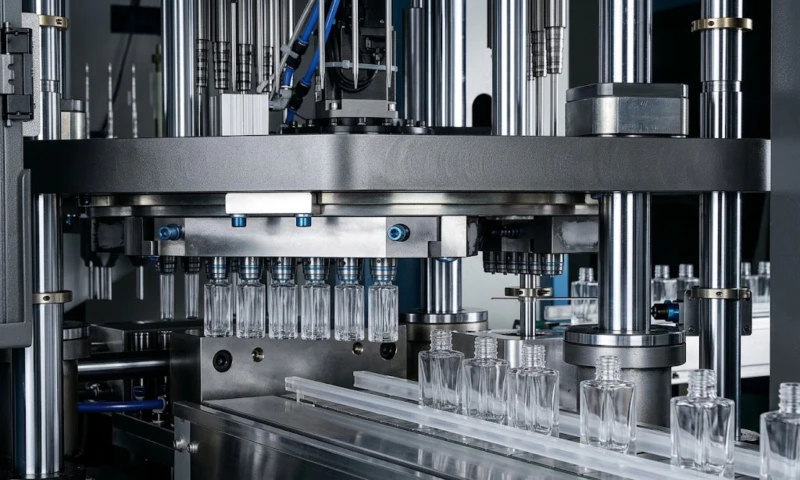
Fig. 2 — A fully automatic One-Step ISBM Machine powering sterile production. The enclosed, enclosed footprint turns raw resin into finished, pristine bottles, eliminating the dust and static attraction common in two-step preform handling.
Materials Engineering
Material Selection Guide for Harsh Environments
Industrial fluids and laboratory reagents degrade inferior plastics, leading to panelling (bottle collapse), swelling, or environmental stress cracking (ESC). Our ISBM-Maschine platform offers the flexibility to process highly resilient engineering resins to match your specific chemical payload.
| Resin | Resistance Profile | Key Industrial Properties | Primary Applications |
|---|---|---|---|
| Polypropylene (PP) | High Chemical & Solvent Resistance | Excellent resistance to acids, alkalis, and many organic solvents. Autoclavable (withstands high-heat sterilization). High fatigue resistance. | Harsh agrochemicals, industrial cleaning solvents, autoclavable lab ware |
| Heavy-Wall PET | Good General Resistance | Biaxial orientation provides immense tensile strength and drop resistance. Excellent clarity for visual inspection. Good gas barrier. | Reagent bottles, automotive additives, non-solvent agrochemicals, diagnostic liquids |
| Polycarbonate (PC) | Extreme Impact & Heat | Virtually unbreakable. Withstands extreme temperatures (autoclavable up to 121°C). Glass-like transparency. | Cell culture flasks, high-end reusable lab bottles, cryogenic storage vials |
| PETG | Gamma/EtO Sterilizable | Maintains extreme clarity and toughness even after Gamma or Ethylene Oxide (EtO) sterilization. High resistance to stress cracking. | Medical diagnostics, sterile sampling vials, biological media bottles |
.webp)
Fig. 3 — A varied display of high-quality PET bottle samples suitable for industrial and laboratory use. The process ensures extreme clarity and precise wall distribution, ideal for visual inspection of high-value diagnostic liquids.
Technical Advantages
Technical Advantages That Guarantee Chemical Containment
A leaking beverage is a mess; a leaking agrochemical is an environmental incident. The ISBM process provides the architectural certainty required to package dangerous, expensive, or highly regulated liquids safely.
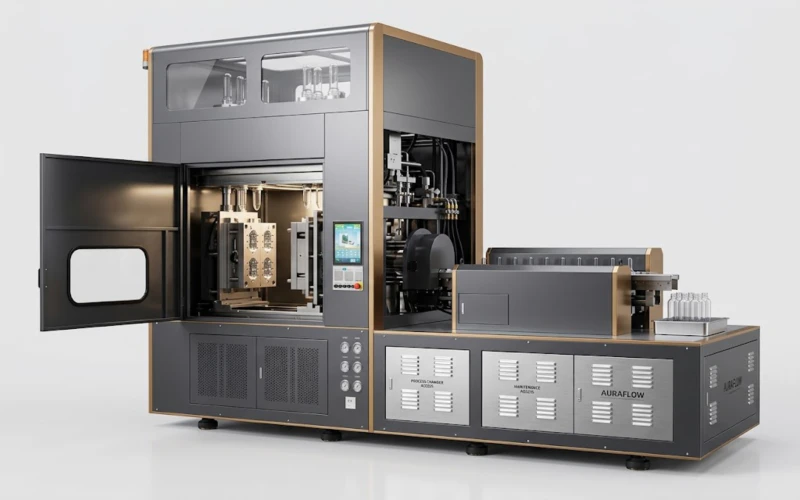
Fig. 4 — Precision tooling inside the ISBM machine, showing the exact molds and stretch rods required to produce flawless industrial neck threads and seamless, structurally sound bases for heavy liquid containment.
Zero-Flash Base Integrity
Unlike EBM, which pinches off a hollow tube of plastic and leaves a welded seam at the bottom of the bottle, ISBM stretches a seamless preform. There is no base weld line, completely eliminating the most common point of structural failure and leakage in industrial bottles.
Hermetic Neck Sealing (±0.05mm)
The bottle neck is injection-molded, not blown. This yields exact dimensional tolerances essential for PTFE-lined caps, induction foil seals, and Child-Resistant Closures (CRC). It prevents the evaporation of highly volatile organic compounds (VOCs) and stops toxic leaks.
Uniform Wall Distribution
Aggressive chemicals will attack the thinnest part of a bottle first. The stretch rod in the ISBM process physically guides the plastic, ensuring perfect, uniform wall thickness even in square or asymmetric shapes, leaving no weak corners for chemicals to compromise.
Absolute Biological Purity
For laboratory and medical diagnostics, foreign particulates ruin tests. Because the ISBM process converts molten resin into a finished bottle inside a single, enclosed sterile environment, it bypasses the dust, cardboard fibers, and static-cling associated with handling preforms or EBM bottles.
Process Comparison
One-Step ISBM vs. EBM: Eliminating the Weak Points
For decades, Extrusion Blow Molding (EBM) was the default for industrial chemicals, mostly producing opaque HDPE jugs. But as the industry demands clarity, lighter weights, and better chemical barriers, EBM’s mechanical limitations become severe liabilities.
| Parameter | One-Step ISBM Machine ✦ | Traditional EBM |
|---|---|---|
| Base Integrity (Drop Test) | ✔ Seamless, injection-molded base. Extremely high drop-impact resistance for UN certification. | ✘ Welded “pinch-off” seam at the base is a fundamental weak point prone to splitting on impact. |
| Neck Sealing & Accuracy | ✔ Injection-molded threads (±0.05mm). Guarantees airtight fit for CRC and PTFE caps. | ✘ Blown and mechanically trimmed/reamed neck leaves a rough surface; highly prone to VOC vapor leaks. |
| Material Efficiency / Flash | ✔ Zero flash. 100% of melted resin goes into the final bottle. No trimming or waste. | ✘ Generates substantial “flash” (scrap) at the neck and base that must be cut, ground, and recycled. |
| Optical Clarity | ✔ Perfect, glass-like transparency allows exact visual inspection of lab reagents and liquid levels. | ✘ Inherently cloudy or opaque, preventing clear visual assessment of the chemical contents. |
“We package highly concentrated agricultural solvents. A single bottle splitting during pallet transit is a disaster. Moving away from EBM to ISBM-produced heavy-wall PET completely eliminated base seam failures and gave our products a premium, transparent look that farmers trust.”
— Supply Chain Director, Global Agrochemical Producer
Procurement Guide
Procurement Guide: Specifying an ISBM Machine for Industrial Use
If you are a chemical manufacturer or laboratory supplier looking to internalize packaging production, an ISBM-Maschine requires rigorous evaluation. Focus on its capability to handle difficult engineering resins and maintain absolute precision.
Verify Engineering Resin Compatibility (PP/PC/PETG)
Industrial applications often move beyond standard PET. If your chemicals require Polypropylene (PP) for solvent resistance or Polycarbonate (PC) for autoclavability, ensure the machine’s injection screw, barrel design, and heating profiles are specifically engineered to handle the melt flow indexes of these demanding polymers.
Assess Clamping Force for Thick-Walled Containers
Lab reagent bottles and pesticide jugs require significantly thicker walls than beverage bottles to pass UN Drop Tests. Pushing thick preforms into heavy bottles requires massive blowing pressure and immense mold clamping force. Validate the machine’s tonnage capabilities to ensure no mold separation occurs during blowing.
Confirm Micro-Cavitation for Diagnostics
If you are producing 10ml to 50ml diagnostic vials, the machine must be capable of high-precision, multi-cavity injection (e.g., 12, 16, or 24 cavities). Ask for demonstrations showing uniform melt distribution across all cavities, as tiny variations in small vials lead to significant volumetric errors.
Ensure Cleanroom (All-Electric/Hybrid) Compliance
For medical and laboratory use, ambient contamination is unacceptable. Look for all-electric or advanced hybrid ISBM machines that eliminate the risk of hydraulic oil misting. Ensure the machine footprint can seamlessly integrate into an ISO Class 7 or Class 8 cleanroom environment with HEPA filtration setups.
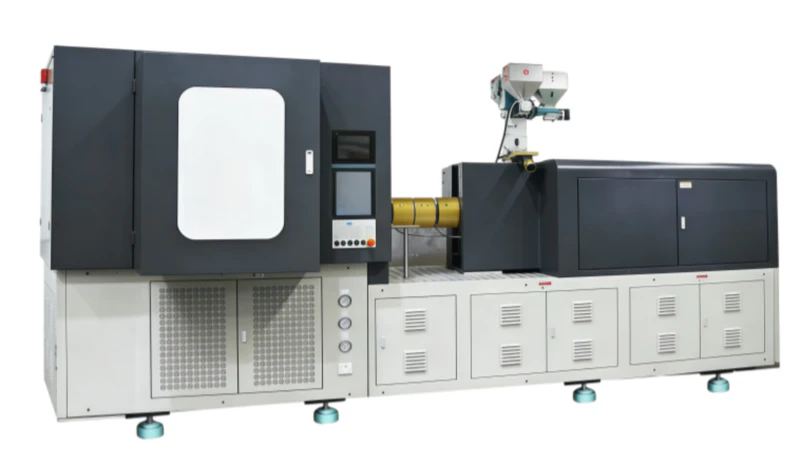
Fig. 5 — A high-capacity, Fully Electric ISBM Machine model engineered for industrial and lab scale. Its robust clamping force and advanced servo controls provide the power needed to produce heavy-walled chemical bottles and sterile diagnostics vials safely.
In the industrial and scientific sectors, a container is a critical piece of safety equipment. Settling for packaging with weak base seams, imprecise necks, or particulate contamination puts personnel, the environment, and your company’s liability at risk. The Injection Stretch Blow Molding Machine eliminates these risks, delivering structurally invincible, chemically resilient, and hermetically sealed containers. For chemical manufacturers, agrochemical producers, and laboratory suppliers demanding zero-failure packaging, ISBM technology is the definitive engineering solution.
Industrial & Laboratory Packaging · 20+ Years Industry Experience
Specializing in ISBM machine applications for hazardous chemicals, agrochemicals, and sterile laboratory environments. Experience spans drop-impact structural optimization, engineering resin (PP/PC) qualification, and cleanroom-compliant production workflows. Published in association with injectionstretchblowmolding.com — a leading One-Step Injection Stretch Blow Molding Machine manufacturer backed by 20+ years of manufacturing excellence (est. 2003), delivering robust packaging solutions for the global chemical and scientific sectors.