
IBM Machine Buyer Guide
A factual, data-driven comparison of two 60T-class injection blow molding machines — covering clamping force, injection weight, platen size, machine footprint, and total cost of ownership — to help procurement teams make an informed evaluation decision.
When a packaging facility reaches the point of evaluating high-output injection blow molding (IBM) machinery, the Jomar IBM65 is almost always on the shortlist. It has been a market reference machine in the 60-to-65-ton clamping class for decades, with an established track record across pharmaceutical, cosmetic, and food packaging production lines globally.
But the IBM machine market has changed. Chinese manufacturers producing IBM machines to European structural standards have introduced machines in the same tonnage class that, on paper, offer higher injection weight, stronger clamping force, and dramatically lower machine height — at a significantly more competitive acquisition price. The ZQ60 is one such machine.
This article is not a promotion for either machine. It is a factual technical comparison, using published and available specification data, designed to give procurement teams the information they need to structure an informed evaluation. Where the ZQ60 has an advantage we say so. Where Jomar IBM65 has an advantage — or where data is not directly comparable — we say that too.
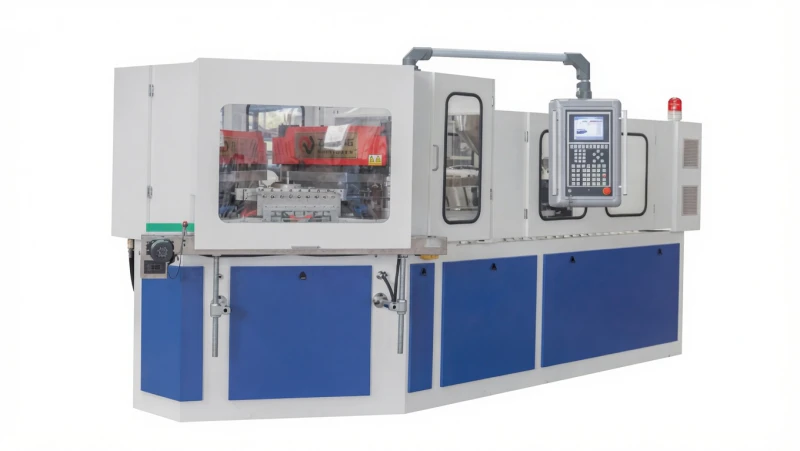
60T-Class IBM Machine Comparison: Jomar IBM65 and ZQ60 — key specification differences at a glance
What Is the 60T/65T IBM Machine Class?
Injection blow molding machines are categorised by their injection clamping force — the hydraulic force applied to hold the injection mold closed during the parison-forming stage of the IBM cycle. The “60T” or “65T” designation refers to approximately 60 to 65 US tons of clamping force, roughly translating to 520 kN to 600 kN.
Machines in this class are designed for medium-to-high volume bottle production: pharmaceutical oral liquid vials (1–250 ml), cosmetic sample and travel bottles (5–100 ml), eye dropper bodies, nasal spray containers, and larger food supplement capsule bottles. The 60T class typically supports between 2 and 14 cavities per cycle depending on bottle volume, making it the workhorse choice for dedicated, high-output IBM packaging lines.
The Jomar IBM65 has occupied this tier for many years and is widely used as a reference point when specifying new machinery. The ZQ60 is positioned in the same tonnage class by its manufacturer and targets the same bottle volume range and cavitation levels. Both machines use the same fundamental one-step three-station rotary table IBM process: injection station, blow station, stripping station — all operating simultaneously within each machine cycle.
Core Specification Comparison — Jomar IBM65 vs ZQ60
The table below compiles available specification data for both machines across the parameters most relevant to procurement decisions in the 60T IBM class.
| Parameter | ZQ60 | Jomar IBM65 | Advantage |
|---|---|---|---|
| Injection Clamping Force | 600 kN | 520 kN (52 Tons) | ZQ60 +15.3% |
| Screw Diameter | 45 / 50 / 60 mm | 35 / 50 mm | ZQ60 larger options |
| Injection Weight | 260 / 383 g | ~375 g | Comparable capacity |
| Max. Platen Size (L x W) | 600 x 390 mm | 660 x 431 mm | Differs by orientation |
| Blow Clamping Force | 100 kN | — | ZQ60 published |
| Machine Height | 1.8 m | 2.75 – 3.4 m | ZQ60 -34% lower |
| Machine Footprint (L x W) | 3.8 x 1.4 m | 2.92 x 1.98 m | Comparable floor area |
| Dry Cycle Time | 4.0 s | ~3–4 s | Comparable |
| Total Installed Power | 37 kW | ~37 kW | Comparable |
| Bottle Volume Range | 1 – 2,000 ml | ~1 – 1,200 ml | ZQ60 wider range |
| Origin | China | USA | ZQ60 lower cost |
Note: Jomar IBM65 specifications sourced from publicly available technical data. Some Jomar parameters are not published; where unavailable, cells are marked —. Specification comparison is provided for reference only.
Parameter Deep Dive — Where the Differences Matter Most
1. Injection Clamping Force: 600 kN vs 520 kN
This is the most significant structural difference between the two machines. The ZQ60 delivers 600 kN injection clamping force versus the Jomar IBM65 at 520 kN (52 US tons) — a difference of 15.3%. In practical terms, higher clamping force means the injection mold is held closed with greater force during the parison injection stage, reducing the risk of flash (material escaping at the mold parting line), extending mold service life, and allowing the machine to sustain higher injection pressures without mold deflection.
For high-cavitation tooling — particularly 10-cavity to 14-cavity molds at small bottle volumes — the additional 80 kN of clamping force on the ZQ60 provides a meaningful operational margin that reduces flash-related scrap rates on multi-cavity production. For low-cavity tooling, the difference is less practically significant.
2. Platen Size: Different Orientations, Comparable Total Area
The ZQ60 platen is 600 x 390 mm in landscape orientation — wider than it is tall. The Jomar IBM65 platen is 431 x 660 mm (approx. 17″ x 26″) in portrait orientation — taller than it is wide. Total platen area is comparable, giving roughly the same physical space for mold layouts.
What matters operationally is the layout orientation. The ZQ60 landscape platen accommodates symmetric horizontal cavity arrays particularly well — for example, an 8-cavity mold arranged in two rows of four sits naturally within the 600 mm width. The Jomar IBM65 portrait platen suits vertical column arrays. The optimal orientation depends on your specific bottle geometry and mold design.
For buyers considering transferring existing Jomar IBM65 molds to the ZQ60: the different platen aspect ratios mean direct transfer is generally not feasible without backing plate modifications. Cavity inserts and core rods may be adaptable, but the mold assembly requires re-engineering for the ZQ60 platen geometry. This is a real cost consideration and should be factored into any ZQ60 evaluation alongside machine acquisition price.
3. Machine Height: 1.8 m vs 2.75 m+
The ZQ60 stands 1.8 m tall — at least 34% lower than the Jomar IBM65, which ranges from 2.75 m up to 3.4 m depending on the screw configuration installed. This is a consistent design characteristic across the ZQ series, reflecting a deliberate European-style low-profile structural approach.
In practice, this means the ZQ60 can be installed in facilities with standard industrial ceiling heights of 3 m or above without overhead clearance concerns. The taller Jomar IBM65 requires higher minimum ceiling clearance to allow for mold change access and material feeding above the machine. For packaging facilities repurposing existing factory space — rather than building purpose-designed IBM production rooms — the ZQ60 height advantage can represent a real installation cost saving.
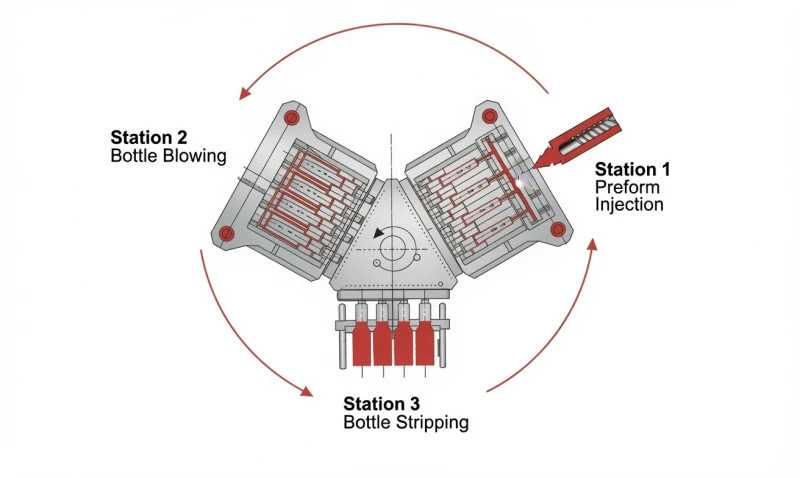
The one-step IBM three-station process is identical in principle between ZQ60 and Jomar IBM65 — differences lie in structural specifications rather than process architecture
Cavitation Comparison: How Many Bottles Per Cycle?
For pharmaceutical and cosmetic packaging buyers, cavitation — the number of bottles produced per cycle — is often the primary production planning metric. The table below shows reference maximum cavitation for the ZQ60, with Jomar IBM65 estimates based on comparable platen area and clamping constraints.
| Bottle Volume | ZQ60 Max Cavities | Jomar IBM65 Est. |
|---|---|---|
| 10 ml | 12 – 14 | 10 – 12 |
| 30 ml | 9 – 10 | 8 – 9 |
| 60 ml | 7 – 8 | 6 – 7 |
| 100 ml | 6 – 7 | 5 – 6 |
| 250 ml | 4 – 5 | 4 |
| 500 ml | 3 | 2 – 3 |
Cavitation estimates are reference values. Actual achievable cavitation depends on bottle geometry, wall thickness, and mold design. Jomar IBM65 cavitation estimates are based on publicly available comparable data and may vary.
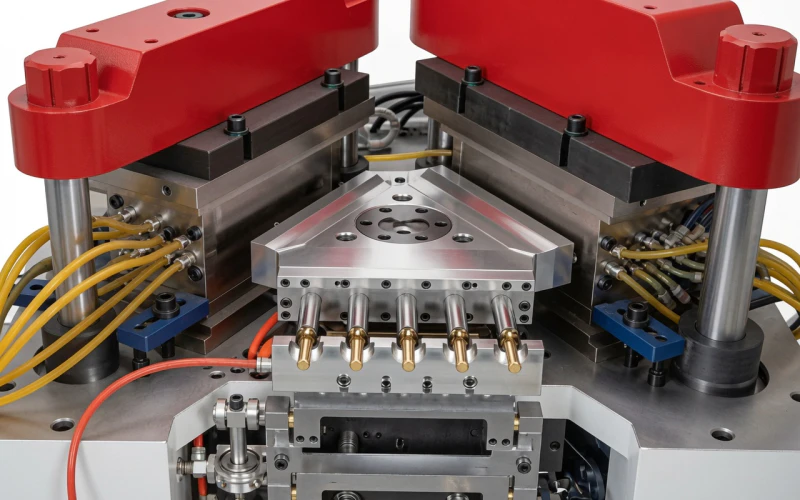
Multi-cavity IBM mold tooling — cavitation potential is directly influenced by platen area, shot weight, and clamping force
Where the Jomar IBM65 Retains Advantages
A fair comparison requires acknowledging where the Jomar IBM65 maintains genuine advantages that buyers should weigh carefully:
⚠ Established Service Network
Jomar has a long-established service and spare parts network in North America and Europe. For buyers in these regions, proximity to factory-authorised technicians and stocked spare parts can reduce machine downtime significantly versus sourcing support from an overseas IBM machine supplier.
⚠ Portrait Platen for Certain Mold Layouts
The Jomar IBM65 portrait platen (431 x 660 mm) has a longer vertical axis that suits certain bottle geometries — particularly taller bottles where core rods need maximum vertical separation. Buyers with existing mold investments in portrait-format tooling may find the Jomar platform a better geometric fit.
⚠ Long Reference History
For regulated pharmaceutical environments where equipment qualification history and vendor stability are procurement criteria, Jomar long operating history in the IBM sector provides a reference depth that newer entrants in the same class cannot yet match on purely documentary terms.
⚠ Existing Mold Compatibility
If a buyer already operates a Jomar IBM65 and is acquiring a second machine for line expansion, adding another Jomar IBM65 allows direct mold interchangeability — eliminating the re-engineering cost and requalification timeline that a platform switch would require.
Materials and Applications: What Both Machines Can Process
Both the Jomar IBM65 and ZQ60 are designed to process standard injection-grade thermoplastic resins used in IBM bottle production. The ZQ60 published material compatibility list includes:
LDPE
PP
PS
High-Transparency PS
ABS
EVA
PCTG
PLA
The Jomar IBM65 processes the same core IBM resin portfolio (HDPE, PP, PS, LDPE, ABS) with the same IBM process fundamentals. Both machines are suitable for the primary application sectors of the 60T class:
Pharmaceutical Packaging
1–250 ml vials, oral liquid, eye dropper
Cosmetics & Personal Care
5–150 ml lotion, serum, sample bottles
Health Supplements
Tablet, capsule, and liquid supplement bottles
Food Packaging
PS lactic acid bacteria drinks, condiment bottles
.webp)
Typical output from 60T-class IBM machines: pharmaceutical vials, cosmetic sample bottles, oral liquid containers, and food supplement packaging
A Note on the IBM Process Itself: What Does Not Change Between Platforms
It is worth clarifying what both machines share, because buyers sometimes overweight platform differences when the underlying IBM process delivers the same fundamental quality outputs regardless of machine brand:
Zero flash and no bottom pinch-off waste — this is a characteristic of the IBM process itself, not of either machine brand. Any correctly functioning IBM machine produces bottles with no parting-line flash and no bottom scar, versus extrusion blow molding which generates 10–40% flash waste per cycle.
Precision neck thread formation — the IBM process forms bottle necks in the injection station, producing thread geometry to injection molding tolerances (±0.05 mm). This is inherent to IBM and applies equally to Jomar IBM65 and ZQ60 production.
Uniform wall thickness — both machines achieve the wall thickness consistency advantage of IBM versus EBM, where parison expansion from a core rod produces more uniform wall distribution than free-blown parisons.
The differences between the Jomar IBM65 and ZQ60 are structural and commercial — clamping force magnitude, shot capacity, machine geometry, service network, and price. The IBM process quality output is determined primarily by tooling design, material selection, and process parameter setup — not by which brand of machine is running it.
Compressed Air Requirements: A Utility Often Overlooked in IBM Procurement
Both the Jomar IBM65 and ZQ60 require a reliable compressed air supply for the blow station — and for pharmaceutical or food packaging production, that supply must be oil-free. This is frequently an afterthought in IBM machine procurement but becomes a capital and operating cost factor once commissioning begins.
The ZQ60 requires 0.7–1.2 MPa at 0.7 m³/min. An oil-free screw air compressor matched to this specification — such as the CM-B Series Oil-Free Screw Air Compressor — should be costed into the project budget alongside the IBM machine itself. For pharmaceutical bottle lines where GMP requires oil-free blow air, this is a non-negotiable line item regardless of which IBM machine platform is selected.
The Mold Compatibility Question: A Critical Evaluation Factor
For any buyer considering the ZQ60 as a replacement for Jomar IBM65, the mold compatibility question requires direct investigation before a procurement decision. The platen geometry difference (landscape vs portrait, different aspect ratios) means that existing Jomar IBM65 tooling cannot be transferred to a ZQ60 without modification.
The practical scenarios are:
Scenario A — New tooling investment: Buyer is purchasing new IBM tooling alongside the machine. In this case, molds can be designed for the ZQ60 platen from the outset — no compatibility penalty applies. This is the optimal scenario for ZQ60 evaluation.
Scenario B — Existing Jomar molds to be retained: Cavity inserts and core rods may be adaptable to ZQ60 backing plates, but the mold assembly requires engineering assessment. Budget for potential re-engineering costs (typically 15–30% of original tooling cost) when modelling total switch cost.
Scenario C — Capacity expansion, not replacement: Buyer is adding a second machine alongside existing Jomar IBM65. Adding a ZQ60 introduces a second platform — which means separate spare parts stock and potential process parameter differences between lines. Adding a second Jomar IBM65 preserves single-platform simplicity at the cost of forgoing ZQ60 technical and price advantages.
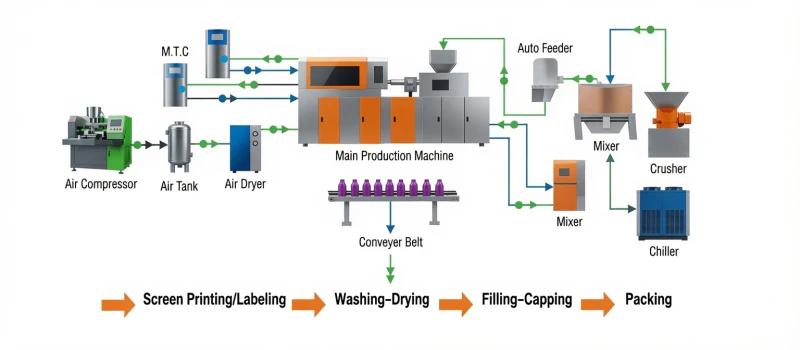
A complete IBM production line includes the machine, mold tooling, oil-free air compressor, chiller, and downstream inspection equipment — all should be evaluated as a system, not as individual components
Summary: Which Machine Fits Which Buyer Profile?
Based on the specification comparison and evaluation factors above, the following buyer profiles emerge:
✅ ZQ60 is likely the stronger fit if:
- You are investing in new IBM tooling (no existing Jomar mold portfolio to transfer)
- Your facility has ceiling height constraints below 3 m
- Your production requires high clamping force (600 kN) to reduce multi-cavity flash
- Price competitiveness and clamping force per dollar are primary criteria
- You are building a new packaging line from scratch with no legacy platform
💡 Jomar IBM65 may be the stronger fit if:
- You already operate Jomar IBM65 equipment and need mold-compatible expansion
- Your facility is in North America or Europe where Jomar service network is an operational advantage
- Your production demands match the 520 kN and 375 g baseline effectively
- Vendor qualification history depth is a procurement requirement
- You have existing portrait-format Jomar IBM65 tooling you intend to retain
How to Structure a Proper Evaluation
If your procurement team is formally evaluating IBM machine replacement or new investment in the 60T/65T class, the following evaluation framework covers the key decision variables:
Define your bottle specification matrix — bottle volume range, required cavitation per cycle, wall thickness, material grade (confirm MFI). This determines minimum injection weight and clamping force requirements, which narrows the field before any vendor conversation.
Audit your existing tooling — list every IBM mold in your current inventory, its platen dimensions, and whether you intend to operate it on the new machine. If yes, platen compatibility becomes a hard filter.
Assess your facility constraints — ceiling height, available floor space, electrical supply capacity (ZQ60 requires 37 kW / 3-phase), cooling water flow (4 m³/h), and compressed air availability.
Build total cost of ownership, not just machine price — acquisition price, new tooling cost (or mold adaptation cost), freight and installation, commissioning engineer days, spare parts initial stock, and after-sales service contract terms. The machine with the lower acquisition price is not always the lower TCO option.
Request sample production trials — before committing to either platform on a new bottle design, request sample bottles produced on the candidate machine with your specified resin and bottle geometry. Weight consistency data across cavities is the most meaningful quality output to evaluate.
⚠ Brand Reference Notice: The Jomar brand name and IBM65 model designation are the intellectual property of Jomar Corporation. This article references Jomar IBM65 specifications for comparative educational purposes only. We do not manufacture, sell, or represent Jomar products. Specification data for the Jomar IBM65 has been compiled from publicly available technical sources and may not reflect the most current published figures — buyers should verify directly with Jomar Corporation for current specifications.
Evaluating the ZQ60 as an IBM Machine Alternative?
View the full ZQ60 technical specification page — including complete parameter tables, cavitation reference data, mold size comparisons with Jomar IBM65, and direct contact for quotation requests.