
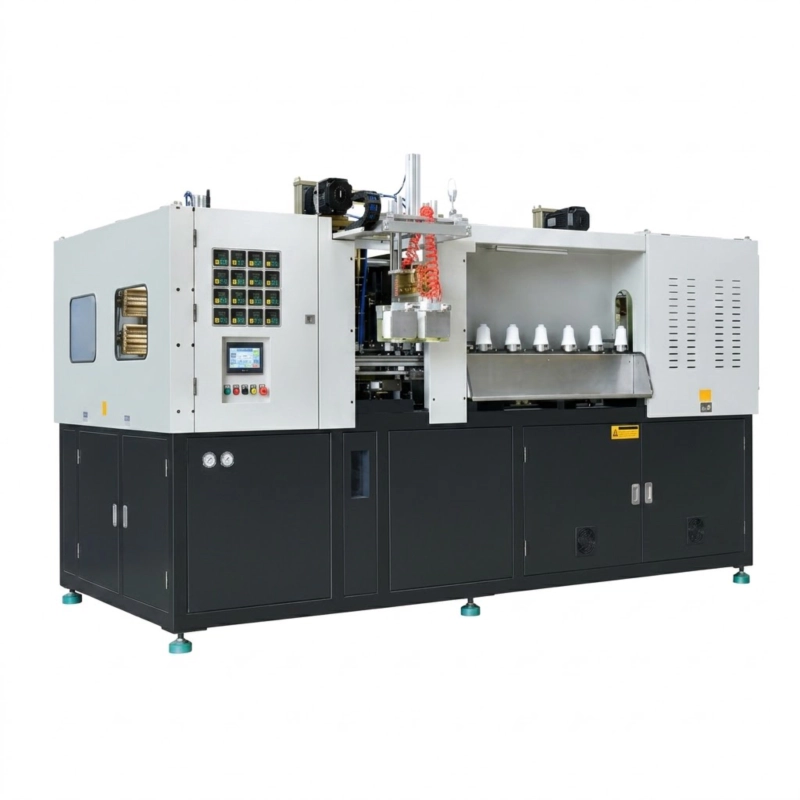
Irregularly Shaped Bottle Series Blow Molding Machines
AS-grade PET & PETG irregularly shaped bottle blow molding machines. 5 models, 1–4 cavities, 38–114.3 mm neck, 500–4,000 bph. Perfume, spirits, decorative & craft packaging. CE certified.
Irregularly Shaped Bottle Series
Blow Molding Machines — Complete Model Guide
► 150 ml – 700 ml
► 500 – 4,000 bph
► 38 mm – 114.3 mm Neck
► AS-Grade Precision All Models
► CE Certified
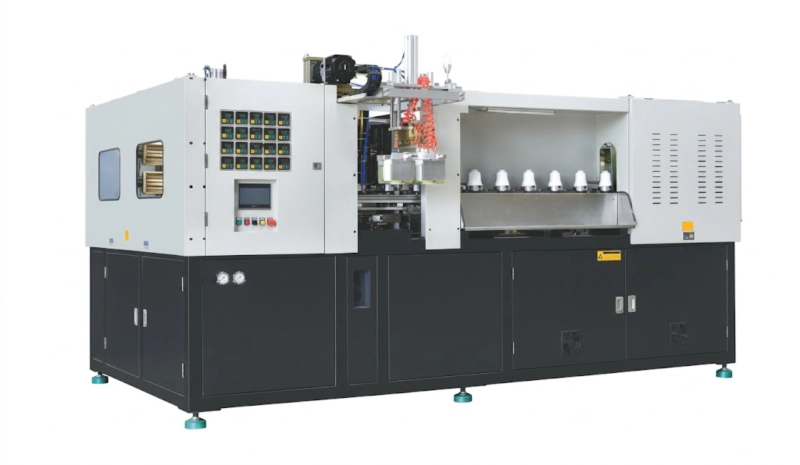
1. Product Overview
The Irregularly Shaped Bottle Series Blow Molding Machines comprise 5 models — all AS-grade high-precision servo — designed exclusively for non-standard, asymmetric, multi-faceted, and decorative bottle geometries that cannot be reliably produced on standard servo machines. The series addresses the fundamental challenge of irregularly shaped bottle production: when a preform is stretched into a non-cylindrical mold geometry, differential radial resistance across the cross-section causes wall-thickness variation, stress whitening, and surface distortion unless the stretch and blow parameters are controlled to a precision level beyond what standard machines deliver.
All models use AS-grade servo motors and precision reducers — the same higher-specification drive system used in the pharmaceutical and baby bottle series — providing ±0.03 mm stretch-rod positioning accuracy and sub-millisecond blow-timing control that maintains wall-thickness uniformity across all facets of complex bottle geometry. PETG processing capability is built into all models, enabling the superior surface clarity, gloss, and scratch resistance that premium decorative bottle applications require.
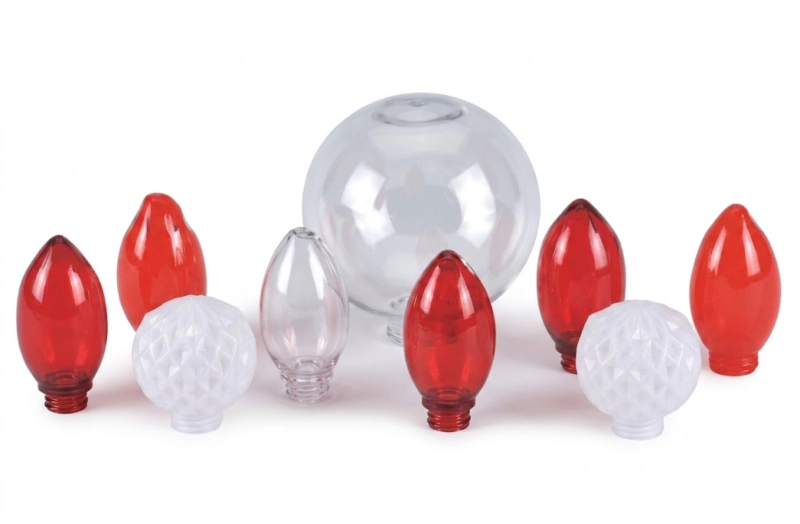
The series spans from the AS-4C38 (4 cavity, 4,000 bph, 38 mm neck) for high-volume miniature perfume vials and cosmetic sample bottles, through 2-cavity mid-volume platforms for premium spirits, artisan spirits, and specialty food packaging, to the single-cavity AS-1C114.3 (500 bph, 114.3 mm neck) for wide-mouth decorative jars and premium gift packaging requiring maximum per-bottle precision at modest production volumes.
Applicable Industries & Applications
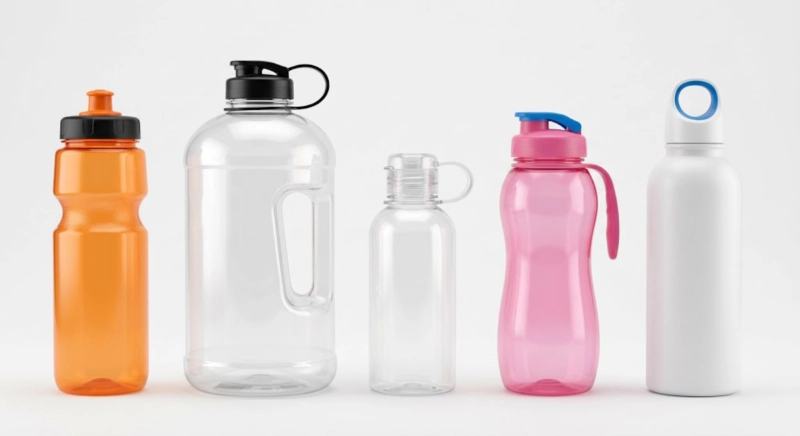
✓ Premium Spirits & Liqueur Bottles
✓ Artisan & Craft Beverage Packaging
✓ Decorative Cosmetic Containers
✓ Gift & Luxury Packaging
✓ Specialty Food & Condiment Bottles
✓ Miniature Collectible & Travel Bottles
✓ Custom OEM Decorative Packaging
2. Working Principle
All models operate on the two-step reheat stretch blow molding (RSBM) process. PET or PETG preforms are automatically fed, oriented, and conveyed through a multi-zone NIR oven. For irregularly shaped bottles, preform design is more critical than in standard cylindrical packaging — the preform wall profile must be engineered to account for differential stretch ratios across the cross-section, providing more material at positions that will undergo greater radial expansion in the finished bottle.
At the blow station, the AS-grade servo stretch rod extends axially with ±0.03 mm positioning accuracy while low-pressure pre-blowing initiates radial expansion. The critical AS-grade advantage for irregular geometries is sub-millisecond blow-timing control: in a non-cylindrical mold, different faces of the bottle reach their mold wall at different moments. Premature high-pressure application before all faces have seated causes surface stress marks on the last-seating faces. The AS-grade servo’s timing precision minimises this differential, enabling wall uniformity on hexagonal, oval, flattened, and multi-faceted bottle profiles that standard servo machines cannot achieve.
PETG processing — available on all models — provides superior surface clarity, higher gloss, and better impact resistance for decorative bottles where visual presentation is the primary commercial driver. PETG has lower processing shrinkage than PET, providing better dimensional accuracy on complex mold geometries with fine surface detail. PLC recipe sets for PET-mode and PETG-mode are stored separately and selected on the HMI without hardware changes.
Key structural components: AS-grade servo-electric toggle-link clamping • AS-grade per-cavity servo stretch rod with ±0.03 mm accuracy • multi-zone NIR oven with precision neck-protection cooling • automatic preform feeder and orientation system • Siemens/Mitsubishi PLC with PET/PETG dual-mode recipe storage • inline visual and dimensional rejection for surface-quality critical applications.
3. Core Advantages
AS-Grade Precision — All 5 Models
Every model in this series uses AS-grade servo motors and precision reducers — the only blow molding series where AS-grade precision is standard across all configurations, not a premium upgrade option. This reflects the irreducible precision requirement of non-standard bottle geometry, where standard servo machines produce commercially unacceptable surface quality on complex cross-sections.
PETG — Crystal Clarity for Decorative Bottles
PETG delivers visibly superior surface clarity, gloss, and scratch resistance versus standard PET — the difference is commercially significant for premium perfume, spirits, and decorative packaging where glass-like clarity is a purchase driver. PETG also offers better dimensional accuracy on fine-detail mold geometries due to lower processing shrinkage. All models support PETG via stored dual-mode PLC recipes.
38 mm to 114.3 mm — Full Neck Range
The series spans the full neck-diameter range encountered in specialty packaging — from 38 mm miniature perfume and cosmetic vials (AS-4C38) through 76 mm premium spirits formats (AS-2C76, AS-4C76) to 114.3 mm wide-mouth decorative jars (AS-1C114.3, AS-2C114.3). Five models cover every major specialty packaging neck standard without cross-series compromise.
PET vs Glass — Weight, Safety, Cost
Stretch-blown PET and PETG deliver glass-like clarity at 60–70% lower weight — reducing shipping cost and breakage risk across luxury retail distribution. For premium spirits and perfume brands, PET/PETG irregularly shaped bottles eliminate the glass-breakage liability in travel retail, e-commerce fulfilment, and gift packaging while maintaining the visual sophistication that premium consumers expect.
Sub-Millisecond Blow Timing Control
The AS-grade servo’s sub-millisecond blow-timing precision minimises differential face-seating stress on non-cylindrical molds — the root cause of stress marks on multi-faceted bottle designs. This enables successful production of hexagonal, oval, square-shoulder, and compound-curve bottle geometries that consistently fail on standard servo platforms.
Complete Turnkey Supply
We supply irregularly shaped blow molds (including multi-faceted, oval, hexagonal, and bespoke geometry tooling), PET and PETG preform injection molds, industrial chillers, and oil-free compressor packages from a single source — with DFM review before mold construction to verify stretch-ratio feasibility and wall-thickness distribution for each custom bottle geometry.
4. Technical Specifications
▶ AS Series — All-Model AS-Grade High-Precision Servo (1 / 2 / 4 Cavity, PET / PETG)
5 models. All AS-grade precision servo drive as standard — the only blow molding series where every model is AS-grade without exception. Neck diameters from 38 mm (miniature decorative) to 114.3 mm (wide-mouth artisan). Volume range 150 ml to 700 ml.
| Parameter / Unit | AS-1C114.3 | AS-2C76 | AS-2C114.3 | AS-4C38 | AS-4C76 |
|---|---|---|---|---|---|
| Material | PET / PETG | PET / PETG | PET / PETG | PET / PETG | PET / PETG |
| Cavities | 1 | 2 | 2 | 4 | 4 |
| Max. Container Volume (ml) | 350 | 700 | 350 | 150 | 700 |
| Output (bph) | 500 | 900 | 900 | 4,000 | 2,000 |
| Max. Neck Diameter (mm) | 114.3 | 76 | 114.3 | 38 | 76 |
| Max. Body Diameter (mm) | 80 | 75 | 80 | 45 | 75 |
| Max. Container Height (mm) | 235 | 250 | 235 | 200 | 250 |
| Clamping Stroke (mm) | 122 | 100 | 122 | 60 | 100 |
| Mold-Open Distance (mm) | 302 | 280 | 302 | 220 | 280 |
| Mold-Close Distance (mm) | 180 | 180 | 180 | 138 | 180 |
| Stretching Stroke (mm) | 400 | 350 | 400 | 200 | 350 |
| Base Mold-Close (mm) | 114.3 | 76 | 114.3 | 38 | 76 |
| Preform Holder | 24 | 48 | 48 | 96 | 96 |
| Max. Heating Power (kW) | 20 | 28 | 30 | 28 | 40 |
| Normal Heating Power (kW) | 8 | 12 | 15 | 12 | 20 |
| Blowing Pressure (kg/cm²) | 35 | 35 | 35 | 35 | 35 |
| HP Air Consumption (L/min) | 500 | 800 | 1,000 | 2,000 | 4,000 |
| LP Air Consumption (L/min) | 300 | 400 | 600 | 600 | 800 |
| Cooling Water Flow (L/min) | 30 | 30 | 30 | 30 | 30 |
| Machine Size L×W×H (mm) | 2150×1660×2150 | 2660×1660×2150 | 2660×1660×2150 | 2900×1850×2100 | 3290×1850×2260 |
| Machine Weight (kg) | 1,500 | 2,000 | 2,600 | 3,500 | 3,500 |
5. Structure & Material Engineering
⚙ AS-Grade Servo System
All five models use higher-specification AS-grade servo motors, precision harmonic reducers, and servo drives — delivering ±0.03 mm stretch-rod positioning accuracy and sub-millisecond blow-valve timing control. These specifications are mandatory for irregular geometries, not optional upgrades. The mechanical drive train is engineered to maintain positional accuracy across the full production speed range, preventing the position drift at elevated cycle rates that causes dimensional variation on complex bottle geometries.
🛠 Rigid Frame for Complex Mold Loads
Irregularly shaped bottle molds generate asymmetric clamping forces across the platen face — unlike cylindrical bottle molds where clamping load is evenly distributed. The AS-series machine frame and platen are designed with additional rigidity at the non-symmetric loading points, preventing platen deflection that would cause parting-line flash on irregular cross-section molds.
🌡 Decorative Surface NIR Conditioning
Decorative bottle preforms often have complex wall-profile distributions to pre-position material for differential stretch zones. The multi-zone NIR oven with individually controlled zone power provides the axial thermal gradient customisation required to heat irregular-profile preforms to the correct stretch temperature at each axial position simultaneously. Zone configurations for each bottle format are stored as PLC recipes — ensuring reproducible thermal conditioning across production campaigns separated by weeks or months.
💉 PETG-Mode Optimisation
PETG requires lower blowing temperatures and benefits from faster cooling versus PET to maximise surface gloss and minimise crystallisation haze. All models store dedicated PETG-mode oven profiles, transfer timing, and cooling duration settings as separate on-board recipes — enabling consistent high-gloss PETG surface finish production without empirical parameter searching at each format changeover.
🔓 Decorative Mold Tooling
Irregularly shaped blow molds are machined from high-strength aluminium alloy using 5-axis CNC with surface finish Ra ≤ 0.4 μm on all visible bottle surfaces — the standard required for glass-substitute decorative packaging. Conformal cooling channels follow the complex mold cavity geometry, ensuring uniform cooling across all facets of non-cylindrical bottle profiles and preventing the thermal asymmetry that causes post-mold bottle warping. We offer DFM (Design for Manufacturability) review before mold construction at no charge, verifying stretch-ratio feasibility and preform design for each custom geometry.
📱 PLC & Dual-Mode Recipes
Siemens or Mitsubishi PLC with HMI. Up to 50 bottle-format recipes stored on-board, including separate PET-mode and PETG-mode sets. Irregular bottle producers typically run multiple SKUs (different bottle silhouettes for different product lines or seasonal editions) — the on-board recipe storage enables same-day format changeover without manual parameter reconstruction.
6. Typical Application Scenarios
7. Our Machines vs. European Brand Platforms — Objective Comparison
| Comparison Item | Sidel SBO Series | Krones Contiform | SMI Smiflexi | Sipa SFR EVO | Our Series |
|---|---|---|---|---|---|
| Origin | France | Germany | Italy | Italy | Asia |
| Irregular Shape Focus | Beverage-primary | Beverage-primary | General purpose | General purpose | Dedicated AS series |
| AS-Grade on ALL Models | Premium upgrade | Premium upgrade | Standard only | Standard only | Yes — all 5 models |
| PETG Processing | Selected models | Selected models | Limited | Limited | All 5 models — dual-mode |
| Min. Neck Diameter | ~18 mm (selected) | ~20 mm (selected) | ~28 mm | ~28 mm | 38 mm (AS-4C38) |
| Approx. Entry CapEx (1-cav.) | USD 120K – 200K | USD 110K – 180K | USD 90K – 160K | USD 100K – 170K | Significantly lower — direct |
| Spare Parts Lead Time | 4–12 weeks | 4–10 weeks | 4–10 weeks | 4–10 weeks | 3–7 days (stocked) |
| CE Certification | Yes | Yes | Yes | Yes | Yes |
CapEx figures are indicative market estimates. Our pricing is provided by confirmed quotation only.
8. Model Selection Guide
| Your Requirement | Recommended Model |
|---|---|
| Premium / bespoke irregular bottle, single-cavity, max precision | AS-1C114.3 (1 cavity, 500 bph, 114.3 mm neck) |
| Spirits / cosmetic irregular bottle, 2 cavity, up to 700 ml, 76 mm | AS-2C76 (2 cavity, 900 bph) |
| Wide-mouth decorative jar, 2 cavity, up to 350 ml, 114.3 mm | AS-2C114.3 (2 cavity, 900 bph) |
| Miniature / vial / sample bottle, 4 cavity, up to 150 ml, 38 mm | AS-4C38 (4 cavity, 4,000 bph) |
| High-volume spirits / specialty food, 4 cavity, up to 700 ml, 76 mm | AS-4C76 (4 cavity, 2,000 bph) |
9. Frequently Asked Questions
Explore our full range of two-step and one-step blow molding machines for standard and specialty packaging:
► Browse All Blow Molding Machines
✉ Request a Free Quotation
10. Work with a Specialist Manufacturer
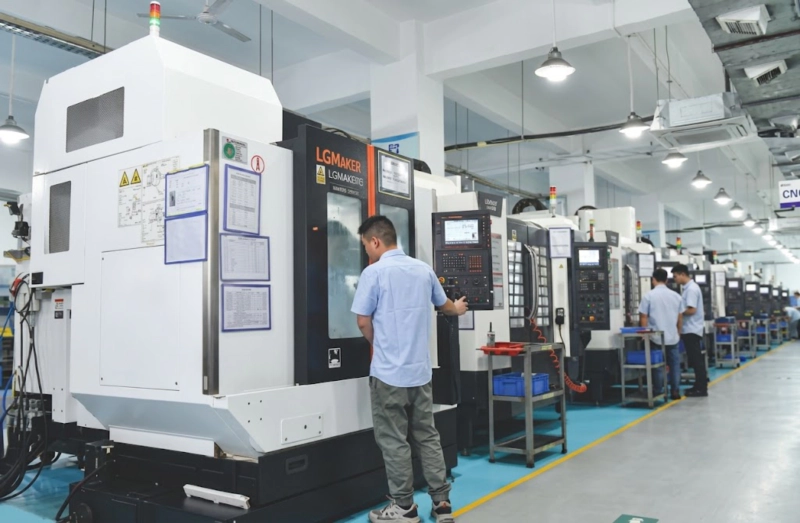
With over two decades of dedicated experience in blow molding machine design, manufacturing, and specialty mold fabrication, we supply AS-grade PET and PETG irregularly shaped bottle blow molding machines to perfume houses, spirits brands, cosmetic producers, specialty food companies, and premium packaging converters across more than 20 countries. Our production facility operates dedicated 5-axis CNC machining, precision decorative mold fabrication, machine assembly, and quality-control departments. Our engineering team provides DFM feasibility review for every custom bottle geometry at no charge before mold construction begins.
Whether you are launching a new premium bottle silhouette, transitioning an existing glass packaging line to PET or PETG, adding an irregular-geometry capability to an existing blow molding operation, or replacing an ageing European machine on a specialist decorative packaging line, our technical team will provide a no-obligation specification review, stretch-ratio feasibility assessment, and delivered-cost comparison within 48 hours of enquiry.