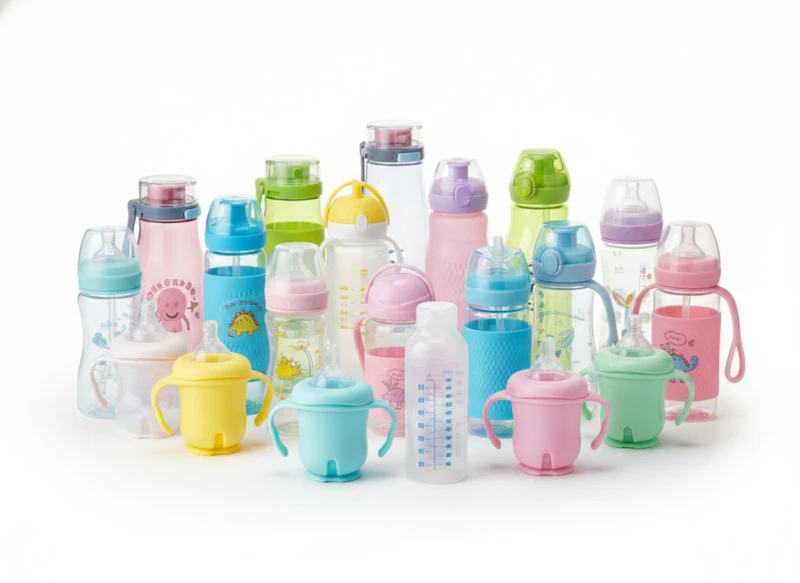
Polycarbonate (PC) is the undisputed king of engineering plastics in the blow molding industry. Boasting a glass-transition temperature (Tg) of 147°C, extreme impact resistance, and crystal-clear optical properties, PC is the mandatory material for reusable 5-gallon water coolers, high-end baby bottles, aviation tableware, and LED light bulb covers. However, processing PC on a One-Step Injection Stretch Blow Molding (ISBM) machine is an unforgiving engineering challenge. Unlike standard PET, Polycarbonate has a brutally high melt viscosity, requires barrel temperatures exceeding 300°C, and is catastrophically sensitive to even trace amounts of moisture. Attempting to run PC with standard PET parameters or auxiliary equipment will instantly result in silver streaking (splay), severe yellowing, un-blowable preforms, and severe safety hazards for the operator. This comprehensive guide outlines the exact thermodynamic, pneumatic, and safety protocols required to successfully process Polycarbonate on an ISBM platform.
1. The Material Science of PC: High Viscosity and Hydrolysis
To process PC effectively, the process engineer must understand two defining traits of the polymer: its rheology (flow behavior) and its chemical vulnerability.
First, Polycarbonate is an amorphous engineering thermoplastic. Unlike PET, which has a relatively low melt viscosity (making it flow easily like syrup), PC has a highly viscous, stiff melt. It fiercely resists flowing through the narrow channels of the hot runner and the gate. To force it into the mold, you must apply significantly higher injection pressures and elevate the barrel temperatures far beyond standard packaging polymers.
Second, Polycarbonate undergoes Hydrolysis at processing temperatures. If there is even a microscopic amount of moisture trapped inside the resin pellet when it enters the 300°C barrel, the water instantly turns to superheated steam. This steam chemically reacts with the polymer chains, severing them. The molecular weight of the PC plummets. The visual result is “silver streaks” (splay marks) on the preform surface. The mechanical result is a brittle bottle that shatters upon impact—completely negating the exact reason you chose PC in the first place.
2. Extreme Desiccant Drying: The 0.02% Moisture Absolute Limit
Proper drying is responsible for 80% of success in PC processing. A standard hopper dryer (which merely blows hot ambient air) is utterly useless for Polycarbonate. You must use a high-performance Desiccant Rotor Dryer (адсорбционный осушитель) capable of producing bone-dry air with a dew point of -40°C.
| Material | Drying Temp | Drying Time | Max Allowable Moisture | Required Dew Point |
|---|---|---|---|---|
| Standard PET | 160°C – 170°C | 4 – 6 Hours | < 0.005% (50 ppm) | -40°C |
| PETG | 65°C – 70°C | 4 – 6 Hours | < 0.04% (400 ppm) | -40°C |
| Polycarbonate (PC) | 120°C – 125°C | 3 – 5 Hours | < 0.02% (200 ppm) | -40°C |
If you over-dry PC (e.g., leaving it in the hopper at 125°C for 12 hours over the weekend), the additives and colorants will degrade, and the resin will turn irreversibly yellow. If the machine stops for more than 2 hours, lower the dryer temperature to 80°C to put the resin in “standby” mode.
3. Injection Station: Managing 300°C+ Melt Temperatures
PC melts at much higher temperatures than PET. If the barrel is too cold, the machine will require massive injection pressure to fill the mold, inducing severe internal stress that will cause the bottle to crack later. If the barrel is too hot, the PC will burn, outgas, and turn brown.
Standard PC Barrel Profile:
Feed Zone (Zone 1): 275°C – 285°C
Compression Zone (Zone 2/3): 290°C – 305°C
Metering/Nozzle: 300°C – 315°C
Hot Runner Manifold: 310°C – 320°C
Because PC requires such high temperatures, the residence time (the amount of time the plastic spends cooking inside the barrel) is critical. If you are running a small preform on a machine with a massive injection screw, the PC will sit in the barrel for too many cycles and degrade. Always match the shot-size of the mold (typically using 40% to 70% of the barrel capacity) to ensure fresh material is constantly moving through.
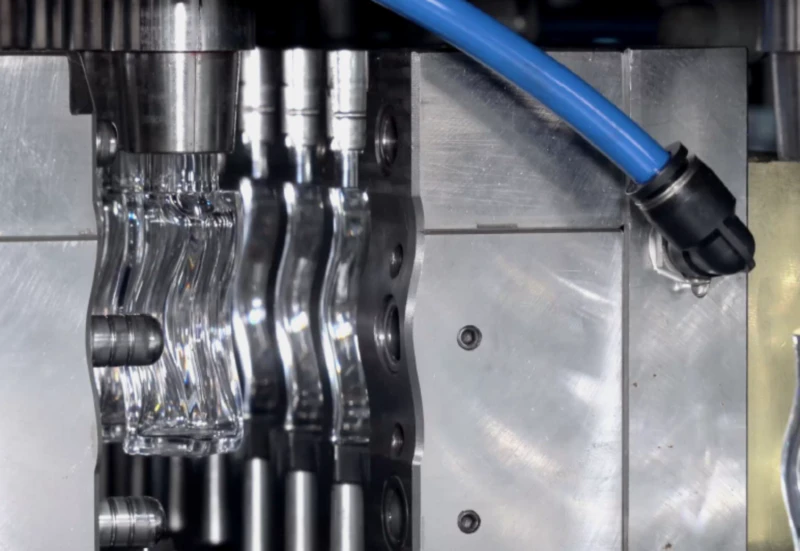
4. Mold Temperature Control: Why You Must Use Hot Oil, Not Water
This is the most common mistake made by factories transitioning from PET to PC. PET requires a cold injection mold (using 10°C chilled water) to freeze the preform quickly. If you inject 310°C Polycarbonate into a 10°C mold, disaster strikes.
The extreme temperature differential causes the outer skin of the PC to freeze instantly upon hitting the mold wall, creating immense flow resistance and trapping devastating internal stresses (birefringence). The resulting bottle will look clear, but the moment it is dropped, or sterilized in hot water, it will craze and shatter into dangerous shards.
To process PC, the injection mold must be heated. You must connect the injection mold to an Oil Temperature Controller (Термостат масляный) set between 80°C and 110°C. This keeps the mold hot, allowing the stiff PC melt to flow smoothly into the cavity, minimizing internal stress. Once filled, the plastic cools slowly relative to its extreme starting temperature, resulting in an impact-resistant, stress-free preform.
5. Injection Velocity Profiles and Managing Internal Stress
Polycarbonate exhibits “Newtonian-like” flow behavior at low shear rates, but pushing it rapidly through a small gate causes massive friction. You must use a multi-stage injection profile to manage this.
Set the initial injection speed low (15-30%) as the melt passes the hot runner gate. Injecting PC too fast through the gate will fracture the melt, causing a visible matte white halo (gate blush) at the preform base.
Once past the gate, increase speed to fill the cavity. Because PC is viscous, you will need high injection pressure (often 120 – 150 MPa) to push it to the top of the neck ring without freezing mid-flow.
Holding Pressure: Keep holding pressure as low as possible. Excessive holding pressure packs too much material into the mold, locking in stress. Use just enough pressure to prevent sink marks and ensure the neck threads are fully formed.
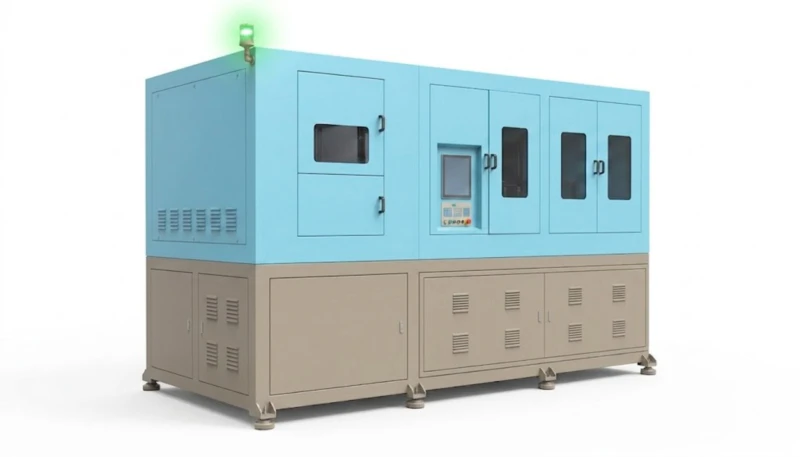
6. Stretch Blow Dynamics: Overcoming Polymer Stiffness
When the PC preform transfers to the stretch-blow station, it is much stiffer than PET. Because its Glass Transition Temperature (Tg) is 147°C, the preform must be significantly hotter than a PET preform to stretch without tearing.
The 4-Station Advantage: If you are using a 4-station ISBM machine, the Thermal Conditioning Station (Station 2) is highly beneficial. You can use it to gently equalize the heat across the thick walls of the PC preform, ensuring the outer skin doesn’t cool below the Tg before it reaches the blow mold.
Blow Pressure: PC requires high-pressure air to force it against the blow mold walls and replicate fine details (like embossed logos or sharp bottom radii). A robust 30 to 40-bar oil-free compressor system is mandatory. The blow mold itself, unlike the injection mold, should be cooled with standard chilled water (15°C) to rapidly freeze the blown bottle and lock in the final geometry before ejection.
7. Operator Safety and High-Temperature Purging Protocols
Processing at 320°C introduces severe safety hazards. If Polycarbonate is left in the barrel while the machine is stopped (e.g., for a mold change or lunch break), it will continue to cook. It will outgas, expand, and generate immense internal pressure inside the barrel. If an operator approaches the nozzle and the pressure suddenly releases, 300°C molten plastic will violently spray out, causing catastrophic burns.
- ⚠Purging Protocol: NEVER look directly into the nozzle area when purging PC. The machine safety doors must be closed, and purging must be done remotely via the PLC. Operators must wear heat-resistant Kevlar gloves and full-face polycarbonate shields when working near the injection carriage.
- ⚠Shutdown Procedure: If the machine is stopping for more than 15 minutes, you must purge all PC from the barrel. It is highly recommended to purge the barrel using a low-temperature purging compound or standard PP/HDPE before turning off the heaters. Letting PC freeze solid inside the barrel makes reheating and restarting extremely difficult, often resulting in a snapped injection screw.
- ⚠Ventilation: Overcooked PC emits noxious gasses. Ensure the factory space above the ISBM injection unit has proper overhead exhaust ventilation to remove fumes.
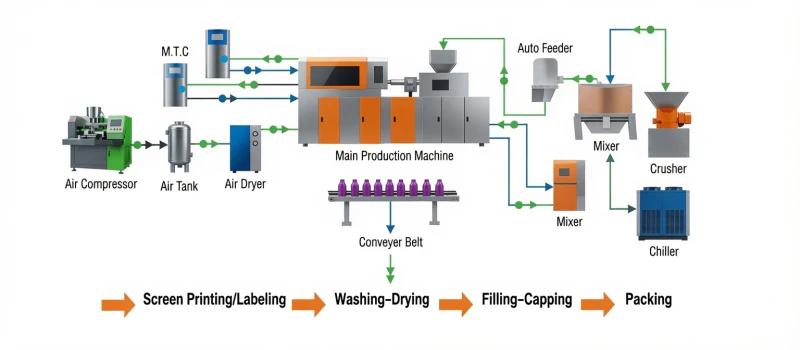
8. Troubleshooting Common Polycarbonate Defects
When switching to PC production, operators will inevitably encounter defects. Use this engineering matrix to quickly isolate and resolve process issues:
- Defect: Silver Streaks / Splay (Серебристые полосы).
Cause: Moisture in the resin. Solution: The dryer has failed. Check the desiccant rotor dew point (must be -40°C) and ensure drying time is > 4 hours at 120°C. Check for leaking water hoses cooling the feed throat. - Defect: Yellowing or Brown Streaks.
Cause: Thermal degradation. Solution: The melt is too hot, or it is sitting in the barrel too long. Lower nozzle temperatures by 5°C. Check if the heater band SSRs are stuck “on.” Reduce screw RPM to lower shear heating. - Defect: Gate Haze / White Blush at the Base.
Cause: Excessive shear stress through the gate. Solution: Decrease Stage 1 injection speed. Slightly increase the hot runner tip temperature. - Defect: Bottles Crack Easily (Drop Test Failure).
Cause: Internal flow stress. Solution: The injection mold is too cold. Ensure the oil temperature controller is delivering 90°C+ to the injection mold cores and cavities. Decrease holding pressure. - Defect: Short Shots (Incomplete Preforms).
Cause: Viscosity too high or pressure too low. Solution: Increase injection pressure. If at max pressure, increase barrel temperatures in 5°C increments. Check for blocked hot runner nozzles.
Mastering Polycarbonate requires process discipline. By establishing unyielding standards for resin drying, managing the high-viscosity melt with hot oil molds, and strictly enforcing operator safety protocols, your ISBM platform will produce the toughest, clearest premium packaging available on the market.
Struggling with Polycarbonate Processing or Defects?
PC is the most challenging polymer in the blow molding industry. Our senior process engineers can audit your machine parameters, verify your auxiliary drying systems, and provide targeted training to eliminate splay, yellowing, and stress cracking.