A packaging manufacturer running Nissei ASB machines for 10 years has accumulated a tooling asset that rarely appears on the balance sheet but represents a real investment: a library of validated molds, each representing USD 30,000 to 80,000 in engineering, sampling and qualification cost. When that manufacturer evaluates a Chinese ISBM machine — attracted by the 40 to 60 percent purchase price advantage — the first technical question is always the same: can we keep our ASB molds? The answer is not a simple yes or no. It depends on which ASB machine series the molds were built for, which Chinese machine is being evaluated, and whether three specific interface dimensions are compatible. This guide provides the complete technical framework for making that determination — the interface specifications, the verification protocol and the common incompatibility scenarios that catch buyers by surprise after the purchase order has been signed.
1. Why Mold Compatibility Is a USD 30,000 to 80,000 Question
When a cosmetics or pharmaceutical packaging manufacturer evaluates switching from a Nissei ASB machine to a Chinese ISBM platform, the machine purchase price comparison is straightforward. The mold situation is more complicated. A typical ASB mold set — preform mold, blow mold and neck ring set for a single product — costs between USD 30,000 and 80,000 depending on cavity count, bottle complexity and steel specification. A manufacturer running three products on an ASB machine has USD 90,000 to 240,000 in tooling that is immediately stranded if the new machine cannot accept ASB-interface molds.
The tooling compatibility question therefore has two distinct financial implications:
If compatible
Existing tooling transfers directly. The cost comparison between ASB and Chinese machine is purely on purchase price, energy and maintenance. First production can begin within days of installation. Product qualification is already complete — the bottle has regulatory approval based on the mold geometry already in use.
If not compatible
New tooling required for every product. Add USD 30,000 to 80,000 per product to the machine cost. Add 8 to 16 weeks for tooling design, manufacture and sampling. Add the cost of re-qualifying each product with the new mold geometry — significant for pharmaceutical and regulated cosmetic applications.
The correct question to ask a Chinese ISBM supplier: Not “are you ASB-compatible?” — every supplier claims this. The correct question is: “What are the specific neck ring inner diameter range, parting face dimensions and core rod pitch for your machine, and can you provide these in a written technical document that I can compare against my mold drawings?” A supplier who cannot answer with specific dimensions is claiming compatibility without having engineered for it.
2. The ASB Machine Series: Which Molds Are You Actually Running?
Nissei ASB produces multiple machine platforms, and molds are not interchangeable between series. Before any compatibility discussion can begin, you must identify which ASB machine series your molds were built for — not the machine you currently run, but the machine the mold was designed to fit. This matters because a mold built for an older machine may have been used on a newer platform with an adapter plate that does not need to exist on the Chinese machine.
| ASB Machine Series | Typical Applications | Interface Standard | HGY Compatibility |
|---|---|---|---|
| ASB-12M / 12MII | Cosmetics, pharma, up to 500ml, 4–12 cavities | ASB-12M standard interface | ✓ Full compatibility (HGY150-V4 / V4-EV) |
| ASB-70DPH | High-speed small format, pharma vials, cosmetics up to 200ml | ASB-70DPH interface (smaller platen) | Partial — verify parting face dimensions |
| ASB-250 | Large format, up to 5L, wide-mouth jars | ASB-250 interface (larger platen) | Partial — verify with HGYS280-V6 specs |
| ASB-650EX / 1500EX | Very large format, industrial containers | Large-frame interface | ✗ Not compatible with current HGY range |
| Older ASB series (pre-12M) | Legacy machines, various applications | Non-standard — varies by machine age | ✗ Requires dimensional verification case by case |
Check the mold design drawings or the machine serial number plate. On the mold drawing title block, the machine series is usually noted as “for ASB-12M” or “ASB-70DPH.” If drawings are unavailable, measure the neck ring outer diameter and the preform mold parting face footprint — these two dimensions identify the interface standard uniquely across ASB series. The neck ring OD for ASB-12M is a fixed reference dimension: send us this measurement and we can confirm compatibility within 24 hours.
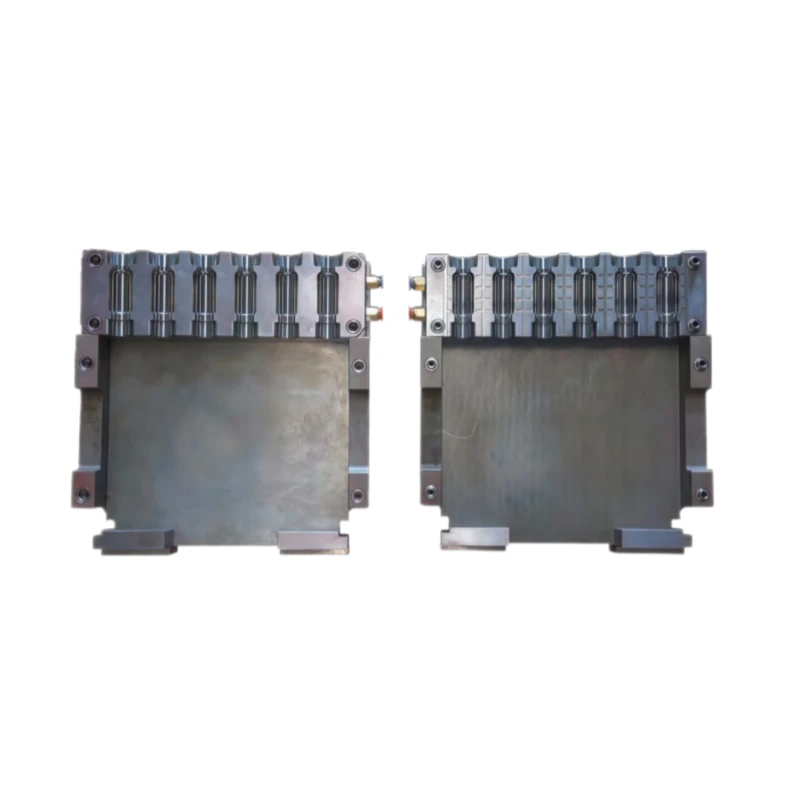
Fig. 1 — ISBM preform mold and blow mold sets. Compatibility between an ASB mold and a Chinese ISBM machine is not a general property — it is a function of three specific interface dimensions: the neck ring seating geometry, the preform mold parting face footprint, and the core rod pitch spacing. All three must match. If any one does not, the mold cannot be installed without modification.
3. The Three Interface Dimensions That Determine Compatibility
An ISBM mold attaches to the machine at three mechanical interfaces. All three must be dimensionally compatible for the mold to install and operate correctly. Compatibility at two out of three is not partial compatibility — it means the mold cannot be used without modification.
-
1Neck ring interface — the most critical dimensionThe neck ring is the component that holds the bottle neck geometry during the entire cycle. It must seat precisely in the turntable neck ring carrier. The seating bore diameter, the depth of the carrier pocket and the locating pin positions must all match between the mold and the machine. A neck ring that is 0.5mm oversize in OD will not seat; one that is 0.5mm undersize will rattle and produce inconsistent thread dimensions. This is the dimension that ASB specifies most tightly across machine series — and the one Chinese suppliers most commonly handle incorrectly when claiming “ASB compatibility.”
-
2Preform mold parting face — the mounting footprintThe preform mold mounts to the injection platen via a specific pattern of bolt holes and a locating ring. The bolt circle diameter, bolt size, locating ring diameter and mold height (stack height from platen face to parting surface) must all fall within the machine’s accommodation range. If the mold is taller than the machine’s maximum daylight allows, the mold cannot close fully. If the locating ring diameter differs, the mold cannot be precisely centred.
-
3Core rod pitch and count — the cavity layoutThe core rod pitch is the centre-to-centre distance between adjacent preform cavities. This must match the turntable’s neck ring carrier pitch exactly — if it does not, the core rods cannot enter the preform cavities simultaneously. The number of cavities in the mold must also be within the machine’s capacity range (typically 1 to 8 on HGY150-series). A 6-cavity ASB-12M mold will not fit on a 4-cavity machine configuration, even if all other dimensions match.
4. ASB-12M Interface Specification: The Most Important Numbers
The ASB-12M is the most widely deployed Nissei ASB platform for cosmetic and pharmaceutical bottle production in the 20ml to 500ml range. It is also the machine series for which our HGY150-V4 and HGY150-V4-EV machines are specifically engineered to provide interface compatibility. The following specifications define the ASB-12M mold interface:
| Interface Parameter | ASB-12M Specification | Tolerance / Notes |
|---|---|---|
| Neck ring outer diameter range | 17mm minimum to 83mm maximum | OD to be confirmed from mold drawing — varies by closure standard |
| Neck ring carrier seating bore | Specific to OD — H7/h6 fit | Max diametral clearance 0.02mm for dimensional stability |
| Core rod pitch (cavity-to-cavity spacing) | 50mm standard pitch (most common); 60mm and 75mm for larger formats | Must match machine turntable pitch exactly — no tolerance |
| Maximum cavity count supported | Up to 12 cavities (machine-dependent) | HGY150-series supports up to 8 cavities |
| Preform mold locating ring diameter | Standard ASB-12M locating ring | HGY150-V4/V4-EV injection platen machined to accept same ring |
| Mold stack height range | Machine minimum to maximum daylight | HGY150-V4/V4-EV: 200mm to 480mm mold stack height accommodated |
| Cooling water connection specification | BSP or metric fittings per ASB standard | Adapters may be required — low-cost modification, not a compatibility barrier |
The critical caveat on “standard” pitch: The 50mm core rod pitch is the most common ASB-12M standard but not the only one. ASB produced machines with 60mm and 75mm pitch configurations for specific large-format products. If your mold was built for a non-standard pitch, a machine with only 50mm pitch turntable carriers cannot accept it — regardless of all other dimensional compatibility. Measure the centre-to-centre distance between adjacent core rods on your mold before any compatibility discussion proceeds.
5. HGY150-V4 and V4-EV: What We Engineered to Match
Our HGY150-V4 (hydraulic) and HGY150-V4-EV (full servo) 4-station machines are designed from the ground up to accept ASB-12M interface molds without adapter plates or mold modification. The specific engineering decisions that enable this compatibility are:
-
✓Turntable neck ring carrier machined to ASB-12M bore specificationThe neck ring carrier pockets in the HGY150 turntable are precision-machined to the same bore and depth specification as the ASB-12M machine. Neck rings from ASB-12M molds seat directly without adapter rings, shimming or modification. The locating pin positions also match the ASB-12M standard.
-
✓Injection platen locating ring bore matches ASB-12M standardThe injection platen of the HGY150-V4/V4-EV is machined with a locating ring bore that accepts the same locating ring used by ASB-12M preform molds. The mold centres precisely on the platen without adapter plates. The bolt circle for mold clamping is also positioned to accept ASB-standard mold base dimensions.
-
✓Core rod pitch selectable at 50mm, 60mm and 75mmThe turntable carrier configuration is selectable at the time of machine order to match the core rod pitch of the buyer’s existing mold. This is specified as a machine option — it does not require custom machining. Confirm the pitch of your ASB mold core rods and specify the matching carrier configuration in your machine order.
-
✓Daylight range covers ASB-12M mold stack heightsThe HGY150-V4 and V4-EV accommodate mold stack heights from 200mm to 480mm — covering the full range of standard ASB-12M mold stack heights used in cosmetic and pharmaceutical production. Molds at the upper end of the ASB-12M range (large-format bottles with tall preforms) should have stack height confirmed against the machine specification before ordering.
-
✓Neck ring OD range 17mm to 83mm fully accommodatedThe HGY150-V4/V4-EV supports the full ASB-12M neck ring OD range without turntable modification. Neck rings from 17mm (pharmaceutical eye dropper) to 83mm (wide-mouth cosmetic jar) all seat in the standard carrier configuration. Neck rings above 83mm OD require the HGYS280-V6 platform.
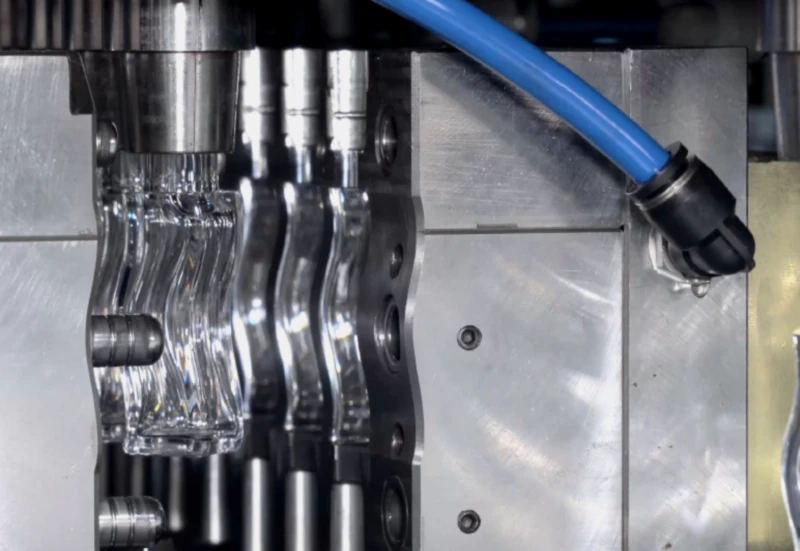
Fig. 2 — ISBM injection mold assembly. The locating ring visible at the mold centre is the primary alignment feature for platen mounting. On the HGY150-V4 and V4-EV, this bore is machined to the same diameter as the ASB-12M standard, allowing ASB-12M preform molds to mount directly without adapter rings. The neck ring carrier positions visible at the mold periphery are also matched to the ASB-12M pitch standard.
6. 3-Step Compatibility Verification Before You Order
This protocol is designed to be completed using the mold drawings you already have — no physical measurement of the mold is required until Step 3. If you do not have drawings, Step 3 provides the physical measurement instructions.
7. Common Incompatibility Scenarios and How to Resolve Them
The following incompatibility scenarios account for approximately 80% of the cases where an initial “yes, compatible” assessment turns out to be incorrect or conditional:
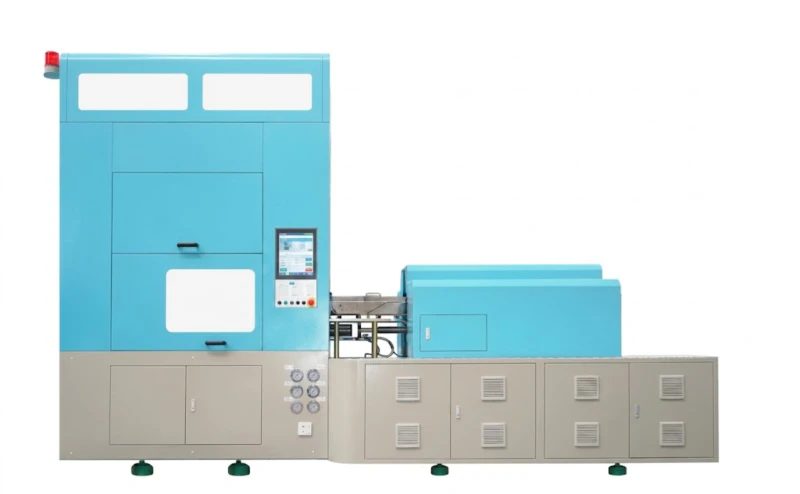
Fig. 3 — The HGY150-V4-EV 4-station full-servo ISBM machine. The 4-station rotary turntable (centre) houses neck ring carriers machined to ASB-12M specifications. The injection unit (right) mounts preform molds via a platen with ASB-standard locating ring bore and bolt pattern. These are designed-in interface dimensions — not adapter-based approximations.
8. Process Parameter Migration: What Changes, What Stays the Same
Even when mold compatibility is confirmed, the process parameters from the ASB machine do not transfer directly to the HGY machine without adjustment. Understanding which parameters transfer and which require re-optimisation prevents lost production time during commissioning.
| Parameter | Transfer Status | Migration Notes |
|---|---|---|
| Barrel temperature profile | Transfers directly | Use ASB setpoints as starting point; verify actual melt temperature with contact probe and adjust by ±5°C as needed |
| Injection pressure | Requires scaling | HGY and ASB use different pressure units or systems — convert using the ratio of injection cylinder bore areas. Our engineers provide the conversion factor for your specific models |
| Blow pressure | Transfers directly | Blow pressure is absolute — 2.5 MPa on ASB equals 2.5 MPa on HGY. Reduce by 0.2 MPa initially and verify bottle formation before matching exactly. Stable supply from a properly sized oil-free air compressor for ISBM is critical for replicating ASB blow results on the HGY machine |
| Cooling water temperature | Transfers directly | Set the same chiller setpoint as used on the ASB machine. HGY cooling circuit layout may differ — monitor outlet temperature and adjust flow rate to match the cavity surface temperature achieved on the ASB |
| Cycle time | Typically improves | HGY150-V4-EV full servo typically achieves 5 to 15% shorter cycle time on the same mold compared to equivalent ASB machines, due to faster servo actuation on non-injection phases |
| Gram weight per cavity | Requires one-run verification | Hot runner temperature calibration differs between machines. Run one trial and check gram weight per cavity. Adjust hot runner zone temperatures in 2°C increments to balance fill |
| Conditioning station time (4-station) | Requires optimisation | HGY150 conditioning station has different thermal mass from ASB equivalent. Use ASB conditioning time as starting point and adjust by ±0.5s increments based on wall thickness measurement from first bottles |
9. The Financial Case: ASB Compatibility vs New Tooling
The financial impact of mold compatibility or incompatibility is large enough that it can reverse the apparent cost advantage of the Chinese machine. The following scenarios illustrate:
| Scenario | Machine Cost | Tooling Cost | Total Upfront | vs ASB (USD 350,000) |
|---|---|---|---|---|
| ASB machine (new), 3 products | 350,000 | 150,000 (existing) | 500,000 | Baseline |
| HGY150-V4-EV + ASB molds compatible | 148,000 | 0 (reuse existing) | 148,000 | ↓ USD 352,000 savings |
| HGY150-V4-EV + new tooling (3 products) | 148,000 | 150,000 (new molds) | 298,000 | ↓ USD 202,000 savings |
| HGY150-V4-EV + new tooling + requalification | 148,000 | 150,000 + 60,000 requalification | 358,000 | ↓ USD 142,000 — barely ahead |
The table illustrates why mold compatibility is the single most important factor in evaluating a Chinese ISBM machine for an existing ASB operator. The difference between scenario 2 (compatible, USD 352,000 savings) and scenario 4 (incompatible with requalification, USD 142,000 savings) is USD 210,000 — and that gap widens further if the products involved have pharmaceutical or regulated cosmetic qualification requirements where requalification costs are higher.
10. Pre-Order Compatibility Checklist
Complete this checklist before signing a purchase order for any ISBM machine when mold reuse is a factor in the buying decision. Every item must be confirmed in writing from the supplier — verbal confirmation is not sufficient.
| Item | What to Confirm | Status |
|---|---|---|
| ASB series identification | Confirmed ASB-12M (or specific series) from mold drawing title block | ☐ |
| Core rod pitch measured | Pitch confirmed as 50mm, 60mm or 75mm for all cavities | ☐ |
| Neck ring OD measured | OD confirmed between 17mm and 83mm for HGY150 series | ☐ |
| Mold stack height confirmed | Stack height between 200mm and 480mm for standard HGY150 | ☐ |
| Cavity count within machine range | Cavity count is 8 or fewer for HGY150 / 16 or fewer for HGYS280 | ☐ |
| Machine pitch option specified in order | Turntable carrier pitch (50/60/75mm) confirmed in machine purchase order | ☐ |
| Written compatibility confirmation | Supplier has provided written confirmation of compatibility for specific mold — not a general claim | ☐ |
| FAT mold run confirmed | Contract includes a FAT production run using the buyer’s own ASB mold (or representative equivalent) | ☐ |
| Parameter migration support agreed | Supplier has committed to providing starting parameter set and commissioning support for first production run with ASB molds | ☐ |
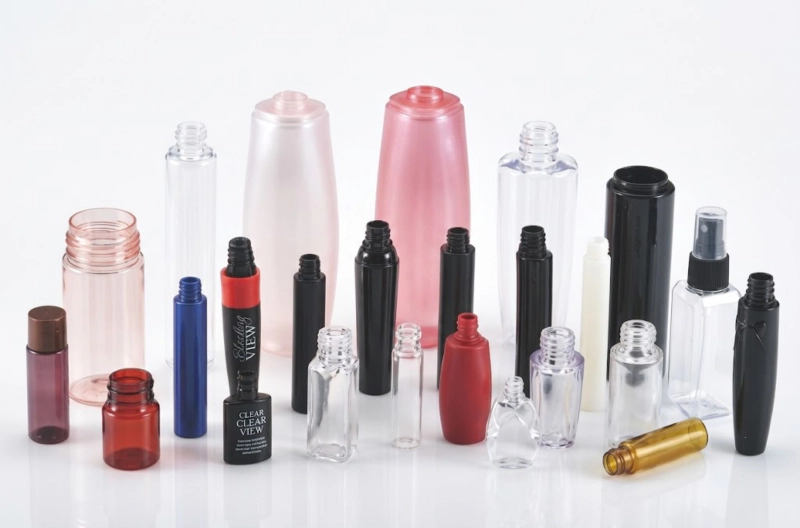
Fig. 4 — Premium PETG cosmetic bottles produced using ASB-12M molds on an HGY150-V4-EV machine. The mold transferred directly without modification; the blow pressure and barrel temperature from the original ASB recipe were used as starting parameters, with only gram weight re-verification required after one trial run. Total commissioning time from mold installation to approved production: 3 days.
1. Compatibility is specific, not general. “Compatible with ASB” is not a specification. ASB-12M compatibility is specific — it means the three interface dimensions (neck ring carrier, parting face locating ring, core rod pitch) all match. Demand written confirmation against your specific mold dimensions.
2. Core rod pitch is the most frequently overlooked incompatibility. Confirm the pitch of your mold against the machine before any other discussion. A pitch mismatch cannot be resolved without custom machine modification.
3. The 3-step verification takes less than 30 minutes. Mold drawing review plus two caliper measurements produces the compatibility determination. There is no reason to proceed to contract without this information.
4. Process parameters mostly transfer. Barrel temperature, blow pressure and cooling setpoints transfer directly as starting points. Injection pressure requires scaling, gram weight requires one-run verification. Commissioning with an existing ASB mold is typically 3 to 5 days — not weeks.
5. The financial stakes justify the 30-minute check. The difference between compatible mold reuse (USD 352,000 savings vs ASB) and incompatible mold replacement (USD 142,000 savings after requalification) is USD 210,000. The verification protocol costs nothing but time.
Send Us Your Mold Dimensions — Get a Compatibility Confirmation in 24 Hours
Share your neck ring OD, core rod pitch, cavity count and mold stack height (or your mold drawings). Our engineers will confirm in writing whether your ASB molds are directly compatible with the HGY150-V4-EV, and which machine configuration to specify in your order.