
Enterprise IBM Machine Buyer’s Guide • Apex Capacity Tier
A comprehensive, engineering-led analysis for enterprise packaging manufacturers evaluating the absolute upper limits of injection blow molding machinery. We dissect the mechanical realities of the 135-ton and 175-ton classes, comparing clamping dynamics, massive shot capacities, platen architectures, and the complex economics of facility integration and total cost of ownership.
At the absolute pinnacle of injection blow molding (IBM) capacity, the stakes are exceptionally high. When global pharmaceutical giants require 32-cavity tooling to output millions of vaccine vials weekly, or when international nutraceutical brands demand flawlessly executed 2,500ml thick-walled packer bottles, standard machinery simply fails. This is the realm of the apex tier: machines that possess the colossal mechanical force and immense plastification volumes necessary to bend physics to the demands of extreme-scale manufacturing.
For decades, the Jomar IBM175 has sat at the top of the North American hierarchy, representing the heavy-duty standard for maximum-capacity production. However, modern capital equipment procurement has shifted dramatically in recent years. Advancements in servo-hydraulic efficiency, hot runner manifold balancing, and European-style low-profile structural engineering have led many packaging engineering teams to ask a critical question: Do we actually need a 175-ton machine, or can a highly optimized 135-ton flagship deliver the exact same extreme cavitation output at a significantly lower capital and operational cost?
The ZQ135 represents this disruptive shift. As the flagship model of the ZQ series, it offers a true 1,350 kN of clamping force, massive platen real estate, and ultra-high shot capacities within a modernized horizontal architecture. This article serves as a deep-dive, factual evaluation framework for procurement and engineering teams looking to navigate the transition between the legacy 175T standard and the modern 135T flagship alternative.
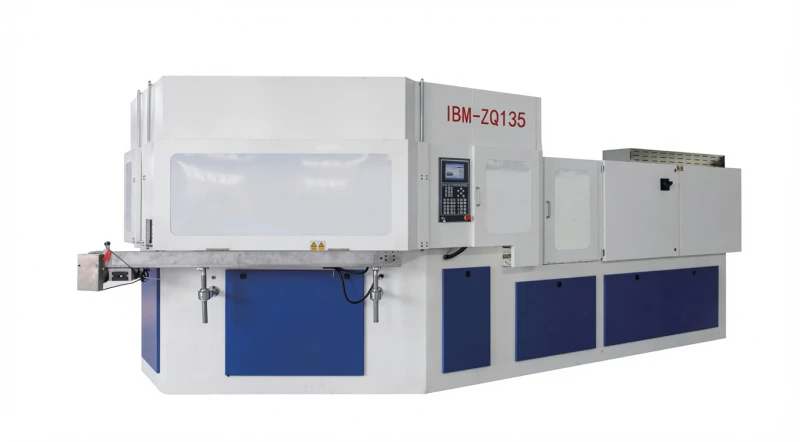
The Apex Capacity Tier: Evaluating the ZQ135 flagship platform against legacy 175T-class vertical plastifier architectures.
1. Defining the Apex Tier: The 135T to 175T Operational Landscape
Before comparing specific models, it is vital to understand what the 135-to-175-ton class actually represents. These designations refer to the hydraulic force (tonnage) applied to keep the injection mold hermetically sealed during the intense pressure of the parison injection phase. 135 metric tons equates to 1,350 kiloNewtons (kN), while 175 US tons translates to roughly 1,550 kN.
This immense force is required for one of two distinct reasons:
- Extreme Cavitation (Micro-Molding): Running 24, 28, or even 32 cavities simultaneously. While each individual 10ml or 15ml bottle is small, the combined projected surface area of 32 cavities, plus the expansive hot runner manifold required to feed them, creates a massive outward force that tries to push the mold halves apart (causing flash).
- Massive Surface Area (Macro-Molding): Running 3 to 6 cavities of extremely large, wide-mouth containers (e.g., 2,000ml to 3,000ml protein powder packers or heavy-wall cosmetic jars). The wide neck diameters and sheer volume of viscous polymer being injected require immense counter-force to maintain dimensional stability.
Both the ZQ135 and the Jomar IBM175 are built to conquer these extremes using the traditional one-step, three-station rotary process. The primary differentiation lies in their structural philosophies: brute-force legacy engineering versus highly optimized, low-profile kinetic efficiency.
2. Core Specification Matrix: A Side-by-Side Evaluation
Procurement decisions in this tier must be grounded in raw data. The following matrix directly compares the published and estimated capabilities of both flagship platforms.
| Technical Parameter | ZQ135 Flagship | Jomar IBM175 (Legacy) |
|---|---|---|
| Injection Clamping Force | 1,350 kN (135 Metric Tons) | ~1,550 kN (175 US Tons) |
| Screw Diameter Configurations | 75 mm / 85 mm | 76 mm / 89 mm |
| Maximum Injection Shot Weight | 1,280 g / 1,650 g | ~1,400 g / ~1,850 g |
| Usable Platen Size (L x W) | 1,000 x 650 mm (Landscape) | ~860 x 710 mm (Portrait-leaning) |
| Blow Station Clamping Force | 180 kN | — (Varies by spec) |
| Machine Structural Height | 2.3 meters (Low Profile) | 4.0+ meters (Vertical Tower) |
| Floor Footprint (L x W) | 5.4 x 1.7 meters | ~4.5 x 2.6 meters |
| Total Installed Power | 75 kW (Servo Driven) | ~90+ kW (Traditional) |
| Max Supported Bottle Volume | 3,000 ml | 3,000 ml |
Disclaimer: Jomar IBM175 specifications are aggregated estimates based on historical published class data and standard conversions to metric for comparative reference only. Actual figures may vary based on specific manufacturing years, custom retrofits, and upgrades.
3. Dissecting the Force Gap: Does the 40-Ton Difference Matter?
The most glaring difference on paper is the clamping force: 1,350 kN (ZQ135) versus approximately 1,550 kN (Jomar IBM175). For conservative production engineers, this roughly 15% reduction in clamping force might initially seem like a downgrade. However, a deeper look into the physics of modern injection blow molding reveals why 135T is rapidly becoming the new standard over 175T.
The Evolution of Mold and Resin Dynamics
Historically, 175 tons of force was necessary because older hot runner manifolds were highly restrictive, and polymer melt flow indices (MFI) were less optimized. Pushing plastic into 32 cavities required immense injection pressure from the screw, which in turn required immense clamping force to prevent the mold from blowing open.
Today, fluid dynamics within hot runner systems have vastly improved. Modern molds require significantly lower injection pressures to fill perfectly. Consequently, the counter-force required to keep the mold closed has dropped. In 95% of ultra-high-volume scenarios—including aggressive 24-to-32 cavity layouts for pharmaceutical vials—a true, evenly distributed 1,350 kN of force is more than sufficient to guarantee a zero-flash parting line.
🔍 Engineering Reality Check: When do you actually need 175 Tons?
You only genuinely require 1,550+ kN of clamping force if you are molding parts with an unusually large projected surface area combined with a highly viscous, difficult-to-flow resin (like specific grades of PCTG or thick-wall Polycarbonate). If you are running standard HDPE, PP, or PS vials, dropper bottles, or standard packers, paying the capital premium and ongoing energy cost for 175 tons of force yields no additional product quality.
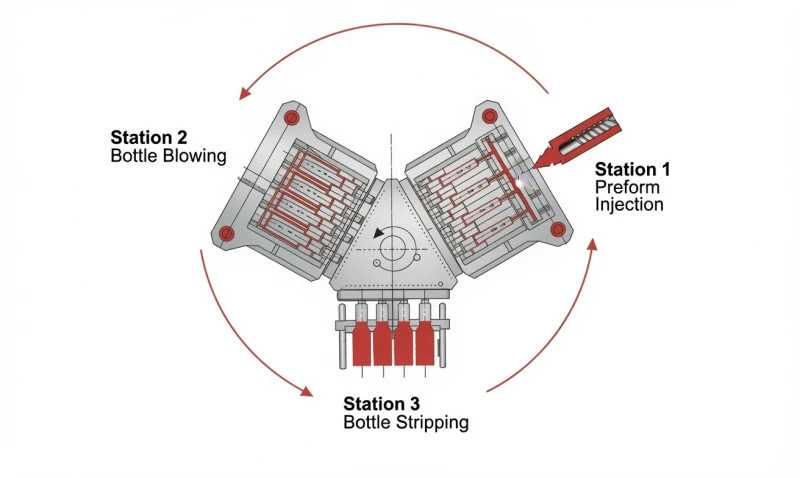
The three-station IBM process (Inject, Blow, Strip). The ZQ135 applies its 1,350 kN clamp evenly across a massive landscape platen, preventing localized flash.
4. Injection Capacity and Plastification: Feeding the Beast
In the apex tier, total shot weight is often the true bottleneck. If the machine cannot melt and inject enough plastic fast enough, cycle times must be artificially extended, destroying your return on investment (ROI).
The ZQ135 addresses this by offering a massive 85 mm screw configuration, capable of delivering up to 1,650 grams of polymer per cycle. While the Jomar IBM175 can reach similar heights (up to ~1,850g with its largest screw), the ZQ135’s 1.65 kg capacity completely covers the realistic limits of what can be blown and cooled within a standard 12-to-15 second IBM cycle.
Crucially, the ZQ135 utilizes modern servo-driven plastification. This ensures that even when injecting 1.6 kg of HDPE, the melt homogeneity is flawless, completely preventing un-melted “fish-eyes” or thermal degradation in the parisons—a common issue when pushing older hydraulic systems to their absolute limits.
5. Platen Geometry and Mold Layout Strategy
The physical shape of the clamping platen dictates how your toolmaker designs the mold, heavily influencing thermal balancing and cavity count.
- The ZQ135 Approach (Landscape): Featuring a massive 1,000 mm wide by 650 mm high landscape platen. This incredibly wide format is highly advantageous for multi-row layouts (e.g., 4 rows of 8 cavities). By spreading the cavities horizontally, parisons remain closer to the central injection nozzle, ensuring that the melt travel distance in the hot runner is minimized and balanced.
- The Legacy Approach (Portrait-Leaning): The IBM175 utilizes a platen that is narrower in width but taller. While excellent for long, tall bottles where the core rods need extreme vertical clearance to index, it can make balancing extreme cavity counts (like a 32-cavity tool) thermally challenging, as the outermost cavities sit far from the injection center.
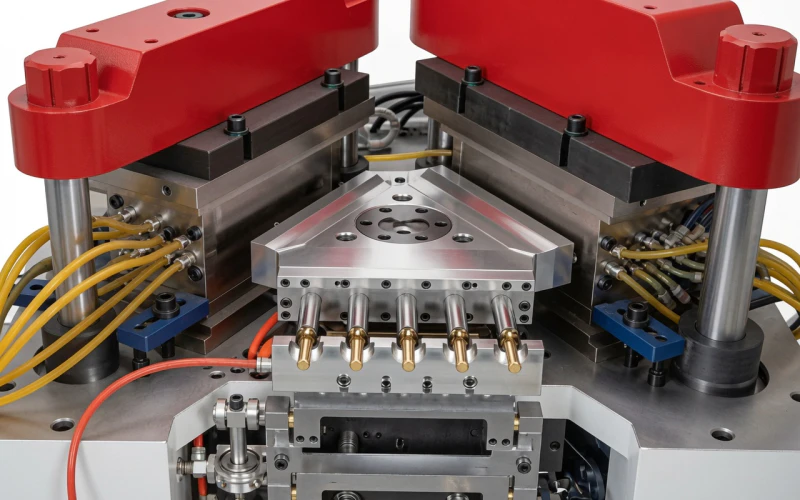
Massive cavitation (24 to 32 cavities) relies heavily on platen geometry. The ZQ135’s 1,000mm wide landscape platen simplifies hot runner thermal balancing.
6. Facility Integration: The Hidden Cost of Vertical Tower Architectures
Perhaps the most consequential operational difference between these two platforms lies in their physical architecture, which dictates how they interact with your factory infrastructure.
The legacy Jomar IBM175 utilizes a traditional vertical plastifier design. The injection unit stands vertically atop the machine, resulting in a towering overall height that frequently exceeds 4.0 meters (13+ feet). When you factor in the overhead space required for a gantry crane to pull the massive vertical screw for maintenance or to drop in heavy 175T molds, facilities often require 5-to-6 meter ceiling clearances.
The HVAC Cleanroom Penalty: Because apex-tier machines operate almost exclusively in pharmaceutical or food-grade environments, they must be housed in cleanrooms or controlled environments. Building and maintaining a 5-meter-high cleanroom means you are paying to purify, cool, and dehumidify an enormous volume of empty vertical air space. This constitutes a massive, continuous drain on your operational budget.
The ZQ135 utilizes a European-style low-profile horizontal architecture. The injection unit runs horizontally, keeping the total machine height to an incredibly compact 2.3 meters. This allows the ZQ135 to be installed in standard industrial facilities and lower-clearance cleanrooms, drastically slashing construction costs and ongoing HVAC energy consumption.
7. Extreme Cavitation Potential Breakdown
The primary justification for entering the apex tier is sheer volume. The table below outlines the expected maximum cavitation potential for the ZQ135, directly rivaling legacy 175T output.
| Target Bottle Volume | ZQ135 Max Cavities | Typical 175T Expectation |
|---|---|---|
| 10 ml – 15 ml | 24 – 32 | 24 – 32 |
| 30 ml | 18 – 22 | 18 – 24 |
| 60 ml | 14 – 16 | 14 – 18 |
| 100 ml | 12 – 14 | 12 – 14 |
| 500 ml | 8 – 10 | 8 – 10 |
| 1,000 ml | 4 – 5 | 4 – 6 |
| 2,000 ml – 2,500 ml | 2 – 3 | 2 – 3 |
*Note: Maximum cavitation is highly dependent on specific bottle geometry, wall thickness, required neck finishes, and tool design. Consult with engineering for exact cavity mapping.
8. The Economics of Tooling Transfer: Adapting 175T Molds
The most significant barrier to adopting a new platform is legacy tooling lock-in. If you own a fleet of highly expensive 175-ton molds, can they be used on the ZQ135?
Because the ZQ135 employs a 1,000 x 650 mm landscape platen and the Jomar IBM175 utilizes a different aspect ratio, direct drop-in compatibility of an entire mold assembly is not possible. You cannot simply bolt a 175T die set into the ZQ135 without modification.
However, the transition is rarely a total write-off. The highest-cost elements of your tooling—the precision core rods, the polished cavity inserts, and the specialized neck rings—are fundamentally transferable. To execute the migration, your toolmaker must machine new backing plates, die sets, and adjust water/air channeling to match the ZQ135 platen layout. This adaptation typically represents a fraction (15% to 30%) of the cost of fabricating a brand-new mold. When mapping your TCO, this one-time mold adaptation expense must be weighed against the lower acquisition cost and long-term energy savings of the ZQ135.

The ZQ135 ensures flawless neck finishes and perfect parting lines across all 32 cavities, eliminating downstream inspection failures.
9. Auxiliary Utility Demands: Air, Water, and Power
Apex-tier machines consume utilities at an industrial scale. Properly sizing your auxiliary equipment is critical to preventing bottlenecks.
- Oil-Free Compressed Air: Blowing 32 parisons simultaneously requires a massive surge of high-pressure air. The ZQ135 demands a baseline of 2.0 to 2.5 m³/min of compressed air at pressures up to 1.2 MPa. For pharma/food applications, this must be 100% Class-0 oil-free air to maintain GMP compliance. A highly recommended solution for this capacity tier is integrating a continuous-duty system like the CM-B Series Oil-Free Screw Air Compressor, which provides the precise flow and pressure stability required without risking pneumatic contamination.
- Chiller Capacity: When you are injecting up to 1.65 kg of molten polymer every 14 seconds, the thermal load on the mold is staggering. The ZQ135 requires robust industrial chilling capabilities (approx. 5-7 m³/h flow rate) to extract that heat rapidly and maintain fast cycle times.
- Electrical Efficiency: The Jomar IBM175 traditionally relies on heavy continuous hydraulic pumping, driving installed power requirements upwards of 90 kW. The ZQ135 integrates advanced servo-driven hydraulics, pulling maximum power only when the cycle demands it. With a 75 kW installed rating, the ZQ135 offers significantly lower baseline energy consumption, compounding savings across a 24/7 operating schedule.
10. Where the Legacy IBM175 Retains Its Edge
An objective evaluation demands acknowledging where the legacy 175-ton platform remains the optimal choice for specific manufacturers:
- Strict Regulatory Lock-In: If you are manufacturing FDA-approved medical devices or life-saving drugs on an existing IBM175, substituting a different machine platform requires a complete, exhausting requalification and validation process (IQ/OQ/PQ). In these highly regulated scenarios, buying another identical 175T is often cheaper than the bureaucratic cost of platform migration.
- Massive Proprietary Tooling Libraries: If a contract manufacturer already possesses fifty 175T molds in a portrait layout, the cost to adapt that entire library to a landscape platen would eclipse any machine price savings.
- Edge-Case Fluid Dynamics: For the rare 5% of projects involving extreme-viscosity specialty resins blown into massively wide, thick-walled asymmetrical geometries, the absolute brute force of 1,550+ kN provides a necessary safety factor against parting line flash.
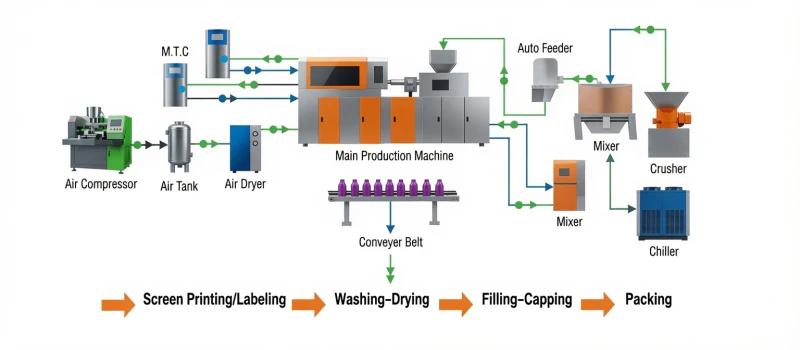
Apex-tier manufacturing requires a holistic approach: integrating the ZQ135 with heavy-duty chillers, resin dryers, and oil-free air systems.
11. Total Cost of Ownership (TCO) Evaluation Framework
To finalize a procurement decision between the 135T modern flagship and the 175T legacy platform, procurement teams should execute the following 4-step framework:
Calculate True Clamping Need
Extract the projected surface area data from your most demanding mold designs. Multiply by anticipated injection pressure. Does the result actually exceed 1,350 kN? If not, a 175-ton machine represents over-capitalization.
Audit Facility Overhead Restrictions
Measure your clear ceiling height to the lowest HVAC duct or fire suppression pipe. If it is less than 4.5 meters, the vertical footprint of legacy machines will incur heavy facility modification costs, strongly favoring the ZQ135’s 2.3m profile.
Quantify Mold Adaptation Expenditures
If migrating legacy tooling, secure a formal toolmaker quotation to design and machine new landscape-format backing plates and die sets for your most critical molds.
Project 5-Year Energy OPEX
Calculate the power consumption difference between a 90kW continuously running hydraulic system and a 75kW servo-optimized system running 24/7/365 at your local industrial kilowatt-hour rate.
Conclusion: Breaking the 175-Ton Dogma
For decades, specifying a 175-ton machine was the safe, unquestioned default for extreme-volume IBM production. However, as engineering tolerances tighten and capital efficiency becomes paramount, the ZQ135 proves that brute force is no longer the only answer. By combining a legitimate 1,350 kN of clamping force with a massive 1.65 kg shot capacity and a low-profile landscape platen, the ZQ135 delivers the exact same 32-cavity output potential as the Jomar IBM175—but with vastly superior energy efficiency, lower facility integration costs, and a highly competitive acquisition footprint.
Ready to Engineer Your Next Apex-Tier Expansion?
Explore the absolute limits of the ZQ135 flagship. Review comprehensive parameter tables, download extreme-cavity layout schematics, verify exact platen dimensions, and connect with our engineering team for a customized capital equipment feasibility analysis.