
The Russian plastic bottle packaging market has been reshaped more fundamentally in the past three years than in the preceding decade. Import substitution policy, the exit of major western brands, accelerated domestic brand development, tightening pharmaceutical GMP requirements and a structural shift toward premium packaging formats have combined to create a manufacturing environment that strongly favours on-site bottle production over import sourcing. For cosmetics, pharmaceutical and food manufacturers evaluating whether to invest in ISBM or IBM equipment, the market dynamics of 2025 and 2026 make the timing analysis significantly more favourable than it would have been in 2021. This article maps the key market trends across the three primary packaging verticals, quantifies the opportunity in each, and draws the direct connection between market-level dynamics and equipment investment decisions.
1. Market Overview: Size, Structure and 2026 Outlook
Russia is one of the largest plastic packaging markets in Europe by volume. The rigid plastic container segment — bottles, jars and closures — accounts for the largest share of packaging material consumption by value in the food, cosmetics and pharmaceutical sectors combined. The market is characterised by a high degree of import dependence in the premium segment (finished bottles and specialty resins) and a growing but still underserved domestic production capacity in mid-market and premium plastic bottle formats.
~820
Billion RUB
Estimated Russian rigid plastic packaging market size 2025 (all formats, all sectors). Growth from approximately 580 billion RUB in 2020 driven by localisation and volume.
12 – 15%
Annual Growth Rate
Premium plastic bottle segment (PETG, Tritan, wide-mouth PET) growing at 12 to 15% annually as domestic brands upgrade from standard PET to premium formats.
40 – 55%
Import Share (Premium)
Share of premium plastic bottles still imported in 2024. This figure was 65 to 70% in 2021 — the localisation trend is accelerating but substantial import replacement opportunity remains.
Three structural forces are driving market growth beyond the natural consumption trend: the import substitution programme that incentivises domestic production over importation; the exit or significant reduction of western brand presence that has created market share for domestic brands; and the growing sophistication of Russian consumer brand owners who now compete on packaging quality in a way that was not commercially viable 10 years ago.
The key market dynamic for equipment buyers: The premium plastic bottle segment is growing faster than the capacity to supply it domestically. A cosmetics manufacturer, pharmaceutical producer or specialty food company that installs ISBM or IBM equipment in 2025 to 2027 enters a market where domestic production capacity is insufficient to meet demand — not one where they must displace established domestic competitors.
2. Import Substitution: What the Policy Means for Packaging Manufacturers
Import substitution policy in Russia creates concrete commercial advantages for domestic manufacturers of goods previously sourced from abroad — including plastic bottles. The policy operates through several mechanisms that directly affect the packaging equipment investment decision:
-
1Preferential procurement for domestically produced goodsState-linked buyers and large retail chains face formal or informal pressure to prefer domestically produced packaged goods. A cosmetics or food brand that can certify domestic production of its packaging has a procurement advantage in these channels. This is directly relevant to a brand that installs its own ISBM line — it can certify the entire product as domestically manufactured.
-
2Equipment investment subsidies and preferential financingThe Russian Ministry of Industry and Trade administers programmes providing subsidised loans for manufacturing equipment investment — including plastic processing machinery. Interest rates under these programmes are substantially below commercial lending rates. Eligibility requirements vary; the equipment must produce goods classified as domestically manufactured under the relevant technical regulations.
-
3Customs duty on imported finished bottlesFinished plastic bottles imported into Russia are subject to customs duties and VAT that do not apply to raw resin or domestically produced bottles. This creates a structural cost disadvantage for imported bottles relative to domestically produced equivalents — a disadvantage that grows as the ruble/euro exchange rate moves. An on-site ISBM line that converts domestically sourced or imported resin into bottles pays no bottle import duty.
-
4Supply chain resilience premiumThe supply chain disruptions of 2022 to 2024 — extended lead times, port delays, payment mechanism complications — have made domestic sourcing of packaging a risk management priority for many manufacturers. A brand owner that controls its own bottle production eliminates one of the highest-risk external dependencies in its supply chain.
Fig. 1 — Premium PETG cosmetic bottles. In 2021, bottles of this specification were predominantly imported from European or Turkish suppliers. By 2026, import share in this segment has fallen to 40 to 55% — but domestic production capacity remains insufficient, meaning that a new domestic producer enters an undersupplied market, not a crowded one. The import substitution dynamic adds a market timing advantage to the normal equipment investment analysis.
3. Cosmetics Packaging: The PETG and Tritan Premium Shift
The Russian cosmetics market has undergone a significant brand landscape change since 2022. The partial or complete withdrawal of major western cosmetic brands — or the significant reduction of their premium packaging SKUs — created market share for domestic brands at the premium tier. Russian cosmetics brands that previously competed only in mass-market segments with standard PET packaging are now winning premium shelf positions that require premium packaging formats.
This transition from standard PET to premium PETG and Tritan packaging is the most commercially significant trend in the Russian cosmetics packaging market in 2025 to 2026:
Standard PET (Mass Market)
- ▶Commoditised, high competition, thin margins
- ▶Large domestic production base — competition established
- ▶Standard shapes, round, thin wall — 3-station ISBM or 2-step capable
- ▶Selling price: 8 – 35 RUB per bottle (volume tiers)
- ▶Low opportunity premium for new entrants
Premium PETG / Tritan (Growing Fast)
- ✓Premium margins, 12 to 15% annual segment growth
- ✓Domestic supply still 40 to 55% import-dependent
- ✓Complex shapes, thick wall, ASB-compatible — requires 4-station ISBM
- ✓Selling price: 85 – 350 RUB per bottle
- ✓High opportunity premium — underserved market
The technical requirement for premium PETG cosmetics packaging — thick walls, complex non-round geometries, glass-like clarity, tight thread tolerances — maps directly to the 4-station ISBM platform. A domestic packaging manufacturer or cosmetics brand investing in an HGY150-V4-EV specifically addresses the underserved premium segment where import share is highest and domestic competition is lowest.
| Cosmetics Format | Resin | Import Share 2024 | Segment Growth | Machine Platform |
|---|---|---|---|---|
| Premium serum / perfume bottle | PETG, Tritan | 55 – 65% | 18 – 25%/yr | 4-station ISBM |
| Luxury lotion / cream jar | PETG | 45 – 55% | 12 – 18%/yr | 4-station ISBM |
| Standard lotion / shampoo bottle | PET, PP | 15 – 25% | 5 – 8%/yr | 3-station ISBM or IBM |
| Small dispensing / dropper bottle | PP, PETG | 20 – 30% | 6 – 10%/yr | IBM (ZQ series) |
4. Pharmaceutical Packaging: GMP Compliance as Market Entry Requirement
The Russian pharmaceutical packaging market is structurally different from cosmetics in one important respect: quality requirements are defined by regulation, not by brand positioning. GMP compliance — in its Russian implementation as GOST R 52249 and the requirements of Roszdravnadzor registration — mandates specific production environment, equipment qualification and quality documentation standards for primary packaging. These requirements create a market access barrier that smaller or less-invested domestic producers cannot cross.
Three regulatory trends in 2025 and 2026 are reshaping the pharmaceutical plastic bottle packaging market:
GMP Inspection Tightening
Roszdravnadzor has increased inspection frequency for primary packaging suppliers. The inspection criteria now explicitly address the production environment, machine cleanability and absence of hydraulic oil contamination risk — criteria that full-servo ISBM machines satisfy more readily than hydraulic alternatives.
Impact: Suppliers without full-servo machines losing pharma contracts
Domestic Pharma Expansion
The Russian pharmaceutical industry has significantly expanded domestic API and finished dosage form production since 2022. This expansion has created demand for domestic primary packaging — particularly oral liquid bottles, topical solution containers and ophthalmic packaging — that was previously imported with the finished drug product.
Impact: 20 to 35% growth in demand for GMP-qualified domestic bottles
PP and PETG in Pharma
Regulatory acceptance of PP and PETG for pharmaceutical primary packaging has expanded the material options beyond the traditional PET mono-segment. Syrup bottles are increasingly specified in PP for chemical compatibility with certain APIs. Topical and ophthalmic packaging is increasingly specified in PETG for clarity and chemical resistance.
Impact: IBM and ISBM machines address different parts of this opportunity
The pharmaceutical segment presents a different equipment logic from cosmetics: the volume per product is typically lower, the neck geometry precision requirements are higher, and the GMP compliance burden is heavier. IBM machines (ZQ series) address the small-format, high-precision pharmaceutical bottle segment — ophthalmic, nasal, oral liquid in PP, HDPE and PET below 200ml. ISBM machines address the larger-format syrup and topical liquid segment where the bottle size, clarity requirements and one-step economics are more favourable.
5. Food and Condiment Packaging: PET Volume Growth and Wide-Mouth Formats
The Russian food and condiment packaging market is the largest by volume among the three primary verticals — and the one undergoing the most rapid format transition. Two trends define the opportunity:
Trend A — PET replacing glass in condiments and sauces
Russian food manufacturers are accelerating the transition from glass to PET in condiment categories — sauces, edible oils, vinegars, honey and liquid seasonings. The driver is cost (PET at 15 to 30 RUB per bottle vs glass at 35 to 80 RUB), weight (PET bottle 30 to 50g vs glass 180 to 380g) and breakage rate. The clarity and shelf appeal requirements for premium condiment PET bottles — clear body, minimal parting line, accurate weight-filling performance — favour one-step ISBM over two-step reheat blow for smaller production volumes below 20 million units per year per SKU.
Trend B — Wide-mouth PET jars replacing glass and PS in food retail
The most technically demanding food packaging segment is the wide-mouth PET jar — up to 180mm neck diameter — used for pickles, spreads, nut butters and premium condiments. This format was previously unavailable in domestic one-step ISBM production; the HGYS280-V6 six-station machine opened this format to domestic producers for the first time. Wide-mouth PET jars command a 25 to 40% price premium over equivalent glass containers in premium retail, while offering the supply chain advantages of plastic.
The food packaging segment is driven by volume economics differently from cosmetics and pharma. The margins per bottle are lower, but the production volumes are higher and the product qualification cycles are shorter. A food manufacturer installing ISBM equipment typically achieves payback in 18 to 30 months compared to 24 to 42 months for a cosmetics ISBM investment — primarily because food bottle production can be ramped to full capacity faster with fewer qualification requirements.
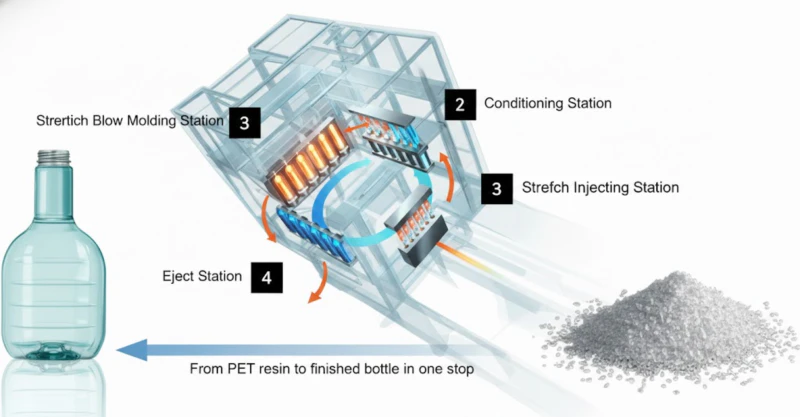
Fig. 2 — The one-step ISBM 4-station process. The single-machine conversion of resin pellets to finished bottles eliminates the preform logistics, preform inventory and reheat energy of two-step processes — producing a cost-per-bottle advantage that grows at lower production volumes (under 20 million units per year per SKU). This operating point describes the majority of Russian cosmetics, specialty food and pharmaceutical packaging manufacturers.
6. Resin Supply in Russia: PET, PETG and PP Availability
Resin supply is the critical input cost and availability risk for any ISBM line in Russia. The situation in 2025 and 2026 differs significantly by resin type:
| Resin | Domestic Supply | Import Situation | 2026 Price Trend | Supply Risk |
|---|---|---|---|---|
| PET (bottle grade) | Substantial — Polief, SIBUR and others | Supplemented from Turkey, India, Asia | Stable to slight decrease | Low |
| PP (injection grade) | Strong — multiple domestic producers | Import not required for standard grades | Stable | Very Low |
| HDPE (blow grade) | Adequate — SIBUR and others | Specialty grades may require import | Stable | Low |
| PETG | Limited — no significant domestic production | Primarily from Korea, India via parallel import channels | Moderate volatility | Medium |
| Tritan (Eastman) | None — imported only | Eastman via distributors; parallel import routes | Price premium maintained | Medium-High |
Resin supply implication for machine platform choice: PET and PP supply is low-risk and price-stable — IBM machines processing PP and HDPE, and ISBM machines processing PET, operate with confident input cost assumptions. PETG supply is adequate via parallel import channels but carries some price and availability risk; Tritan carries more. This does not change the equipment investment logic for premium cosmetics, but does argue for maintaining PET processing capability alongside PETG capability where product range allows — to provide a hedge against PETG supply disruption.
7. On-Site Production vs Imported Bottles: The Economics in 2026
The comparison between buying finished bottles (imported or from a domestic supplier) and producing on-site with an ISBM machine depends on production volume, bottle specification and ruble exchange rate. The following reference cases illustrate the 2026 economics for a Russian cosmetics manufacturer:
| Cost Component | Buy (Import) | Buy (Domestic) | Produce On-Site (ISBM) |
|---|---|---|---|
| Bottle unit cost (30ml PETG, 6g) | 120 – 180 RUB | 85 – 130 RUB | 28 – 45 RUB |
| Minimum order quantity | 5,000 – 20,000 units | 2,000 – 10,000 units | 1 cycle (4 bottles minimum) |
| Lead time to receipt | 35 – 60 days | 10 – 25 days | Same day |
| Inventory carrying requirement | 60 – 90 days stock | 20 – 40 days stock | 0 – 3 days stock |
| Colour / shape change flexibility | Months (new mold order) | Weeks (supplier lead time) | Hours (mold changeover) |
| Break-even annual volume | N/A (baseline) | N/A (baseline) | 1.5 – 3.5M bottles/yr (machine model dependent) |
The on-site production cost advantage of 28 to 45 RUB per bottle versus 85 to 180 RUB for purchased bottles (at 30ml PETG) represents a margin improvement of 40 to 135 RUB per bottle — at 5 million bottles per year, this is 200 million to 675 million RUB in annual margin improvement. Against a machine investment of 13 to 15 million RUB for an HGY150-V4-EV with one mold set, the payback calculation is straightforward. The limiting factor is the break-even production volume — at volumes below 1.5 million bottles per year, the machine utilisation is too low to achieve this economics.
8. Investment Timing: Why 2025 to 2027 Is the Window
Several factors converge in 2025 to 2027 to create a favourable investment window that will narrow as the market matures:
- ▶Import share is still high enough that domestic production is not competing against established players — a new entrant faces an undersupplied market, not a saturated one. This window will close as more domestic producers invest.
- ▶Machine pricing from suppliers has not yet adjusted to ruble weakening — machines priced in USD represent a historically favourable exchange rate relative to the ruble operating cost base.
- ▶Subsidy programme funding is available but finite — equipment subsidies are available now through active government programmes. The availability and terms of these programmes are reviewed annually.
- ▶Brand owners are actively seeking domestic packaging suppliers now — a producer who installs capacity in 2025 to 2026 can present domestic supply credentials to cosmetics and pharma brand owners who are actively replacing import-dependent supply chains.
- ▶Machine lead time is 8 to 16 weeks — an investment decision in Q3 2025 results in production capability in Q1 to Q2 2026. Delaying the decision by 12 months means entering the market in 2027, when domestic supply capacity will be higher and the first-mover advantage will have diminished.
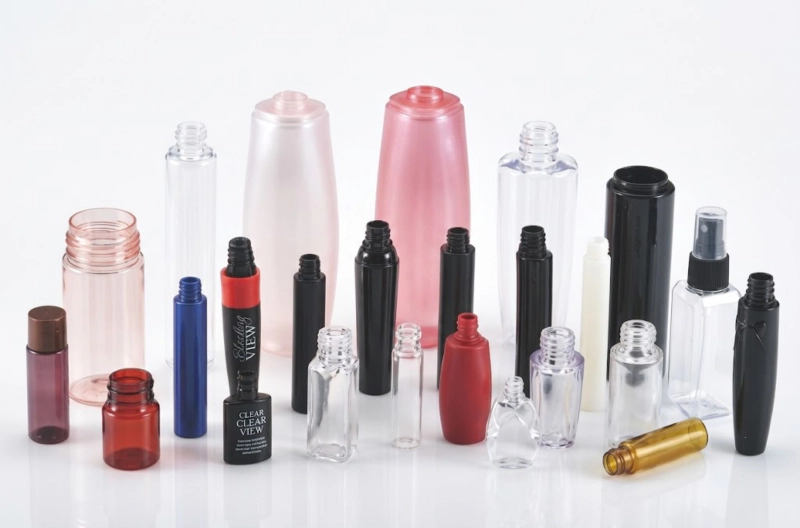
Fig. 3 — Premium PETG cosmetic bottles. The market for these bottles in Russia is growing at 12 to 25% annually by segment, import share remains at 40 to 65% depending on format, and domestic brand owners are actively seeking local production partners. The combination of these three factors — market growth, import gap and active demand — defines the investment timing window for ISBM equipment in Russia.
9. Risks to the Outlook: What Could Change the Calculation
A balanced market analysis requires acknowledging the factors that could reduce the investment return or extend payback periods:
Ruble appreciation reducing the cost advantage of imported bottles
If the ruble strengthens significantly against the euro or dollar, imported bottle prices in ruble terms fall, reducing the cost advantage of domestic production. The risk is real but historically the ruble has shown sustained weakness against hard currencies, and domestic production provides a permanent hedge against this risk rather than exposure to it.
PETG supply disruption or price spike
PETG is entirely import-dependent in Russia, primarily from Korean and Indian suppliers. A significant supply disruption or price increase — driven by global petrochemical market shifts or trade route complications — would increase input costs for premium cosmetic bottle production. Mitigation: maintain capability to process standard PET as a cost hedge, and hold 45 to 60 days of PETG inventory for operational continuity.
Domestic competition entering the premium segment faster than expected
Other domestic producers are making the same investment calculation. If the premium PETG bottle segment attracts significantly more domestic capacity investment than demand growth warrants, pricing pressure could compress margins earlier than the standard payback calculation assumes. Mitigation: differentiate on quality (GMP compliance, ASB-compatible custom shapes) rather than competing on standard formats.
Changes to import substitution subsidy programmes
Government subsidy programmes for equipment investment are subject to annual budget review and policy change. An investment decision that incorporates subsidy financing should be stress-tested against the scenario where subsidies are reduced or removed — the commercial case should be positive without the subsidy, with the subsidy representing an accelerant rather than a prerequisite.
10. Equipment Implications: Matching Machine Platform to Market Opportunity
The market analysis points to specific equipment investment profiles for each vertical. The correct machine platform is determined by the market segment being addressed, not by machine price:
| Market Segment | Key Requirement | Recommended Platform | Market Opportunity Rating |
|---|---|---|---|
| Premium PETG cosmetics (thick-wall, complex shape) | Conditioning station, ASB mold compatibility, glass-like clarity | HGY150-V4-EV (4-station full servo) | ★★★★★ Highest |
| Pharmaceutical oral liquids (PP, PETG, PET, precision neck) | Zero flash, GMP environment, small format precision | ZQ40–ZQ80 IBM (all-electric option) | ★★★★ High |
| Wide-mouth PET food jars | Large neck diameter, food-grade clarity, high throughput | HGYS280-V6 (6-station) | ★★★★ High |
| Standard PET condiment / sauce bottles | Volume, clarity, standard round geometry | HGY50-V3-EV or HGY150-V4-EV | ★★★ Medium |
| Standard cosmetic PET (mass market, thin wall, round) | Cost, volume output | HGY50-V3-EV | ★★ Low-Medium (established competition) |
The premium PETG cosmetics segment stands out as the strongest opportunity because it combines the highest import dependency (55 to 65%), the fastest growth rate (18 to 25% per year), the highest per-bottle margin contribution, and the technical barrier (4-station ISBM with conditioning) that prevents commodity producers from entering the segment with lower-cost equipment. A dedicated oil-free air compressor for ISBM matched to the machine platform is part of the technical qualification package that supports GMP-adjacent cosmetics and pharmaceutical applications.
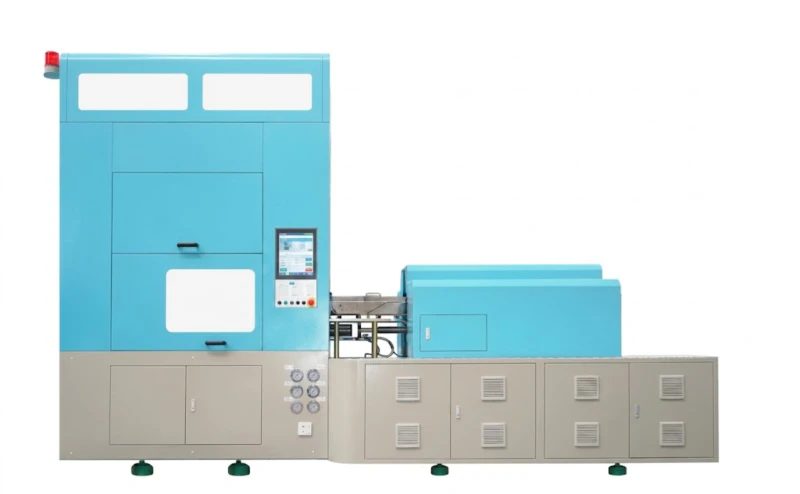
Fig. 4 — The HGY150-V4-EV 4-station full servo ISBM machine. At an indicative investment of 13 to 15 million RUB including one mold set and auxiliary equipment, and producing premium PETG cosmetic bottles at a cost of 28 to 45 RUB versus an imported price of 120 to 180 RUB, the annual margin improvement at 5 million bottles per year reaches 350 to 675 million RUB — placing the payback period at 6 to 15 months under most operating scenarios in the 2026 market.
1. The premium segment is growing fast and still undersupplied. Premium plastic bottle production (PETG, Tritan, wide-mouth PET) is growing at 12 to 25% per year, and 40 to 65% of demand is still met by imports. A domestic producer enters an undersupplied market, not a crowded one.
2. Import substitution dynamics add a policy tailwind to the commercial case. Preferential procurement, customs duties on imported finished bottles and equipment subsidies all improve the return on an ISBM investment beyond the pure cost calculation.
3. Each segment requires a different machine platform. Premium cosmetics needs a 4-station full servo ISBM; pharmaceutical small-format needs IBM; wide-mouth food jars need the 6-station HGYS280. The market analysis and the machine selection are inseparable.
4. 2025 to 2027 is the investment window with the most favourable entry conditions. Import share is still high, subsidy programmes are active, competition is limited, and brand owners are actively sourcing domestic production. These conditions will improve for producers who invest now and worsen for those who wait.
5. The on-site production cost advantage over purchased bottles is large and durable. At 30ml PETG cosmetic bottles, on-site ISBM production costs 28 to 45 RUB versus 85 to 180 RUB for imported or domestic-purchased equivalents. This advantage does not require a specific exchange rate or subsidy programme to maintain — it is structural to the one-step manufacturing economics.
Ready to Calculate the ROI for Your Specific Production Scenario?
Share your bottle specification, annual volume target and current bottle sourcing cost. Our engineers will produce a complete on-site vs purchased bottle cost comparison and payback calculation tailored to your operation — at current Russian electricity rates, ruble-denominated costs and our 2026 machine pricing.