The choice between a 3-station and a 4-station one-step ISBM machine is the most consequential equipment decision a packaging manufacturer makes — more important than the choice between full servo and hydraulic, more important than brand, and more important than price. It determines which bottle geometries are achievable, what wall thickness uniformity is possible, and whether the machine can produce the thick-walled, asymmetric or non-round bottles that premium cosmetic brands increasingly demand. Yet the decision is routinely made on price alone, with buyers selecting the cheaper 3-station platform and discovering only after installation that their bottle geometry requires the conditioning station that only a 4-station machine provides. This guide explains what the fourth station actually does, which bottle types need it and which do not, how to calculate whether it is worth the additional investment for your specific production requirements, and how to avoid the most common mistake in ISBM machine selection.
1. How the Station Count Works: What Each Station Does
In a one-step ISBM machine, the rotary turntable carries the preform from one station to the next, with each station performing a specific operation simultaneously. Because all stations operate in parallel — every station works at the same time — the total cycle time equals the time required at the slowest station, not the sum of all station times.
2. What the Conditioning Station Actually Does
The conditioning station is widely described as “temperature equalisation” — but this description understates its mechanical significance. To understand what it actually achieves, consider what happens to a PETG preform immediately after it leaves the injection station on a 3-station machine.
The preform has just been injected at 250°C and cooled at its outer surface by the mold (set at 10–15°C) for 3 to 5 seconds. At the moment of mold opening, the preform has a steep temperature gradient across its wall: the outer skin has been cooled to approximately 70–90°C and is partially solid; the inner core (near the core rod) may still be at 140–180°C; the gate zone at the base is hottest of all. This thermal gradient is not a problem for a thin-walled PET bottle with a high stretch ratio — PET’s strain-hardening behaviour distributes material reasonably well even with a non-uniform starting temperature. For a thick-walled PETG cosmetic bottle with a lower stretch ratio, the same thermal gradient produces a bottle where the hotter zones stretch significantly further than the cooler zones — creating wall thickness variation that exceeds any premium packaging acceptance limit.
The conditioning station addresses this by holding the preform for 1.5 to 3.5 seconds at a controlled temperature — using both heating elements (to warm zones that cooled too fast) and cooling circuits (to cool zones that retained too much injection heat) — until the preform body reaches a uniform temperature within ±5°C across all zones. The preform that arrives at the blow station is thermally homogeneous. It stretches uniformly. The wall thickness of the resulting bottle is controlled.
The critical insight: The conditioning station does not compensate for a poorly designed preform or incorrect injection parameters. It compensates for the physical reality that a thick-walled preform cannot cool uniformly in the time available at the injection station — because the thermal diffusivity of PETG means that heat removal from the centre of a 5mm wall takes 4 to 6 times longer than from the surface. This is a materials physics constraint, not a machine parameter issue. It cannot be designed around on a 3-station machine regardless of how the injection parameters are set.
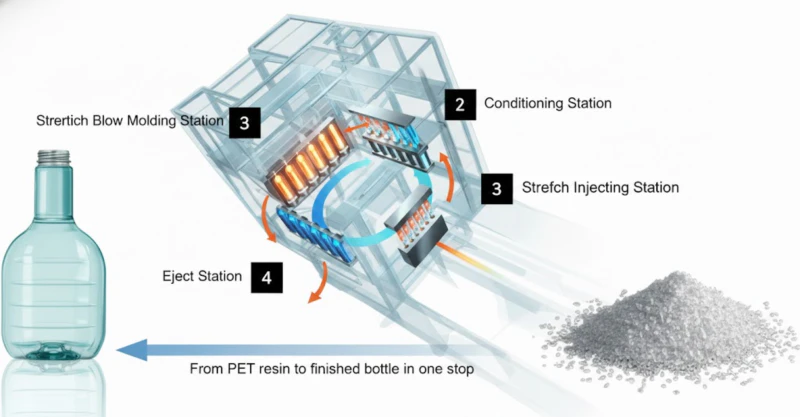
Fig. 1 — 4-station ISBM process flow. Station 2 (temperature conditioning) equalises the preform temperature profile before blowing — reducing wall thickness variation from a typical 18–25% on a 3-station machine running thick-walled PETG to 8–12% on a 4-station machine with the same mold and resin. This is the single most important capability difference between the two platforms for premium cosmetic bottle production.
3. Which Bottle Types Need a 4-Station Machine
The conditioning station is functionally necessary — not just beneficial — for the following bottle categories. Attempting to produce these bottles on a 3-station machine will consistently produce wall thickness variation that exceeds reasonable quality limits:
Thick-Wall Cosmetic Bottles
Any bottle with wall thickness above 2.0mm in the body zone. Premium serum bottles, luxury perfume bases, heavy lotion jars. The thermal gradient across a 3mm wall cannot be resolved in injection cooling time alone.
Wall thickness minimum: 2.0mm+
Non-Round / Asymmetric Bottles
Oval, rectangular, square or faceted bottle cross-sections. The geometry creates unequal stretch ratios in different directions — a uniform preform temperature is essential to prevent the hotter, softer zones from over-stretching into the smaller-radius areas.
Any non-circular cross-section
High Aspect Ratio Preforms
Preforms where the length-to-diameter ratio is above 4:1. The base of the preform (thickest wall) retains heat much longer than the shoulder zone. Without conditioning, this creates a base-heavy bottle with excessive material at the bottom.
Preform L/D ratio above 4:1
PETG Above 8g Preform Weight
PETG has lower thermal diffusivity than PET — it cools more slowly and retains heat longer. For preform weights above 8g in PETG, the thermal gradient at the injection station exit is steep enough that conditioning is required for consistent wall thickness.
PETG preforms above 8g
PC and Tritan Bottles
Polycarbonate and Tritan process at higher barrel temperatures than PETG (280–320°C for PC), retaining more thermal energy at injection. Baby bottles, reusable sports bottles and high-clarity pharmaceutical containers in these resins uniformly require conditioning.
PC and Tritan resins
ASB-Compatible Mold Library
Manufacturers migrating from Nissei ASB-12M machines need a 4-station platform — ASB machines are 4-station by design. ASB mold sets are engineered assuming conditioning. Running an ASB mold on a 3-station machine will produce substandard results even when all other dimensions are compatible.
ASB mold migration
4. Which Bottle Types Run Perfectly Well on 3 Stations
A 3-station machine is not an inferior product — it is the correct platform for a well-defined set of applications where the conditioning station provides no meaningful quality improvement. Choosing a 3-station machine for these applications produces better economics than over-specifying with a 4-station platform:
- ✓Thin-wall PET bottles below 0.5mm wall: Standard pharmaceutical syrups, condiment bottles, beverage bottles. High stretch ratios with PET strain-hardening produce naturally uniform walls even without conditioning.
- ✓Round bottles with standard geometry: Cylindrical bottles without shoulders, facets or undercuts. The rotationally symmetric geometry means even a non-uniform temperature profile produces relatively even stretch.
- ✓PETG bottles under 8g with standard wall profiles: Small cosmetic serum vials (10–20ml), pharmaceutical eye dropper containers and standard lotion bottles in PETG below 8g preform weight run well on 3-station machines when the preform wall profile is correctly designed.
- ✓High-volume small-format production: Where cycle time minimisation is the primary objective and bottle quality requirements are standard (not premium), the 3-station machine achieves faster cycles because the conditioning time is eliminated from the cycle length constraint.
- ✓Budget-constrained entry into ISBM production: A manufacturer starting ISBM production for the first time with standard PET pharmaceutical or beverage products has no immediate need for conditioning. The 3-station machine provides a lower-cost entry point with the option to upgrade later.
5. Cycle Time: Does the Extra Station Slow You Down?
This is the most common misconception about 4-station machines: that the addition of a conditioning station extends the cycle time. In most production scenarios, it does not — and in some scenarios the 4-station machine actually runs faster.
The reason is the parallel architecture: all four stations operate simultaneously. The cycle time is set by the slowest station — whichever station takes the longest. On a 3-station machine running a thick-walled PETG preform, the injection station is the limiting step because the preform requires a long injection cooling time to solidify sufficiently before transfer. Adding a conditioning station does not add to this time — it happens in parallel. The injection station can actually use a shorter cooling time (transferring a warmer preform) because the conditioning station will manage the temperature equalisation that would otherwise require longer injection cooling.
| Scenario | 3-Station Cycle | 4-Station Cycle | Verdict |
|---|---|---|---|
| Thin-wall PET 20ml pharma vial | 3.5 – 4.5 s | 4.5 – 5.5 s | 3-station faster |
| Standard PETG 30ml cosmetic serum | 5.5 – 7.0 s | 5.0 – 6.0 s | Similar or 4-station faster |
| Thick-wall PETG 100ml lotion | 8.0 – 10.0 s (or not feasible) | 5.5 – 7.0 s | 4-station significantly faster |
| Oval PETG cosmetic bottle | Not achievable at spec | 5.5 – 7.5 s | 4-station only |
| PC baby bottle | Not achievable at spec | 6.0 – 8.0 s | 4-station only |
On a 3-station machine running a 15g PETG preform, the injection cooling time must be extended to 5–7 seconds to ensure adequate solidification before transfer — this becomes the cycle-limiting step. On the equivalent 4-station machine, injection cooling can be reduced to 3–4 seconds (transferring a warmer preform) because the conditioning station handles temperature equalisation. The injection station is no longer the bottleneck. The net result is a shorter cycle time on the 4-station machine despite having an additional station.
6. Machine Data: HGY50-V3-EV vs HGY150-V4 and V4-EV
The following comparison covers the three primary ISBM machine platforms in the Henggang range, representing the 3-station and 4-station options available to buyers:
| Specification | HGY50-V3-EV | HGY150-V4 | HGY150-V4-EV |
|---|---|---|---|
| Station count | 3 | 4 | 4 |
| Drive system | Full servo | Hydraulic servo pump | Full servo (10-axis) |
| Injection clamping force | 50 KN | 150 KN | 150 KN |
| Blow clamping force | 80 KN | 200 KN (single side) | 200 KN (single side) |
| Rated total power | 45.2 kW | 53.2 kW | 53.2 kW |
| Max bottle size | Up to 2,000 ml | Up to 2,500 ml | Up to 2,500 ml |
| Neck diameter range | 17 – 60 mm | 17 – 83 mm | 17 – 83 mm |
| Max cavity count | Up to 6 | Up to 8 | Up to 8 |
| Conditioning station | None | Yes — 250mm stroke | Yes — 250mm stroke |
| ASB-12M mold compatible | Not recommended | Yes | Yes |
| Thick-wall PETG / PC / Tritan | Not recommended | Yes | Yes |
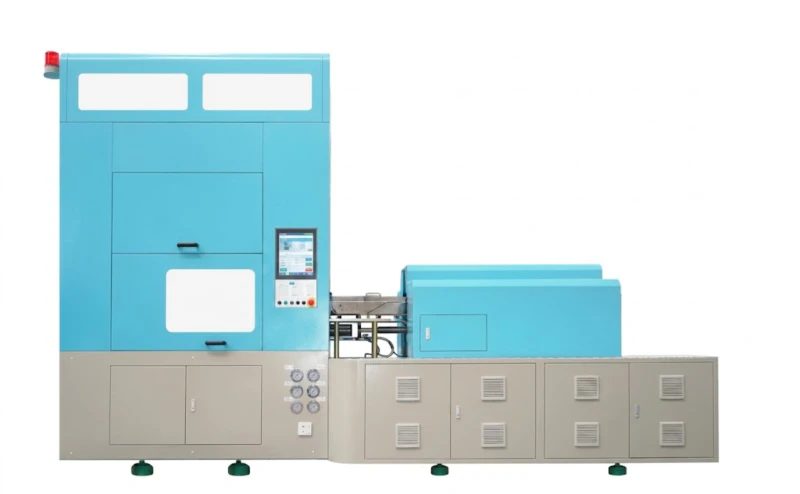
Fig. 2 — The HGY150-V4-EV 4-station full-servo ISBM machine. Station 2 on the rotary turntable is the conditioning station — it holds the preform for 1.5 to 3.5 seconds while active temperature control brings the preform body to a uniform temperature within ±5°C. On a 15g PETG preform, this reduces wall thickness variation from 18–25% (without conditioning) to 8–12% (with conditioning) — moving the bottle from out-of-spec to within the ±15% premium packaging limit.
7. Cost Comparison: Purchase Price, Energy and Output
The 4-station machine costs more than the 3-station machine. Whether that premium is justified depends on the application — and the analysis produces a different result for different bottle types.
For Thin-Wall PET Standard Bottles
- ✓HGY50-V3-EV: USD 65,000 – 85,000 (indicative)
- ✓Lower running power: 24–30 kW vs 32–42 kW
- ✓Faster cycle: 3.5–4.5s vs 4.5–5.5s on thin-wall PET
- ✓Higher BPH at same cavity count on thin-wall PET
- ✗Cannot produce thick-wall or asymmetric bottles at spec
3-station is the correct choice
For Premium Cosmetic / Pharma Bottles
- ✓HGY150-V4-EV: USD 140,000 – 165,000 (indicative)
- ✓Enables thick-wall, asymmetric and PC/Tritan bottles
- ✓Wall thickness variation ±8–12% vs ±18–25%
- ✓ASB-12M mold compatibility — protects existing tooling
- ✓Faster cycle on PETG than 3-station due to shorter injection cooling
4-station is the correct choice
8. Decision Framework: How to Choose for Your Product Range
Apply the following decision criteria in sequence. The first criterion that applies determines your platform:
-
1Do any of your current or planned bottles have wall thickness above 2.0mm? → 4-station requiredThis is not a preference — it is a physical constraint. No process parameter adjustment enables consistent wall thickness at 2.0mm+ in a one-step ISBM machine without conditioning.
-
2Are any bottles non-round in cross-section? → 4-station requiredOval, rectangular, square, faceted or otherwise asymmetric bottles require conditioning to achieve acceptable wall thickness uniformity. This applies even to thin-walled bottles in standard PET if the cross-section is asymmetric.
-
3Are you processing PC or Tritan resin? → 4-station requiredThese resins retain heat longer than PET and PETG. Conditioning is required for all bottle geometries in PC and Tritan, including thin-wall formats.
-
4Do you have existing ASB-12M molds you intend to reuse? → 4-station requiredASB-12M molds are engineered for a 4-station process. They will physically fit a 3-station machine with compatible dimensions, but the bottles they produce will not meet the quality standard the molds were designed to achieve.
-
5If none of criteria 1–4 apply → 3-station is viableThin-wall round PET bottles for pharmaceutical, beverage or standard cosmetic applications in standard PET at normal preform weights can be produced on a 3-station machine at lower cost and potentially higher throughput. The HGY50-V3-EV is the correct platform.
-
6If product range will expand to premium formats within 3 years → consider 4-station nowA machine that is correct today but will be wrong in two years, when you win a premium cosmetics account that requires thick-wall PETG, creates a second capital equipment event that could have been avoided. If product range expansion is a realistic scenario, the 4-station machine provides insurance against early obsolescence.
9. The Most Common Mistakes in 3 vs 4 Station Selection
These are the four errors that account for the majority of post-purchase regret in ISBM machine selection:
Mistake 1: Selecting 3-station because “it is cheaper” without checking bottle geometry
The most common and most expensive mistake. The buyer compares machine prices, selects the 3-station option, orders the machine and molds, installs, and discovers during commissioning that their bottle geometry produces wall thickness variation of 20%+ that the customer will not accept. The machine cannot be upgraded to 4-station — the turntable and frame are different. A second machine must be purchased.
Mistake 2: Assuming parameter adjustment can compensate for the missing conditioning station
Some buyers and even some machine engineers believe that extending injection cooling time or adjusting blow parameters can produce acceptable results on a 3-station machine with thick-wall preforms. It cannot — not at any commercially reasonable cycle time. Extending injection cooling to 8+ seconds reduces output so severely that the machine becomes uneconomic. The thermal gradient in the preform is a physics constraint, not a parameter setting problem.
Mistake 3: Over-specifying 4-station for thin-wall PET production where 3-station is optimal
The reverse error is less catastrophic but still represents a cost that could have been avoided. A manufacturer producing only thin-wall PET pharmaceutical vials on a 4-station machine pays 50 to 80% more for the machine, achieves a longer cycle time than the 3-station equivalent, and uses more energy — with no quality benefit. The conditioning station adds cost and complexity to a process that does not need it.
Mistake 4: Accepting supplier assurance of “ASB compatibility” on a 3-station machine
A 3-station machine with ASB-12M interface dimensions will physically accept ASB-12M molds. The supplier’s “ASB compatibility” claim is technically true in this limited sense. But ASB-12M molds are designed for a 4-station conditioning process — running them on a 3-station machine produces results that fall short of the mold’s designed performance, regardless of interface dimensional compatibility.
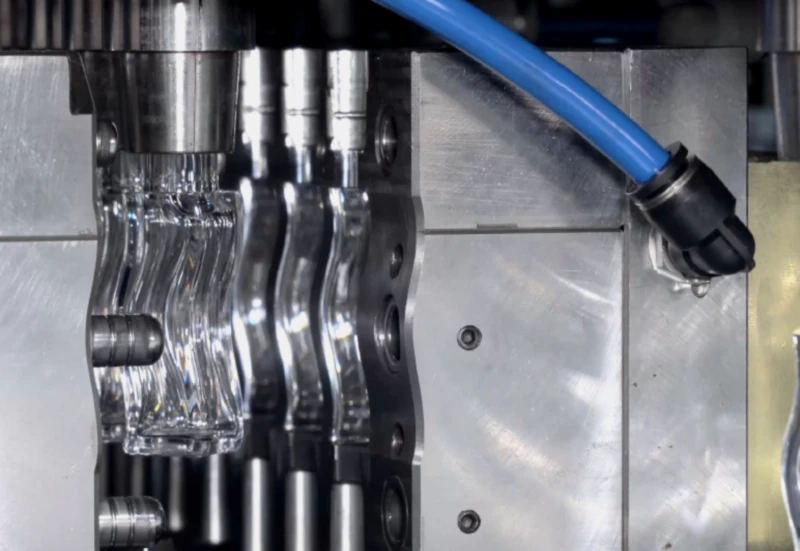
Fig. 3 — ISBM mold assembly. The conditioning station interacts with the preform at this interface — the core pin (still holding the preform) enters the conditioning zone where active temperature control equalises the preform body temperature before it arrives at the blow station. The neck ring (foreground) remains cold throughout. For a thick-wall PETG preform, this step is not an enhancement — it is the mechanism that makes on-specification production physically achievable.
10. Worked Example: Selecting the Right Platform for a Cosmetics Manufacturer
A Russian cosmetics packaging manufacturer is evaluating ISBM equipment for in-house production. Their current product range and planned expansion includes four bottle types. We apply the decision framework to each:
| Product | Resin / Wall | Cross-section | Criterion Triggered | Platform Required |
|---|---|---|---|---|
| 20ml eye serum vial | PETG / 0.8mm | Round | None triggered | 3-station viable |
| 100ml luxury lotion | PETG / 2.5mm | Round | Criterion 1 — wall above 2.0mm | 4-station required |
| 50ml perfume body (oval) | PETG / 1.2mm | Oval | Criterion 2 — non-round | 4-station required |
| 150ml baby wash (BPA-free) | Tritan / 1.0mm | Round | Criterion 3 — Tritan resin | 4-station required |
Three of the four products require a 4-station machine. The fourth (20ml eye serum vial) could be produced on either platform. The correct equipment decision is a single HGY150-V4-EV, which handles all four products. The 20ml vial runs at a slightly longer cycle time on the 4-station machine than it would on the HGY50-V3-EV, but the alternative — purchasing both a 3-station and a 4-station machine — is economically and operationally unjustifiable when all four products can run on one platform. The stable air supply from a dedicated oil-free air compressor for ISBM at 2.0–3.5 MPa is required for consistent blow results across all four product formats on the same machine.
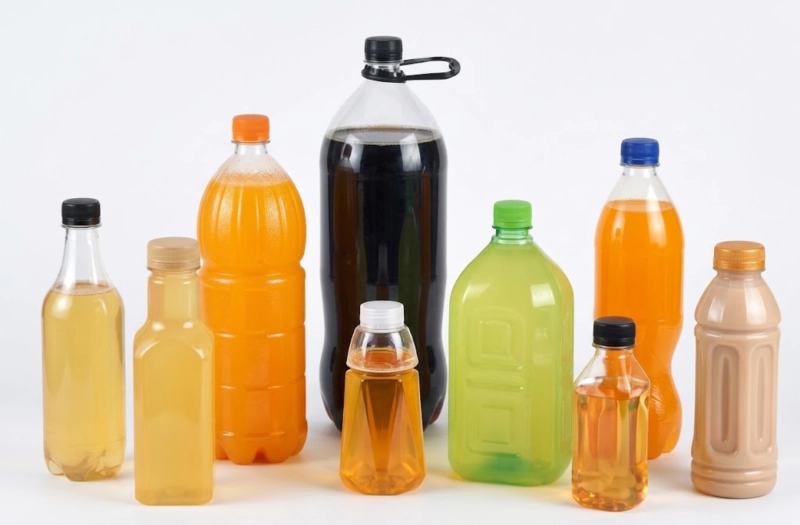
Fig. 4 — Premium PETG cosmetic bottles from the worked example product range. The 100ml luxury lotion bottle (2.5mm wall, round) and the 50ml oval perfume body both require a 4-station machine with active conditioning. The 20ml eye serum vial (0.8mm wall, round) would run on either platform but is produced alongside the others on the HGY150-V4-EV. One machine, four products, full quality compliance.
1. The conditioning station is a physical necessity, not an optional feature. For thick-wall, asymmetric and high-resin-temperature applications, the temperature gradient in the preform cannot be resolved without conditioning. This is materials physics — it cannot be worked around by parameter adjustment.
2. Apply the decision framework before consulting price. The four criteria — wall thickness above 2.0mm, non-round cross-section, PC/Tritan resin, ASB mold library — determine the platform. Only after the platform is determined does price become relevant.
3. A 4-station machine is not slower on PETG. For thick-wall PETG applications, the 4-station machine typically achieves shorter cycle times than a 3-station machine attempting the same preform — because shorter injection cooling is possible when the conditioning station handles temperature equalisation.
4. If any product in your range requires 4-station, specify 4-station for all products. Running a mixed range on a single 4-station machine is more economical than purchasing both platform types. The thin-wall product loses some cycle speed; the complex product becomes achievable.
5. Product range expansion is a legitimate factor in the decision. If there is a reasonable probability that your product range will include thick-wall or asymmetric bottles within the machine’s operating life, specifying 4-station now avoids a capital equipment event that would otherwise be forced by a commercial opportunity you cannot fulfil.
Not Sure Whether Your Bottles Need 3 or 4 Stations?
Send us your bottle drawings or specifications — wall thickness, cross-section geometry, resin and volume. Our engineers will apply the decision framework and confirm in writing which platform is required, and which machine model best matches your production scale.