
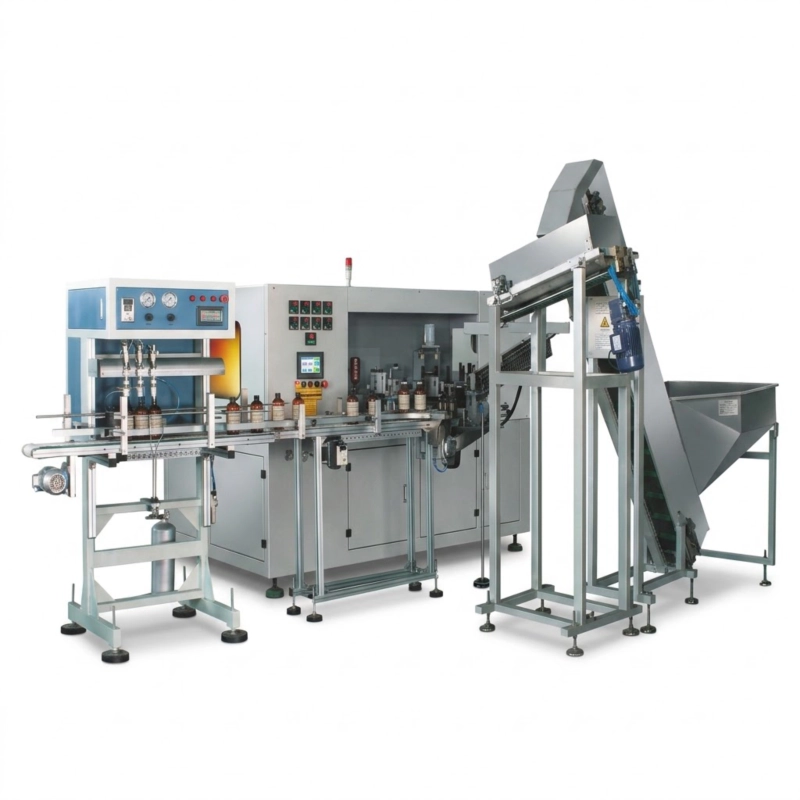
Pesticide Bottle & Chemical Bottle Series Blow Molding Machines
Two-step automatic PET blow molding machines for pesticide, agrochemical & chemical bottles. 12 models, 2–8 cavities, 500 ml–22 L, multi-pitch design, up to 9,200 bph. CE certified. Get a quote.
Pesticide Bottle & Chemical Bottle Series
Blow Molding Machines — Complete Model Guide
► 500 ml – 22,000 ml
► 700 – 9,200 bph
► Multi-Pitch Multi-Cavity
► CE Certified
1. Product Overview
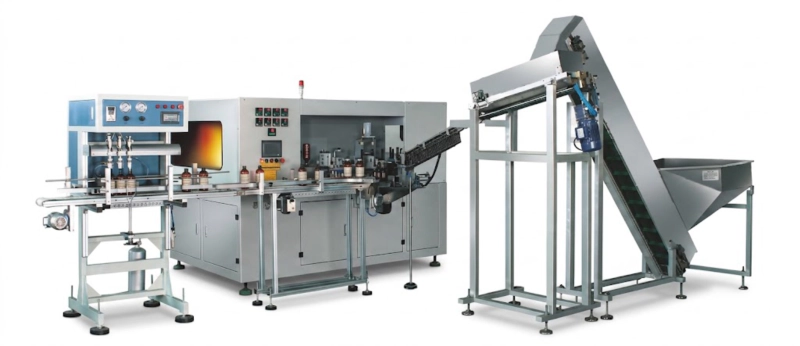
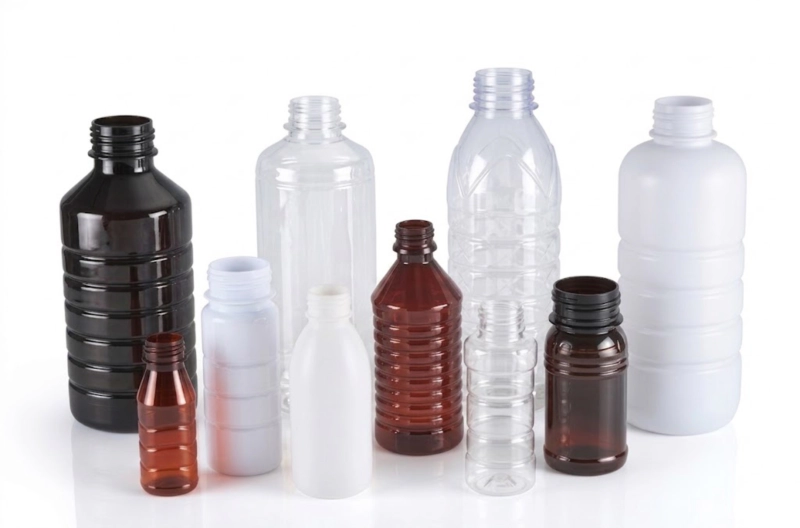
The Pesticide Bottle & Chemical Bottle Blow Molding Machine Series comprises 12 models across the ES and JS sub-series, purpose-configured for the distinct demands of agrochemical and industrial chemical container production. These are multi-pitch, multi-cavity machines engineered to produce pesticide bottles, herbicide containers, fungicide packaging, solvent bottles, industrial cleaning chemical containers, and large-format chemical storage drums with the wall-thickness consistency, chemical barrier properties, and closure-geometry precision that this regulated sector demands.
PET containers produced by two-step stretch blow molding offer decisive advantages over HDPE in the agrochemical and specialty chemical market: superior barrier properties against hydrocarbon and polar solvent permeation, crystal clarity enabling direct visual inspection of product colour and fill level without opening the container, 30–40% weight reduction versus equivalent glass or HDPE, and a single-material recyclability profile increasingly required by agrochemical brand sustainability commitments.
All models adopt servo-electric drive architecture, eliminating hydraulic circuits and reducing energy consumption by up to 35% versus pneumatic-cam competitors. Multi-pitch cavity configurations with independent per-cavity servo stretch-rod control maintain bottle-to-bottle dimensional consistency — critical for automated cap-sealing and induction-seal application on chemical filling lines where off-specification neck finishes cause leakage failures.
Applicable Industries & Applications
✓ Fungicide & Insecticide Containers
✓ Agrochemical Packaging
✓ Industrial Solvent Bottles
✓ Lubricant & Engine Oil Containers
✓ Industrial Cleaning Chemicals
✓ Fertiliser & Growth Regulator Solutions
✓ Specialty Chemical Drums & Canisters
2. Working Principle
All ES-series models operate on the two-step reheat stretch blow molding (RSBM) process. PET preforms are automatically fed, sorted, and conveyed through a multi-zone NIR oven where each zone is independently temperature-controlled. For chemical and agrochemical bottle production, preform wall thickness is typically heavier than equivalent beverage bottles — the oven zone configuration is adjusted to ensure full-wall thermal conditioning without surface overheating that causes stress whitening or optical haze in the finished container.
At the blow station, servo stretch rods extend axially per cavity while low-pressure air initiates radial expansion, followed by a high-pressure blast (26–35 kg/cm² depending on model) driving PET against the cooled mold wall. The resulting biaxial orientation dramatically increases the chemical barrier performance of the PET wall — reducing hydrocarbon permeation rates by up to 3× compared with un-oriented extrusion-blown containers.
The multi-pitch cavity design is a key engineering feature of this series. Unlike single-pitch machines that fix cavity spacing to one bottle diameter, multi-pitch configurations allow the same machine to run different cavity spacings — enabling production of narrow 100 ml pesticide vials on the same platform as wider 1-litre agrochemical containers by substituting mold blocks, without rebuilding the core machine.
Key structural components common to all models: servo-electric toggle-link clamping • per-cavity servo stretch rod • multi-zone NIR oven with neck-protection cooling • automatic preform sorter and inclined feeder • Siemens/Mitsubishi PLC with HMI and recipe storage (up to 50 bottle formats) • inline dimensional rejection before downstream filling.
3. Core Advantages
Superior Chemical Barrier — PET vs HDPE
Biaxially oriented PET offers up to 3× lower hydrocarbon and polar solvent permeation versus extrusion-blown HDPE of equivalent wall weight — extending shelf life of agrochemical formulations and reducing product loss through container wall migration in storage and distribution.
Crystal Clarity — Direct Product Inspection
PET transparency enables end-users to visually verify product colour, fill level, and sedimentation without opening the container — a safety and quality advantage in agrochemical distribution where tamper-evidence and product verification are regulatory requirements in many markets.
Multi-Pitch Multi-Cavity — Format Flexibility
Multi-pitch cavity design allows the same machine to produce different bottle diameters by changing mold blocks and pitch spacers — without rebuilding the machine base. Agrochemical packaging ranges spanning 100 ml vials to 5-litre field containers can be produced on a single platform, reducing capital investment in dedicated single-format machines.
Neck-Finish Precision for Induction Sealing
Per-cavity servo stretch-rod control holds neck-finish diameter variation within ±0.2 mm across all cavities and production shifts — the consistency required for reliable induction-seal application used as child-resistant and tamper-evident closure systems across agrochemical and chemical packaging globally.
Up to 35% Energy Saving — Servo Drive
Full-series servo-electric mold clamping eliminates hydraulic circuits, reducing electricity consumption per 1,000 bottles by up to 35% versus pneumatic-cam equivalents — delivering measurable utility cost savings on agrochemical lines running extended multi-shift production campaigns.
Complete Turnkey Supply
We supply blow molds, preform injection molds, industrial chillers, and oil-free high-pressure compressor packages from a single source — simplifying procurement and ensuring food-grade and chemical-grade compressed air purity compliance for direct-contact chemical bottle production.
4. Technical Specifications
▶ ES Series — Standard Servo Chemical & Pesticide Bottle (2 / 4 / 6 / 8 Cavity, PET)
10 models covering 500 ml to 1,500 ml. Multi-pitch multi-cavity configurations for agrochemical, industrial chemical, and specialty packaging. Neck diameters from 48 mm to 98 mm.
| Parameter / Unit | ES-2C100 | AS-2C114.3 | ES-2C130 | ES-4C76 | ES-4C100 | ES-4C114 | ES-4C130 | ES-6C76 | ES-6C114 | ES-8C76 |
|---|---|---|---|---|---|---|---|---|---|---|
| Cavities | 2 | 2 | 2 | 4 | 4 | 4 | 4 | 6 | 6 | 8 |
| Max. Volume (ml) | 500 | 1,000 | 1,500 | 700 | 800 | 1,300 | 1,500 | 700 | 1,500 | 700 |
| Output (bph) | 2,400 | 2,000 | 1,800 | 4,800 | 4,600 | 3,300 | 3,200 | 7,200 | 5,400 | 9,200 |
| Max. Neck Dia. (mm) | 68 | 88 | 98 | 48 | 68 | 88 | 98 | 68 | 68 | 68 |
| Max. Body Dia. (mm) | 80 | 94 | 110 | 68 | 80 | 94 | 110 | 68 | 94 | 68 |
| Max. Height (mm) | 200 | 260 | 260 | 240 | 250 | 250/330 | 250 | 240 | 250/330 | 250/330 |
| Clamping Stroke (mm) | 110 | 122 | 160 | 100 | 128 | 132 | 148 | 100 | 128 | 100 |
| Stretching Stroke (mm) | 350 | 400 | 350 | 350 | 350 | 400 | 400 | 350 | 350/450 | 450 |
| Preform Holder | 60 | 48 | 60 | 96 | 92 | 100 | 92 | 130 | 96 | 166 |
| Max. Heating Power (kW) | 34 | 45 | 42.5 | 40 | 62.5 | 50 | 68 | 62.5 | 72 | 72 |
| Normal Heating Power (kW) | 8–12 | 20 | 8–13 | 18 | 21 | 25 | 30 | 26 | 32 | 35 |
| Blowing Pressure (kg/cm²) | 26–35 | 35 | 26–35 | 35 | 35 | 35 | 35 | 35 | 35 | 35 |
| HP Air (L/min) | 1,000–1,400 | 1,600 | 1,000–1,500 | 3,900 | 4,000 | 5,000 | 6,000 | 5,800 | 9,500 | 7,500 |
| Cooling Water Flow (L/min) | 30 | 30 | 30 | 30 | 30 | 40 | 40 | 40 | 40 | 40 |
| Machine Size L×W×H (mm) | 2900×1525×1930 | 2660×1660×2150 | 3600×1800×1980 | 3290×1850×2260 | 4170×1930×2340 | 5120×2150×2350 | 5450×2070×2320 | 4690×2000×2000 | 5300×2150×2250 | 5750×2070×2320 |
| Machine Weight (kg) | 2,000 | 2,600 | 3,000 | 3,500 | 4,000 | 5,500 | 6,500 | 5,500 | 6,500 | 8,000 |
▶ JS Series — Large-Format Chemical & Industrial Containers (2 Cavity)
Dedicated large-format platforms for industrial chemical drums and institutional containers up to 22,000 ml. JS-2C200 for 5-litre to 18.9-litre containers; JS-2C366 for up to 22-litre drums. Integrated heating carousel for heavy-wall preforms.
| Parameter / Unit | JS-2C200 | JS-2C366 (20 L) |
|---|---|---|
| Cavities | 2 | 2 |
| Max. Container Volume (ml) | 5,000–18,900 | 22,000 |
| Output (bph) | 1,000 | 700 |
| Max. Neck Diameter (mm) | 58 | 90 |
| Max. Body Diameter (mm) | 180 | 300 |
| Max. Container Height (mm) | 340 | 480 |
| Stretching Stroke (mm) | 450 | 620 |
| Integrated Heating Buffer | 128 preforms | 128 preforms |
| Max. Heating Power (kW) | 65 | 86 |
| Blowing Pressure (kg/cm²) | 35 | 35 |
| HP Air Consumption (L/min) | 5,000 | 12,500 |
| Cooling Water Flow (L/min) | 91.4 | 120 |
| Machine Size L×W×H (mm) | 4100×2150×2350 | 4090×2660×3040 |
| Machine Weight (kg) | 2,500 | 7,000 |
5. Structure & Material Engineering
🛠 Machine Frame
Heavy-gauge welded steel frame, stress-relieved and CNC-machined at all guide-rail and bearing surfaces. The multi-pitch cavity configuration requires a wider mold-platen design than single-pitch machines — the frame is engineered to accommodate variable cavity spacing without resonance amplification at high production speeds.
⚙ Servo-Electric Clamping
Toggle-link servo-electric clamping with no hydraulic fluid — eliminating hydrocarbon contamination risk in chemical production environments and extending maintenance intervals beyond 2,000 operating hours. Chemical bottle molds typically require higher clamping forces than beverage molds due to thicker wall sections; servo clamping delivers consistent force at every cycle position.
🌡 NIR Oven — Heavy-Wall Preform Configuration
Multi-zone NIR quartz-lamp oven with individually controlled zones. Chemical and agrochemical bottle preforms are typically heavier-walled than equivalent-volume beverage preforms, requiring longer zone dwell and higher zone power — oven zone configurations are adjusted for the specific preform weight profile of the application. Neck-protection cooling collar prevents closure-seating surface distortion during heating.
🔓 Chemical-Resistant Mold Materials
Blow mold cavities machined from high-strength aluminium alloy with conformal cooling channels. All mold water-circuit fittings and seals are specified for chilled water with standard corrosion inhibitors. Preform injection molds use imported 2316 mold steel with 420 stainless cavity plates, CNC-machined to ±0.02 mm for consistent induction-seal landing surface geometry.
📱 PLC & Multi-Format Recipe Management
Siemens or Mitsubishi PLC with colour HMI touchscreen. Up to 50 bottle-format recipes stored on-board — critical for agrochemical producers running multiple SKUs (100 ml, 250 ml, 500 ml, 1 L) on the same machine. Format changes including pitch adjustment are documented in the recipe, reducing changeover error and enabling consistent reproduction of validated production parameters.
📈 Inline Rejection System
Dimensional and weight non-conforming bottles are auto-rejected before the downstream conveyor. In agrochemical filling lines where off-specification neck finishes cause induction-seal failures — creating leakage and regulatory non-compliance risk — the inline rejection system provides an essential pre-filling quality gate.
6. Typical Application Scenarios
7. Our Machines vs. European Brand Platforms — Objective Comparison
| Comparison Item | Sidel SBO Series | Krones Contiform | SMI Smiflexi | Sipa SFR EVO | Our Series |
|---|---|---|---|---|---|
| Origin | France | Germany | Italy | Italy | Asia |
| Chemical / Agrochemical Focus | Beverage-primary | Beverage-primary | General purpose | General purpose | Dedicated chemical series |
| Multi-Pitch Cavity Design | Selected models | Selected models | Limited | Limited | Standard — all models |
| Approx. Entry CapEx (4-cav.) | USD 280K – 380K | USD 260K – 360K | USD 180K – 280K | USD 200K – 300K | Significantly lower — direct |
| Servo Drive (standard) | Yes | Yes | Yes | Yes | Yes — all models |
| Spare Parts Lead Time | 4–12 weeks | 4–10 weeks | 4–10 weeks | 4–10 weeks | 3–7 days (stocked) |
| After-Sales Service | Regional agents | Regional agents | Regional agents | Regional agents | Direct + remote video |
| CE Certification | Yes | Yes | Yes | Yes | Yes |
CapEx figures are indicative market estimates. Our pricing is provided by confirmed quotation only.
8. Model Selection Guide
| Your Requirement | Recommended Model |
|---|---|
| Small pesticide vials, 100–500 ml, narrow neck (48–68 mm) | ES-4C76 (4,800 bph) or ES-6C76 (7,200 bph) |
| Agrochemical / pesticide 500 ml–1 L, pilot or mid-volume | ES-2C100 (2,400 bph) or AS-2C114.3 (2,000 bph) |
| Chemical / agrochemical 500 ml–1.5 L, high-volume 4-cavity | ES-4C100 (4,600 bph) or ES-4C114 (3,300 bph) |
| Wide-neck chemical bottle 1–1.5 L, 98 mm neck | ES-2C130 (1,800 bph) or ES-4C130 (3,200 bph) |
| Industrial-scale agrochemical brand, 9,200 bph | ES-8C76 (8 cavity, 9,200 bph) |
| Large-format chemical drum, up to 18.9 L | JS-2C200 (1,000 bph) |
| Extra-large industrial container, up to 22 L | JS-2C366 (700 bph) |
9. Frequently Asked Questions
Explore our full range of two-step and one-step blow molding machines for all packaging categories:
► Browse All Blow Molding Machines
✉ Request a Free Quotation
10. Work with a Specialist Manufacturer
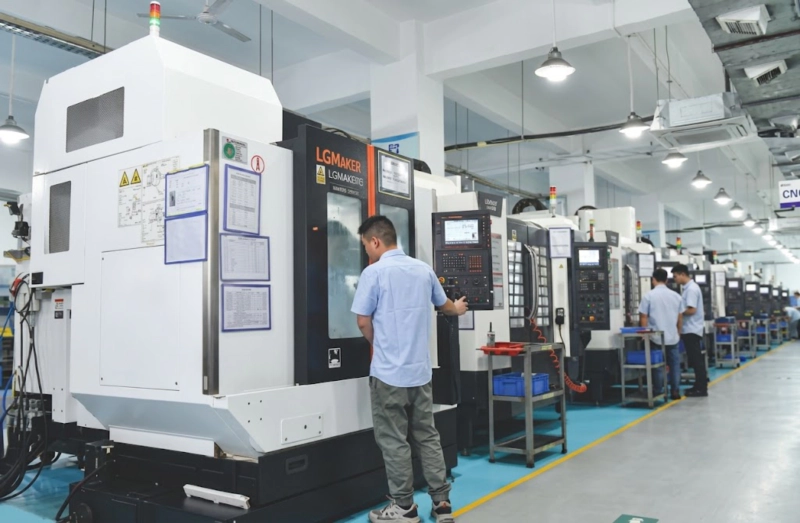
With over two decades of dedicated experience in blow molding machine design, manufacturing, and after-sales service, we supply automatic PET chemical and agrochemical bottle blow molding machines to pesticide brands, agrochemical producers, industrial chemical packagers, and contract filling operations across more than 20 countries. Our production facility operates dedicated CNC machining, mold fabrication, machine assembly, and quality-control departments. Our engineers are available globally for installation, commissioning, and after-sales support.
Whether you are transitioning an existing HDPE agrochemical line to PET, expanding capacity for a growing pesticide brand, adding a high-speed 8-cavity platform to a large-scale chemical filling operation, or specifying a large-format drum molder for industrial chemical bulk-repack, our technical team will provide a no-obligation specification review and delivered-cost comparison within 48 hours of enquiry.