
IBM Machine Buyer Guide • Heavy-Duty Class
An objective, engineering-focused comparison for high-volume packaging manufacturers evaluating 110-to-135-ton class injection blow molding equipment. We analyze clamping force physics, extreme cavitation potential, platen geometry, and how modern machine architecture impacts your cleanroom HVAC costs and total cost of ownership.
At the absolute upper limit of the injection blow molding (IBM) capacity spectrum lies the ultra-high-output class. When global packaging facilities need to run 18-to-24 cavity molds for pharmaceutical vials, or process massive 1,000ml to 2,500ml nutritional packer bottles, standard machines simply lack the required structural rigidity, platen area, and plastification volume. For decades, the Jomar IBM135 and the SUMA 135iB have served as the default North American and European platforms for this extreme workload, prized for their brute strength.
However, capital equipment procurement in this tier has radically shifted. As tooling designs become more efficient and competitive pricing pressures mount on packaging manufacturers, engineering teams are discovering they can achieve the exact same ultra-high-cavitation output on a highly optimized 110-metric-ton platform—without paying the steep capital premium traditionally associated with a 135-US-ton machine. The ZQ110 has emerged as a disruptive European-style alternative, offering massive shot capacity, a highly efficient low-profile footprint, and a true 1,100 kN of hydraulic clamping force.
This article provides a comprehensive technical evaluation framework for facilities looking to retire aging Jomar 135s or SUMA 135iBs, or those aggressively expanding into mega-volume production. We present a factual, deeply detailed comparison of specifications, structural design philosophies, and the transition economics of migrating to the ZQ110 platform.
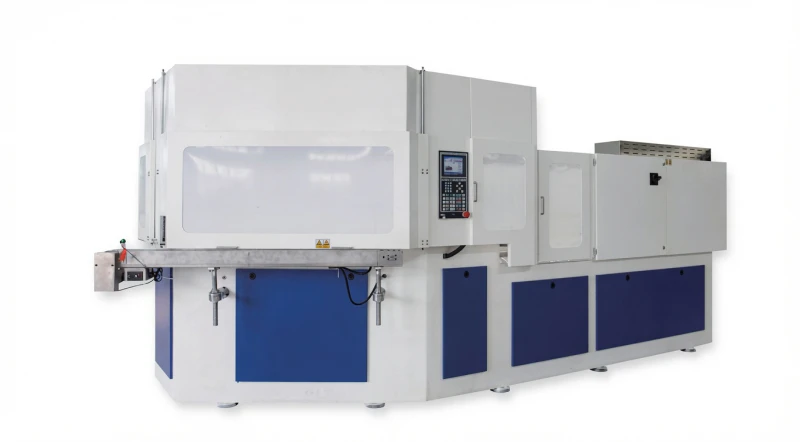
Ultra-High Capacity IBM Machine Evaluation: Assessing the ZQ110 low-profile platform against legacy 135T-class vertical plastifier architectures.
Understanding the 110T–135T Ultra-High Output Tier
Machines in this weight class are colossal engineering achievements, designed to operate 24/7 under immense mechanical stress. The “110T” to “135T” designations refer to the massive hydraulic force required to clamp the injection mold shut—ranging from roughly 1,100 kN (110 metric tons) up to 1,200+ kN (135 US tons). This force is absolutely non-negotiable when dealing with extreme projected surface areas, such as blowing 24 distinct 10ml parisons simultaneously or injecting dense polymer for multi-cavity 1,500ml supplement bottles.
These platforms are reserved for the heaviest, most demanding applications in the global plastics industry: multinational pharmaceutical contracts demanding tens of millions of identical units annually, major nutraceutical brands requiring thick-walled 1L packers with zero tolerance for moisture vapor transmission, and premium cosmetic lines producing heavy, glass-like PCTG jars that require immense packing pressure.
While the ZQ110, Jomar IBM135, and SUMA 135iB all utilize the same core three-station IBM process (Inject, Blow, Strip), their approaches to delivering this force differ drastically. From vertical machine height to platen geometry and total kinetic energy consumption, understanding these structural differences is the key to making a sound 10-year capital investment.
Core Specification Comparison Matrix
The table below illustrates the critical performance parameters across the three platforms, establishing a clear baseline for your procurement and engineering teams.
| Parameter | ZQ110 | Jomar IBM135 | SUMA 135iB |
|---|---|---|---|
| Injection Clamping Force | 1,100 kN | ~1,200 kN (135 US Tons) | 1,200 kN |
| Screw Diameter Options | 65 / 75 mm | 63 / 76 mm | 65 / 75 mm |
| Max Injection Weight (Shot) | 950 / 1,280 g | ~900 / 1,200 g | ~1,100 g |
| Platen Size (L x W) | 900 x 550 mm (Landscape) | ~762 x 584 mm (Portrait) | Portrait Layout |
| Total Machine Height | 2.2 m | 3.8 m+ (approx. 12.5 ft) | 2.9 m+ |
| Total Installed Power | 65 kW (High Efficiency) | ~75 kW | ~60 kW |
| Max Bottle Volume Capability | 2,500 ml + | 2,000 ml | 2,000 ml |
| Fundamental Structural Style | European Low-Profile / Horizontal | Traditional Vertical Plastifier | Vertical Plastifier |
Note: Jomar IBM135 and SUMA 135iB specifications are estimated based on historical published class data and converted to metric for comparative reference only. Actual specifications may vary by specific machine vintage, customizations, and upgrades.
Technical Deep Dive: Do You Really Need 135 Tons of Clamp?
1. The 110T vs 135T Clamping Force Physics
The legacy Jomar 135 and SUMA 135iB boast roughly 1,200 kN of clamping force, whereas the ZQ110 operates at 1,100 kN. The primary engineering question for buyers is: Does your modern tooling actually require that extra 100 kN? Clamping force requirements are dictated by multiplying the projected surface area of the cavities by the polymer injection pressure. In the past, inefficient hot runner systems required massive injection pressures to fill 24 cavities, necessitating 135 tons of clamp to prevent the mold halves from separating (flashing).
Today, advanced hot runner manifolds and more flowable resin grades have lowered required injection pressures. In 95% of standard high-volume applications (including 20+ cavity 10ml vial layouts), a true, evenly distributed 1,100 kN is more than sufficient. Unless you are running ultra-thick-wall 2,500ml jars with excessive parting line surface area, the ZQ110’s clamping system handles the exact same cavitation layouts as the 135T class with absolute rigidity.
2. Unmatched Shot Capacity: The 1,280g Advantage
In the mega-volume tier, total shot weight—the maximum amount of plastic the screw can melt and inject in one cycle—often becomes the production bottleneck long before clamping force does. The ZQ110 can be equipped with a massive 75mm screw, delivering an unparalleled injection weight of 1,280 grams per cycle. This ensures that even when running maximum cavities or heavy-weight cosmetic jars, the injection unit is never starved. It maintains highly homogenous melt quality, prevents unmelted resin specs, and allows for rapid recovery times to keep cycle speeds aggressive.
3. The Vertical Clearance Advantage and Cleanroom HVAC Costs
The traditional vertical plastifier designs of legacy American machines require immense ceiling heights—often exceeding 3.8 meters (12.5 feet) for the machine alone. Once you factor in the overhead space needed for gantry cranes to pull the massive vertical screws or lift molds, you often need 5-meter ceilings. In a GMP pharmaceutical cleanroom, building and maintaining a 5-meter-high ceiling means cooling and purifying a drastically larger volume of air (HVAC cost). The ZQ110 utilizes a European-style low-profile horizontal architecture, bringing the total machine height down to just 2.2 meters. This is a massive hidden cost-saving advantage, allowing installation in standard, lower-ceiling cleanrooms without expensive facility roof modifications or exorbitant HVAC energy bills.
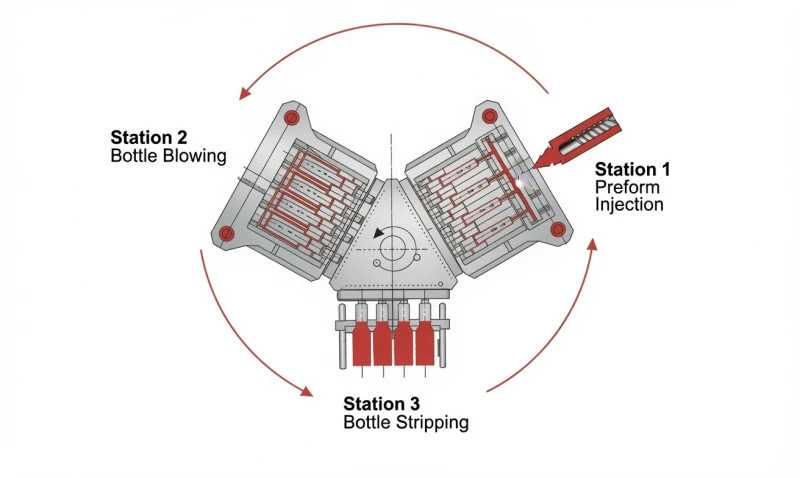
The core three-station IBM continuous motion process is shared across all machines, but the ZQ110 drives it with a highly stable, low-profile hydraulic architecture that reduces vibration.
Extreme Cavitation Output: Maximizing Bottles Per Cycle
When investing in a machine of this magnitude, the entire financial justification hinges on maximizing the cavity count. The ZQ110 features a massive 900 x 550 mm landscape-oriented platen. This extremely wide format is ideal for multi-row layouts (e.g., three rows of eight), keeping parisons closer to the central injection manifold to ensure balanced thermal profiles. Below is the estimated cavitation capacity for the ZQ110, standing toe-to-toe with legacy 135T class output expectations.
| Bottle Volume | ZQ110 Max Cavities | Typical 135T Output |
|---|---|---|
| 10 ml – 15 ml | 18 – 24 | 18 – 24 |
| 30 ml | 14 – 16 | 14 – 16 |
| 60 ml | 12 – 14 | 12 – 14 |
| 100 ml | 10 – 12 | 10 – 12 |
| 500 ml | 6 – 8 | 6 – 8 |
| 1000 ml | 3 – 4 | 3 – 4 |
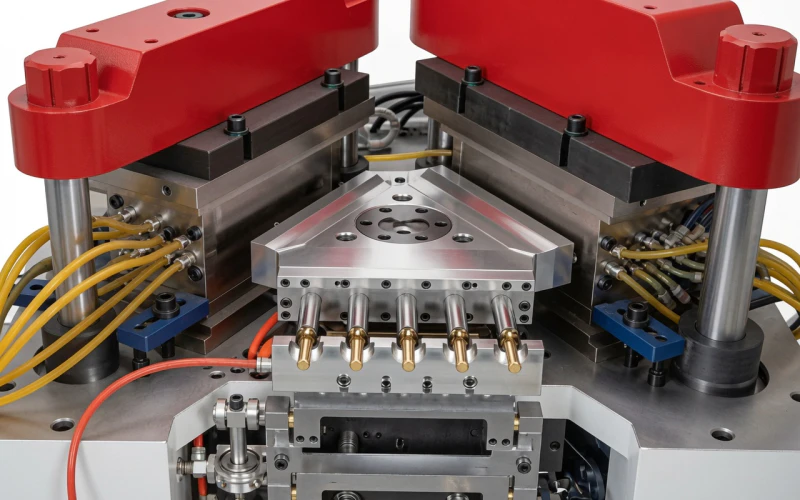
Running 20+ cavity layouts safely requires massive, evenly distributed clamping force to prevent parting-line flash and protect precision tooling.
Tooling Transfer Engineering: Can You Use Existing 135T Molds?
If your facility is looking to replace an aging IBM135 or SUMA 135iB, mold compatibility is often the primary friction point raised by production managers. The ZQ110 uses a massive 900 x 550 mm landscape platen (wider than it is tall), while legacy American machines generally utilized narrower portrait orientations. Direct plug-and-play bolting of an entire 135T mold assembly into the ZQ110 is highly unlikely without adaptation.
However, a complete tooling write-off is rarely necessary. The most expensive and critical components of your mold—the core rods, precision neck rings, the hot runner manifolds, and the cavity inserts—can typically be salvaged and transferred. Your toolmaker will need to invest in engineering new backing plates, die sets, and potentially adjusting the water cooling channels to align with the ZQ110’s landscape platen layout. Buyers should mandate a formal tooling adaptation feasibility study and secure a firm quote for this conversion cost during the procurement phase to accurately calculate the total transition ROI over a 5-year timeline.
Target End-Use Applications for the ZQ110
The ZQ110, much like the traditional 135T platforms, seamlessly processes standard thermoplastics (HDPE, LDPE, PP, PS) as well as demanding specialty resins (PCTG, ABS, PLA). It is engineered to dominate in these three specific manufacturing sectors:
Mega-Volume Pharma
20+ cavity layouts for high-demand vaccines, eye drops, and nasal spray bodies requiring strict FDA validation.
Bulk Nutraceuticals
High-weight 1,000ml to 2,500ml vitamin and sports protein powder packers requiring flawless moisture barriers.
Luxury Cosmetics
Multi-cavity runs of ultra-thick PCTG jars imitating glass, requiring intense injection packing for optic clarity.
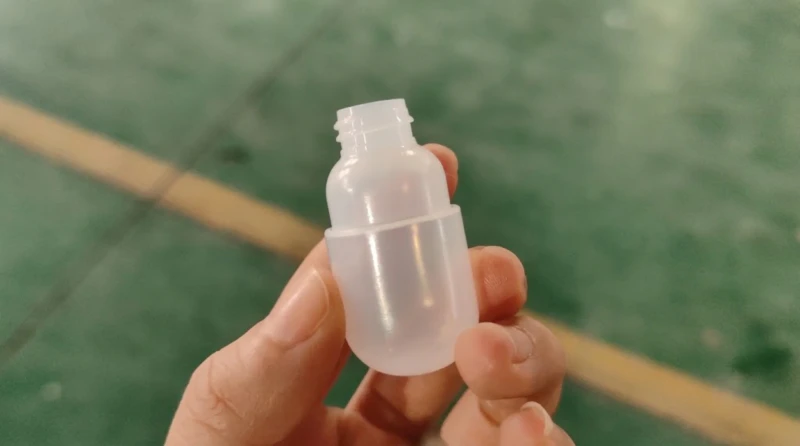
Typical output: The ZQ110 produces the same zero-flash, precision-neck containers as legacy 135T platforms, completely eliminating downstream trimming.
Utility Demands: Preparing the Factory for 20+ Cavities
A critical engineering oversight when planning for 110T–135T class machinery is the massive volume of high-pressure air required. When you are simultaneously expanding 24 thick-walled parisons in the blow station every 12 to 14 seconds, utility consumption skyrockets. A sudden pressure drop in your air lines will result in incomplete parison expansion, leading to uneven bottle walls and massive scrap rates.
The ZQ110 requires a robust, dedicated baseline of roughly 1.5 to 2.0 m³/min of compressed air at pressures up to 1.2 MPa. Furthermore, because these machines almost exclusively serve the sensitive pharma, food, and premium cosmetic sectors, this immense air volume must be 100% oil-free (Class 0) to meet rigorous GMP compliance. Budgeting for an industrial-scale, oil-free screw air compressor alongside the machine purchase is absolutely mandatory for a successful installation.
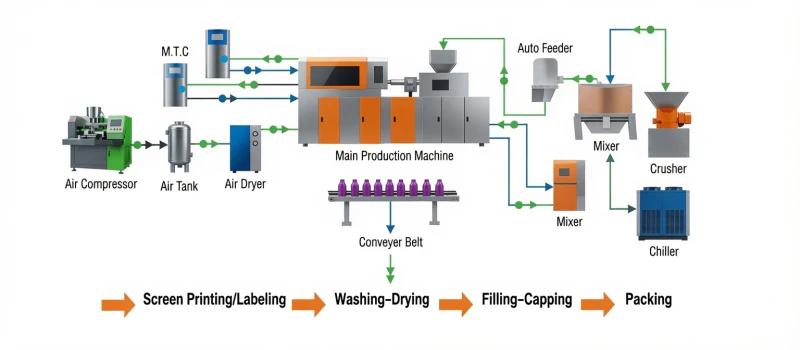
Ultra-high-volume lines require robust auxiliary integration, including heavy-duty chillers, material dryers, and dedicated Class-0 oil-free air compressors to prevent bottlenecking the machine’s speed.
Summary: Which Platform Fits Your Factory’s Future?
Ultimately, deciding between maintaining the 135T legacy path or migrating to the modern ZQ110 architecture comes down to the specifics of your factory setup, your energy goals, and your existing mold library:
✅ The ZQ110 is the strongest financial fit if:
- You are buying new ultra-high-cavity tooling for a new contract and aren’t tied to a legacy portrait platen layout.
- Your cleanroom or factory ceiling is standard height, physically prohibiting the 3.8m+ vertical clearance required by legacy platforms.
- You need maximum 135T-class production capability without paying the 135T capital equipment price premium.
- Your parts are exceptionally heavy (up to 1,280g total shot weight) but do not mathematically require more than 1,100 kN of clamp force.
- Energy efficiency and reducing total installed kW power is a corporate sustainability objective.
💡 Sticking with the Jomar/SUMA 135T tier is logical if:
- Your facility has an extensive, highly specialized library of portrait-layout 135T molds that cannot be economically retrofitted.
- Your strict FDA regulatory compliance requires a direct, identical 1:1 hardware replacement of an existing validated machine to avoid re-qualification.
- You are running highly unusual, extremely wide, thick-walled parts that genuinely generate parting-line forces exceeding 1,150 kN.
Next Steps for Procurement Evaluation
If your company is actively sourcing high-tonnage IBM equipment for a facility upgrade or expansion, we recommend taking the following immediate steps to build a data-driven business case:
Verify True Clamp Requirements: Review your mold data sheets and speak with your toolmaker. Calculate your projected surface area. Determine if you actually need 1,200+ kN, or if the ZQ110’s 1,100 kN is more than sufficient for your specific part geometries.
Assess Tooling Migration Costs: If bringing old molds, do not guess on transition costs. Request a formal quotation from your machine shop specifically for manufacturing new backing plates to adapt to the 900 x 550 mm landscape platen.
Calculate Total ROI and Energy Savings: Combine the acquisition price of the ZQ110, plus mold adaptation, shipping, and estimated HVAC/Energy savings over 5 years. Compare this holistic TCO directly against the quote for a brand new 135-ton legacy unit.
⚠ Brand Reference Notice: The names Jomar and SUMA, along with model designations such as IBM135 and 135iB, are the respective intellectual properties of their manufacturers. This article references these historical class specifications for educational, comparative engineering purposes only. We do not manufacture, represent, or sell Jomar or SUMA equipment. Data regarding legacy platforms is estimated from publicly available historical materials and may not reflect current OEM offerings or custom machine upgrades. Always consult the original manufacturers directly for updated specifications.
Evaluating the ZQ110 for Your Next Major Expansion?
Access the complete technical profile of the ZQ110 — review full parameter tables, 20+ cavity layout schematics, precise platen dimensions, and contact our engineering team directly for a capital equipment quotation tailored to your facility.