Industry Context
Why Baby & Infant Packaging Demands the Highest Manufacturing Standard
There is no consumer more scrutinised than the parent buying for an infant. When a father picks up a baby feeding bottle in a pharmacy, he is not just evaluating a product — he is making a safety decision for someone who cannot protect themselves. He will check the material certification label, look for BPA-free markings, examine the surface for scratches that might harbour bacteria, and assess whether the nipple fitment looks precise enough to prevent air ingestion. Every one of these evaluations is a quality test that the manufacturing process must pass before the product ever reaches the shelf.
The global baby care packaging market is growing at over 5% CAGR, driven by rising birth rates in emerging markets, increasing disposable income among young parents, and the rapid premiumisation of infant product categories across Asia, the Middle East, and Eastern Europe. Within this growth, the shift from glass to high-performance plastic — particularly Tritan, PC, and PETG — is accelerating as brands seek packaging that combines the optical clarity parents associate with purity with the shatter resistance and lighter weight that practicality demands.
The technology that delivers both — optical clarity, material safety, contamination-free production, and dimensional precision — in a single, automated process is the ISBM Machine. One-Step Injection Stretch Blow Molding is the production architecture that infant product brands choose when they refuse to compromise on any dimension of product safety or quality.
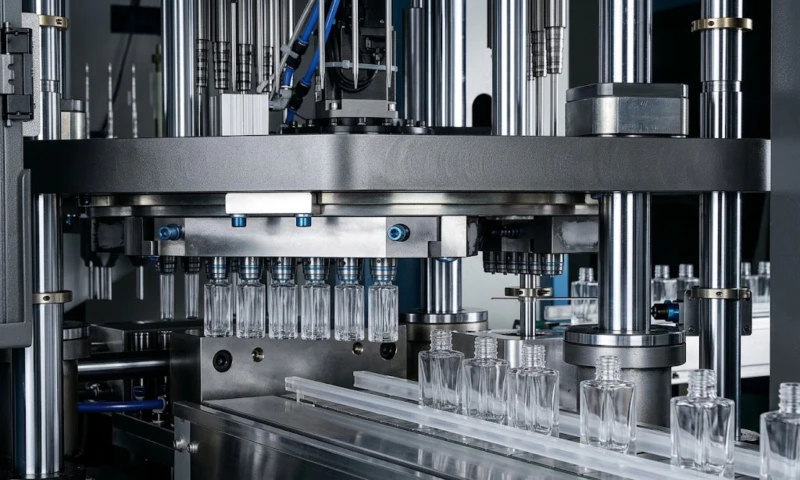
Fig. 1 — A fully automatic One-Step ISBM Machine in operation: the integrated 4-station rotary platform processes Tritan, PC, PP, and PETG from raw resin to finished baby bottle in a single continuous cycle — delivering the BPA-free clarity and zero-contamination production that infant product brands require.
Application Scenes
Core Application Scenes: Baby Bottles to Infant Skincare
The baby and infant product category spans a wide range of container formats, material requirements, and safety standards. What unites every application is a single non-negotiable requirement: the container must never pose any risk to the child who will use it. The Injection Stretch Blow Molding Machine addresses this requirement through material versatility, process purity, and dimensional control that no other blow molding technology can match across the full infant product range.
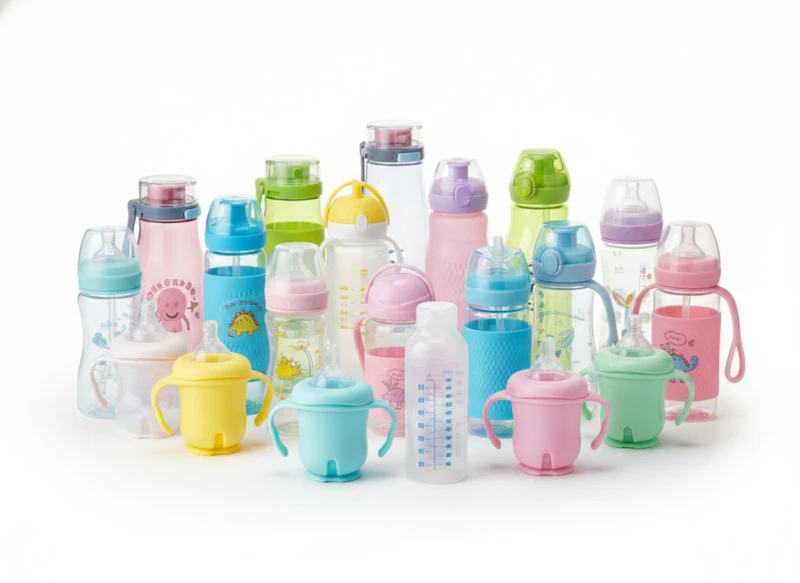
Fig. 2 — Precision-produced containers from our One-Step ISBM Machine: crystal-clear, BPA-free bottles across Tritan, PC, PETG, and PET — demonstrating the optical quality and surface perfection that infant product brands and parents demand.
Material Safety
The BPA-Free Imperative: Material Safety for Infant Products
Bisphenol A (BPA) was identified as a potential endocrine disruptor in the early 2000s and subsequently banned from infant feeding products in the EU (2011), USA (2012), and progressively across all major regulatory jurisdictions. Today, BPA-free certification is not a marketing differentiator — it is a regulatory baseline that every infant container must meet before market entry. What has evolved since then is the consumer expectation that goes beyond BPA: parents now specifically seek out Bisphenol-S (BPS) and Bisphenol-F (BPF) free materials as well, making the choice of resin system — and the process used to convert it — a frontline brand and regulatory concern.
| Resin | BPA/Chemical Safety | Key Properties for Infant Use | Primary Baby Applications |
|---|---|---|---|
| Tritan™ | ✔ BPA, BPS & BPF free FDA & EFSA compliant |
Glass-like clarity, dishwasher safe, impact resistant, odour/taste neutral, wide temperature range | Feeding bottles, sippy cups, food storage jars, sports bottles, premium nursery accessories |
| ПК | ⚠ Traditional PC contains BPA BPA-free PC grades available |
Maximum impact resistance, near-glass optical depth, autoclavable, superior scratch resistance | Premium feeding bottles (BPA-free grades), reusable toddler cups, medical-grade infant containers |
| ПП | ✔ BPA-free by nature USP Class VI, FDA food contact |
Lightest weight, excellent chemical resistance, sterilisable, low extractable profile, flexible squeeze | Feeding bottles, medicine dispensers, food pouches, disposable infant care containers |
| ПЭТГ | ✔ BPA-free FDA & EU food contact approved |
Superior optical clarity, good impact resistance, chemical resistance to mild detergents, laser-engravable | Premium infant skincare bottles, baby lotion dispensers, high-end nursery accessories |
| ДОМАШНИЙ ПИТОМЕЦ | ✔ BPA-free FDA & EU food contact approved |
High clarity, good strength-to-weight, wide availability, low cost, excellent barrier properties | Baby wash bottles, infant medicine droppers, travel-size baby care containers |
Important — Beyond BPA: Regulatory requirements continue to evolve. The EU’s REACH regulation and California’s Proposition 65 increasingly scrutinise a wider range of bisphenols and plasticiser compounds in food-contact and infant-contact materials. Tritan copolyester, manufactured by Eastman Chemical, remains the only commercially available clear plastic that has been independently tested and confirmed free of BPA, BPS, and BPF estrogenic and androgenic activity — making it the preferred resin for infant feeding products in premium and regulatory-risk-sensitive markets.
Process Safety
Why Closed-Process ISBM Is the Safety Standard for Infant Containers
Choosing BPA-free Tritan is the first material safety decision for an infant feeding bottle. The second — equally important and far less discussed — is the process by which that Tritan is converted into a container. A container produced from perfect resin in a contaminated process is not a safe container. The one-step ISBM architecture is the only blow molding process that eliminates manufacturing contamination pathways by design.
Sealed Production Environment
From injection moulding to robot-arm ejection, the preform is never exposed to the ambient environment. No dust, no airborne particulates, no microbial contamination from the production floor — a property that is effectively impossible to achieve in two-step processes where preforms travel through open handling systems.
Zero Mould Release Chemistry
The injection stretch blow process does not require mould release agents of any kind. This eliminates a primary chemical contamination source that affects both the container’s inner surface (which contacts the infant’s food or drink) and its outer surface (which the parent handles). No release agent migration. No residue wash-off required.
Zero Plastic Particle Generation
In two-step RSBM production, preform-on-preform contact in bulk storage and vibratory hoppers generates plastic micro-particles that can deposit inside the container. The ISBM sealed process eliminates every one of these contact events — no particle generation at storage, no particle generation at infeed, no particle generation at ejection.
No Moisture-Driven Material Degradation
Tritan, PC, and PETG are hygroscopic resins. In two-step production, preforms absorb ambient moisture during storage, causing hydrolytic chain scission when reheated — reducing molecular weight, increasing extractable oligomers, and potentially compromising food contact compliance. The ISBM process eliminates the storage period entirely, preventing moisture absorption before it begins.
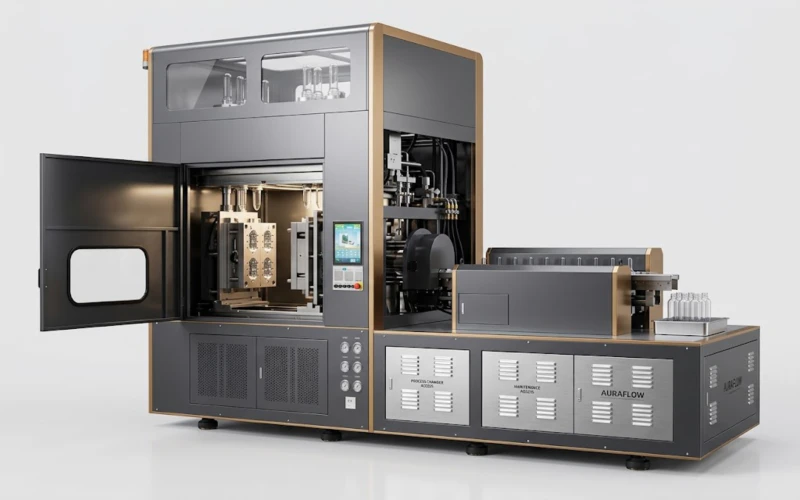
Fig. 3 — One-Step Blow Molding Machine demonstration: the sealed 4-station rotary process integrates injection, conditioning, stretch blow, and robot-arm ejection in a single continuous cycle — eliminating every contamination pathway that makes two-step production unsuitable for infant-contact containers.
Quality Advantages
Quality Advantages That Win Parental Trust
Parents do not read material specifications on the factory floor — they make purchasing decisions in 30 seconds at a pharmacy shelf. The quality characteristics produced by the ISBM Machine are the qualities that translate to immediate parental confidence: a bottle that looks pure, feels safe, and performs reliably every single time.
“The ISBM platform is our production standard for all infant feeding and nursery care containers. The combination of BPA-free Tritan, closed-process sterility, and zero-scratch surface finish is exactly what premium infant brands and their retail partners require. There is no viable alternative process for this application category.”
— Senior Packaging Engineer, Premium Infant Product Brand
Procurement Guide
Procurement Guide: Specifying an ISBM Machine for Baby Product Production
For manufacturers entering or expanding in the baby and infant product segment, the following criteria define the machine specification that delivers the quality, safety, and compliance outcomes required. These are the questions to put to any machine supplier before committing to a platform.
| Specification | Baby Product Minimum Requirement | Why It Matters |
|---|---|---|
| Process architecture | One-step closed process mandatory | Eliminates contamination pathways inherent in two-step bulk handling — required for infant-contact container production |
| Tritan™ processing capability | Documented with measured optical results | Tritan has a demanding process window — request haze and transmittance data from Tritan production runs before purchase |
| Mould release agent requirement | Zero — confirm in writing | Release agents on food-contact surfaces require migration testing — elimination removes the test requirement and the safety risk simultaneously |
| Material certifications | FDA, EU 10/2011, BPA-free, food contact | Infant product retail listings across major markets require these certifications — confirm the supplier supports their documentation |
| Neck thread tolerance | ±0.05 mm measured and documented | Teat assembly, sippy cup valve, and straw cap fitment performance all depend on consistent neck geometry — demand dimensional measurement data |
| Conditioning temperature control | ±1–2°C per zone, independently controlled | Critical for Tritan and PC optical quality — determines whether haze remains below 2% consistently across the production run |
| Drop impact test compatibility | Request test data at 1.5m onto hard surface | Many infant product retail standards require drop impact compliance — biaxially oriented bottles from ISBM consistently outperform non-oriented alternatives in drop testing |
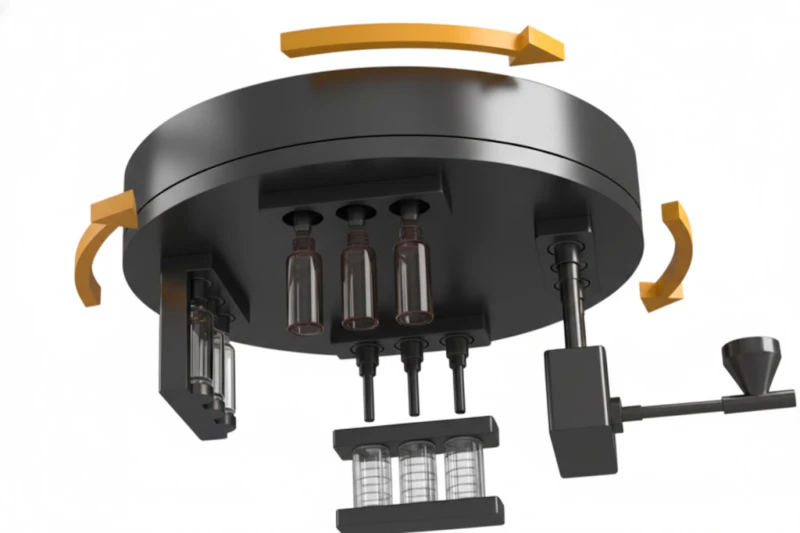
Fig. 4 — ISBM equipment 4-station demonstration: the fully automatic rotary platform integrates injection moulding, temperature conditioning, stretch blow moulding, and robot-arm ejection in one sealed cycle — the production system that delivers BPA-free clarity, zero contamination, and neck precision for every baby bottle produced.
The infant product market holds every manufacturer to a standard that no other consumer category demands: the standard that is set not by a regulatory agency, but by a parent who has decided to trust your product with their child. Meeting that standard requires the right material, the right process, and the right machine. The material is Tritan, PC, or PP — BPA-free and food-contact certified. The process is closed-loop one-step injection stretch blow molding. And the machine is the ISBM Machine — delivering safety, purity, and precision in every cycle, for every bottle, without exception. For manufacturers ready to build a production line that earns and holds parental trust, our One Step Blow Molding Machine platform is where that commitment begins.
Baby & Infant Product Packaging · 20+ Years Industry Experience
Specializing in ISBM machine applications for infant-contact, food-contact, and safety-regulated packaging environments. Experience spans Tritan feeding bottle qualification, BPA-free container certification, and infant care packaging validation across PP, PETG, PC, and Tritan resin systems. Published in association with injectionstretchblowmolding.com — a leading One-Step Injection Stretch Blow Molding Machine manufacturer backed by 20+ years of manufacturing excellence (est. 2003), trusted by global infant product brands.