Industry Context
Why Pharmaceutical Packaging Sets the Highest Standard in Blow Molding
No sector places higher demands on a plastic container than pharmaceuticals and medical applications. The bottle that holds a patient’s eye drops, oral antibiotic, or injectable rinse solution is not evaluated on aesthetics — it is evaluated on whether it will protect drug efficacy, prevent contamination, deliver the correct dose, and maintain integrity across a defined shelf life under validated storage conditions.
These requirements translate into a set of manufacturing specifications that most blow molding technologies simply cannot meet. Contamination control, dimensional precision at the neck and body, barrier performance against moisture and oxygen, and the ability to process materials with specific chemical compatibility profiles — all of these parameters must be delivered consistently, batch after batch, to regulatory standards that carry legal and patient safety implications.
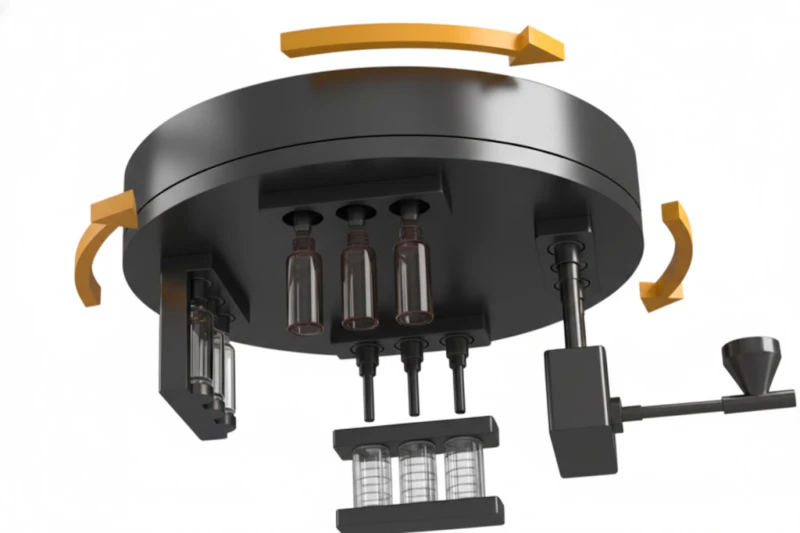
The ISBM Machine — specifically the one-step injection stretch blow molding architecture — addresses every one of these requirements through a process design that is structurally superior to two-step alternatives for pharmaceutical applications. Its closed-process architecture, precision conditioning system, and injection-moulded neck geometry make it the preferred platform for pharmaceutical container manufacturers worldwide, and the technology behind the oral liquid bottles, eye dropper vials, and nasal spray containers produced by leading global pharmaceutical brands.

Fig. 1 — Pharmaceutical and medical containers produced on a One-Step ISBM Machine: the closed-process architecture ensures zero intermediate contamination, while injection-moulded neck precision guarantees closure and dropper fitment that meets pharmacopoeial dimensional standards.
Application Scenes
Core Application Scenes: From Oral Liquids to Eye Droppers
Pharmaceutical and medical packaging encompasses one of the widest ranges of container specifications in any industry — from 5 ml ophthalmic vials to 500 ml irrigation solution bottles, and from simple oral liquid containers to precisely dimensioned dropper assemblies where a 0.1 mm deviation at the neck can affect the accuracy of every dose delivered. The Injection Stretch Blow Molding Machine handles this full spectrum on a single platform.
Process Architecture
Why Closed-Process Architecture Is Non-Negotiable for Pharma
In pharmaceutical manufacturing, contamination is not a quality issue — it is a patient safety issue with regulatory and legal consequences. The container that will hold a patient’s medication must arrive at the filling line in a condition that meets USP, Ph. Eur., and regional pharmacopoeial standards for cleanliness, freedom from particulates, and freedom from residual manufacturing aids.
This is precisely where the one-step ISBM process’s structural advantages over two-step RSBM are most consequential. In two-step production, preforms travel through a bulk storage and handling chain before reaching the blow machine — a journey that introduces particulate contamination, moisture, and the physical contact damage that generates plastic particles inside the containers. In the one-step ISBM process, this contamination pathway does not exist.
“For pharmaceutical applications, the single most important process specification is not dimensional tolerance or optical clarity — it is the guarantee that the container interior has never been exposed to an uncontrolled environment between resin melt and product filling. Only the one-step ISBM architecture provides that guarantee by design.”
— Pharmaceutical Packaging Qualification Engineer, 15+ Years GMP Production Experience
Materials Engineering
Material Selection Guide for Pharmaceutical Containers
Material selection for pharmaceutical containers is governed by pharmacopoeial standards, drug-container compatibility data, and the specific mechanical and barrier requirements of the dosage form and delivery system. Our ISBM Machine platform supports the full range of pharmaceutical-grade resins.
| Resin | Pharma-Relevant Properties | Primary Applications | ISBM Process Advantage |
|---|---|---|---|
| PET | Good chemical resistance, high clarity, low moisture transmission, FDA/EU approved | Oral liquids, vitamins, nasal sprays, disinfectants | Single thermal cycle prevents cold crystallisation; biaxial orientation enhances barrier and reduces permeability |
| PETG | Excellent chemical resistance to alcohols, inherently amorphous, highest clarity, low extractables | Alcohol-based sanitisers, eye droppers, premium supplement bottles | Narrow thermal window requires ISBM precision conditioning; two-step NIR reheat causes surface haze in PETG |
| PC | Autoclavable, high impact resistance, optical clarity, wide temperature range | Reusable medical containers, laboratory bottles, diagnostic equipment | PC is highly hygroscopic — bulk storage causes hydrolytic degradation; closed ISBM process is essential |
| PP | BPA-free, broad chemical resistance, sterilisable, very low leachable profile, USP Class VI compliant | Oral liquids, eye droppers, irrigation containers, multi-dose dispensers | ISBM delivers superior clarity and dimensional precision vs. EBM for PP pharmaceutical containers |
| Tritan™ | BPA/BPS-free, dishwasher-safe, low extractables, glass-like clarity, FDA compliant | Reusable patient containers, premium nutraceuticals, clean-label health supplements | Demanding process window requires ISBM precision conditioning — two-step cannot reliably maintain optical consistency |
Important — Extractables & Leachables Consideration: All pharmaceutical container materials processed on the ISBM platform undergo biaxial orientation during the blow stage. This molecular alignment significantly reduces wall permeability and increases polymer chain density — resulting in lower extractable and leachable migration rates compared to non-oriented containers produced by extrusion blow moulding. This property is increasingly recognised in ICH Q1B and USP <661> container qualification studies.
Precision Engineering
Dimensional Precision: The Detail That Determines Drug Delivery Safety
In pharmaceutical packaging, a dimensional tolerance is not a manufacturing specification — it is a patient safety parameter. The neck thread dimensions of an oral liquid bottle determine whether the measured-dose dispensing cap delivers 5.0 ml or 4.7 ml per actuation. The body diameter of an eye dropper determines whether the dropper assembly maintains its seal. The wall uniformity of a nasal spray bottle determines whether the actuation force is consistent over the product’s rated use life. These are not quality metrics. They are the engineering foundation of drug delivery accuracy.
Injection-Moulded Neck Geometry
In the ISBM process, the bottle neck is injection-moulded at Station 1 and is dimensionally set before any stretching or blowing occurs. It is never deformed by handling, transport, or secondary heating. The result is neck thread dimensions of ±0.05 mm — the precision standard required for child-resistant closures, metered-dose dispensers, and dropper assemblies under pharmacopoeial interface specifications.
Wall Thickness Uniformity
Uniform preform conditioning temperature produces symmetric biaxial stretch — delivering wall thickness uniformity of ±0.05 mm across the bottle body and base. This uniformity prevents hot spots (areas of thin wall) that can deform under temperature cycling during sterilisation, storage, or distribution, compromising container integrity and closure performance.
Body Diameter Consistency
Consistent body diameter is essential for containers that are labelled by roll-on labelling machines, filled on volumetric filling lines, and capped by torquing equipment. All of these downstream operations are calibrated to specific bottle body tolerances. The ±0.3 mm dimensional stability of ISBM-produced bodies ensures compatibility with standard pharmaceutical filling and packaging line equipment without adjustment.
Cycle-to-Cycle Repeatability
Fully servo-electric machine drives eliminate the pressure and flow variability inherent in hydraulic systems. Combined with PID-controlled conditioning temperatures, the ISBM machine delivers dimensional repeatability that remains within specification across millions of cycles — a critical property for pharmaceutical batches where 100% conformance to registered container dimensions is required for regulatory compliance.
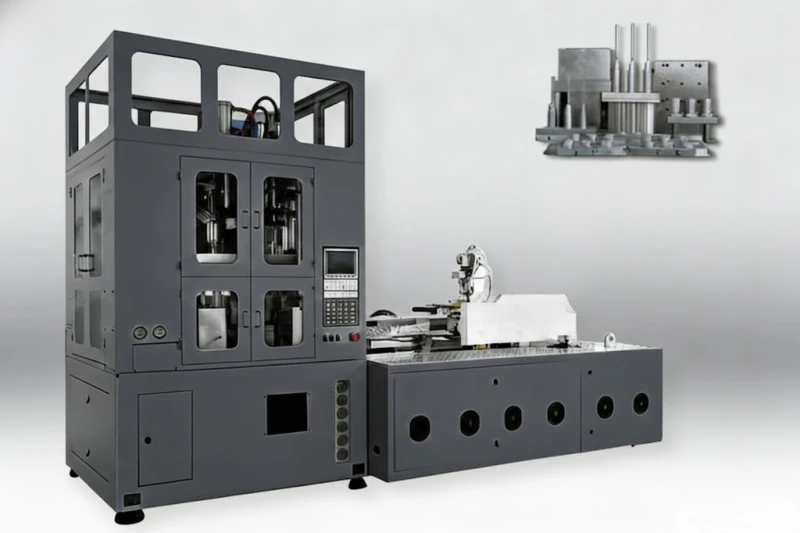
Fig. 3 — Dimensional precision verification for pharmaceutical containers: neck thread accuracy of ±0.05 mm and wall thickness uniformity of ±0.05 mm are mandatory specifications for drug delivery safety — achievable consistently on the ISBM platform through servo-electric closed-loop control.
Procurement Guide
Procurement Guide: Specifying an ISBM Machine for Pharmaceutical Production
Specifying a blow molding machine for pharmaceutical applications requires a more rigorous evaluation than standard packaging machinery procurement. The following criteria define the minimum specifications for a machine intended to produce pharmaceutical-grade containers — and the questions every pharmaceutical packaging procurement team should ask before issuing a purchase order.
| Specification Parameter | Pharma-Grade Minimum Requirement | Why It Matters |
|---|---|---|
| Process architecture | One-step closed process mandatory | Two-step bulk handling introduces contamination pathways incompatible with pharmaceutical GMP requirements |
| Neck thread tolerance | ±0.05 mm measured and documented | Required for child-resistant closure and metered-dose dispenser fitment conformance to Ph. Eur. / USP specifications |
| Temperature control resolution | ±1–2°C per conditioning zone | Ensures uniform preform conditioning for consistent wall thickness and barrier performance across every cycle |
| Drive system | Fully servo-electric preferred | Servo-electric eliminates hydraulic oil contamination risk and delivers the cycle-to-cycle repeatability required for pharmaceutical batch consistency |
| Mould release requirement | Zero — injection stretch blow process requires none | Release agents are a primary extractable source in pharmaceutical containers; elimination removes this risk from the container validation programme |
| Material documentation | FDA/EU food contact, USP Class VI certificates | Required for pharmaceutical container regulatory submission dossiers under ICH Q1B and regional pharmacopoeial standards |
| Process data logging | Cycle-level parameter recording | GMP batch record requirements mandate documented evidence of process parameters for every production batch — real-time logging from machine PLC is the most efficient compliance path |

Fig. 4 — ISBM Machine in pharmaceutical production: the clean, organised production environment and fully closed process architecture align with GMP facility requirements and support the validation documentation that pharmaceutical container qualification demands.
Pharmaceutical packaging is unforgiving. There is no tolerance for contamination, no acceptable rate for dimensional non-conformance, and no second chance when a drug delivery system fails at the point of patient use. The container specification that meets these standards begins with the process that makes it — and in blow molding, that process is the ISBM Machine. Its closed architecture, injection-moulded precision, servo-electric control, and zero-contamination ejection system make it the only blow molding technology whose fundamental process design is aligned with the patient safety requirements that drive every pharmaceutical packaging decision. For manufacturers ready to specify a production platform that meets those requirements from the first cycle, our Injection Stretch Blow Molding Machine delivers exactly that — backed by 20 years of manufacturing excellence and the confidence of pharmaceutical clients who have validated it to their most demanding production standards.
Pharmaceutical & Medical Packaging · 20+ Years Industry Experience
Specializing in ISBM machine applications for pharmaceutical, medical, and regulated packaging environments. Experience spans oral liquid container qualification, ophthalmic packaging, and GMP-compliant container validation across PET, PETG, PC, and PP resin systems. Published in association with injectionstretchblowmolding.com — a leading One-Step Injection Stretch Blow Molding Machine manufacturer, trusted by global pharmaceutical brands, backed by 20+ years of manufacturing excellence (est. 2003).