Water & Beverage Bottle Series Blow Molding Machines
Two-step automatic PET blow molding machines for water, beverage & water-cooler barrels. 12 models, 2–8 cavities, 500 ml–22 L, up to 9,200 bph. Incl. 5-gallon barrel platform. CE certified.
Water & Beverage Bottle Series
Blow Molding Machines — Complete Model Guide
► 500 ml – 22,000 ml
► 700 – 9,200 bph
► Incl. 5-Gallon Barrel Molder
► CE Certified
1. Product Overview
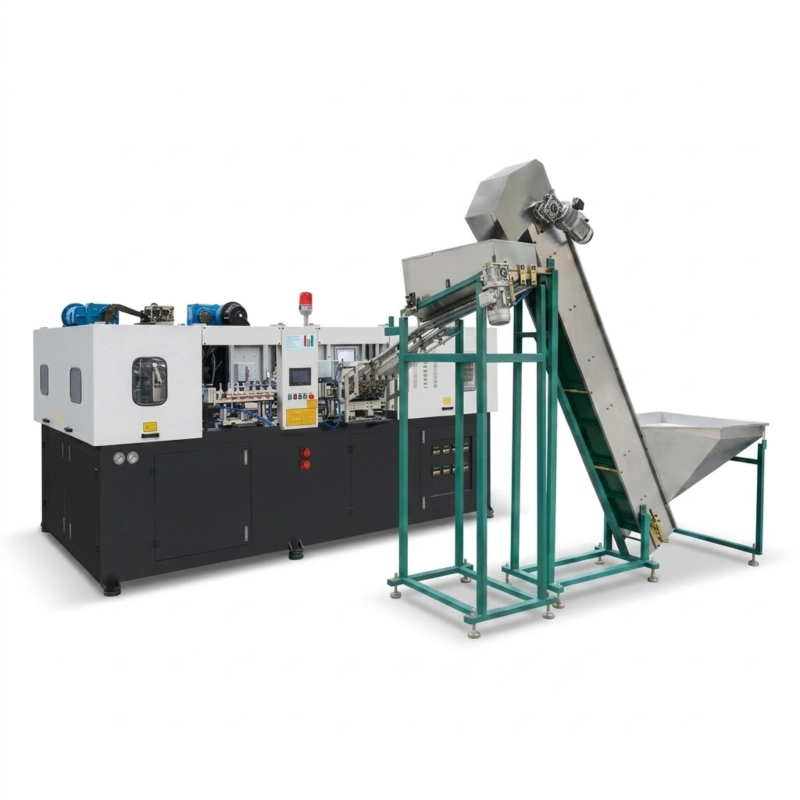
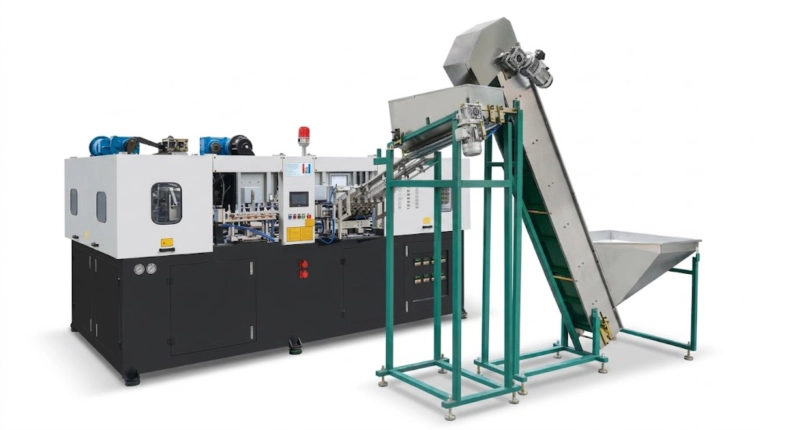
The Water & Beverage Bottle Blow Molding Machine Series comprises 12 models organised into the ES sub-series (standard servo, 2–8 cavities for bottles up to 1,500 ml) and the JS sub-series (dedicated large-format barrel platforms for 5-gallon and 20-litre water-cooler barrels). Together they cover every production scale in the beverage packaging market — from compact 2-cavity beverage-brand pilot lines through to 8-cavity 9,200 bph industrial platforms, and to the specialist integrated-heating barrel molder that is the benchmark for the water-cooler supply industry.
All ES-series models adopt servo-electric drive architecture eliminating hydraulic circuits, reducing energy consumption by up to 35% versus pneumatic-cam competitors. The JS-series barrel molders feature a unique combined preform-heating and blow-forming system engineered specifically for the heavy-wall 5-gallon and 20-litre preforms that cannot be processed on standard beverage machines. Dimensional consistency across all cavities and bottle formats is maintained through per-cavity servo stretch-rod control and independent NIR zone management.
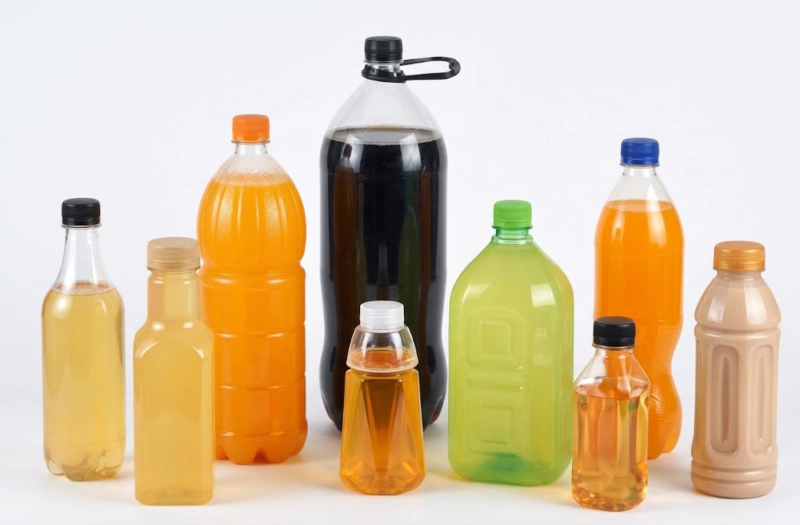
Output quality has been validated at facilities supplying mineral water, sparkling beverage, juice, ready-to-drink tea, and large-format drinking-water brands across global export markets, including regions with demanding hot-fill, CSD (carbonated soft drink), and aseptic filling line specifications.
Applicable Industries & Applications
✓ Sparkling Water & CSD
✓ Juice & Fruit Drinks
✓ Ready-to-Drink Tea & Coffee
✓ Sports & Energy Drinks
✓ 5-Gallon Water-Cooler Barrels
✓ 18.9 L / 20 L Drinking Water Barrels
✓ Hot-Fill & Aseptic Beverage Lines
2. Working Principle
All ES-series models operate on the standard two-step reheat stretch blow molding (RSBM) process. PET preforms are automatically fed, sorted neck-up, and conveyed through a multi-zone NIR oven on pitched mandrel holders. Each zone is independently temperature-controlled to achieve the precise axial thermal gradient required for optimal biaxial orientation of beverage-grade preforms — thinner-walled and lighter than food-jar preforms, demanding faster cycle management.
At the blow station, servo stretch rods extend axially per cavity while low-pressure air initiates radial expansion, followed by a high-pressure blast (26–35 kg/cm² depending on model) that drives PET against the cooled mold wall. Biaxial molecular orientation delivers the CO² retention barrier critical for CSD applications, the creep resistance required for hot-fill formats, and the drop resistance needed for multi-layer retail distribution.
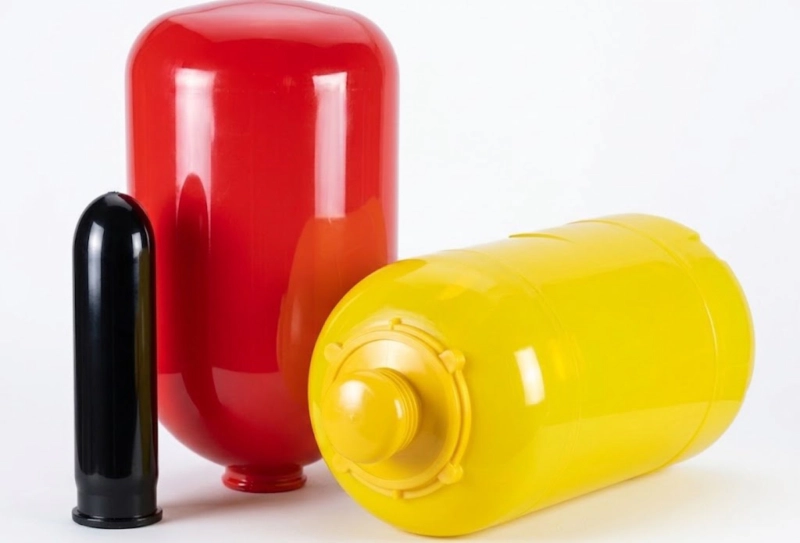
The JS-series barrel molders use a unique combined architecture: an extended high-capacity preform heating carousel (128-position buffer) integrated with a 2-cavity blow station. Heavy-wall 5-gallon and 20-litre preforms require significantly longer heating dwell times than standard beverage preforms — the integrated buffer ensures continuous production without the cycle gaps that would arise if a standard oven conveyor were used.
Key structural components common to all models: servo-electric toggle-link clamping • per-cavity servo stretch rod • multi-zone NIR oven with neck-protection cooling • automatic preform sorter and inclined feeder • Siemens/Mitsubishi PLC with HMI touchscreen and recipe storage • inline rejection system before downstream filler.
3. Core Advantages
Up to 35% Energy Saving — Servo Drive
Full-series servo-electric mold clamping eliminates hydraulic circuits and reduces electricity cost per 1,000 bottles by up to 35% versus pneumatic-cam equivalents — a commercially significant saving on high-throughput beverage lines running 20+ hours per day.
700 to 9,200 bph — Full Range Coverage
From 2-cavity pilot machines (ES-2C100, 2,400 bph) to the 8-cavity ES-8C76 at 9,200 bph, the series spans every production scale in beverage packaging. A single model upgrade path covers the entire growth trajectory from startup to industrial-scale operation.
Dedicated 5-Gallon & 20 L Barrel Platform
The JS-series introduces an integrated heating-and-blowing system purpose-built for heavy-wall 5-gallon (18.9 L) and 20-litre barrel preforms — a format that requires 3–4× longer heating dwell than standard beverage preforms and cannot be reliably produced on adapted standard machines.
Per-Cavity Servo Precision
Independent servo stretch-rod positioning (±0.05 mm) and per-cavity NIR zone control on all models hold bottle weight deviation within ±1% and neck-finish diameter variation within ±0.2 mm — the consistency demanded by high-speed beverage filling and capping machines.
CSD & Hot-Fill Capability
Multi-pitch cavity configurations and variable blowing pressure (26–35 kg/cm²) accommodate both CSD-rated barrier bottles and hot-fill formats requiring higher crystallinity. Heat-set mold configurations available on request for filling temperatures above 85°C.
Complete Turnkey Supply
We supply blow molds, preform injection molds, industrial chillers, and oil-free high-pressure compressor packages from a single source — reducing integration risk and ensuring food-grade oil-free air quality compliance for beverage-contact bottle production.
4. Technical Specifications
▶ ES Series — Standard Servo Beverage Bottle (2 / 4 / 6 / 8 Cavity, PET)
10 models covering 500 ml to 1,500 ml. From compact 2-cavity OEM platforms to 8-cavity 9,200 bph industrial lines. Covers mineral water, CSD, juice, tea, hot-fill, and sports drink bottle production.
| Parameter / Unit | ES-2C100 | AS-2C114.3 | ES-2C130 | ES-4C76 | ES-4C100 | ES-4C114 | ES-4C130 | ES-6C76 | ES-6C114 | ES-8C76 |
|---|---|---|---|---|---|---|---|---|---|---|
| Cavities | 2 | 2 | 2 | 4 | 4 | 4 | 4 | 6 | 6 | 8 |
| Max. Volume (ml) | 500 | 1,000 | 1,500 | 700 | 800 | 1,300 | 1,500 | 700 | 1,500 | 700 |
| Output (bph) | 2,400 | 2,000 | 1,800 | 4,800 | 4,600 | 3,300 | 3,200 | 7,200 | 5,400 | 9,200 |
| Max. Neck Dia. (mm) | 68 | 88 | 98 | 48 | 68 | 88 | 98 | 68 | 68 | 68 |
| Max. Body Dia. (mm) | 80 | 94 | 110 | 68 | 80 | 94 | 110 | 68 | 94 | 68 |
| Max. Height (mm) | 200 | 260 | 260 | 240 | 250 | 250/330 | 250 | 240 | 250/330 | 250/330 |
| Clamping Stroke (mm) | 110 | 122 | 160 | 100 | 128 | 132 | 148 | 100 | 128 | 100 |
| Stretching Stroke (mm) | 350 | 400 | 350 | 350 | 350 | 400 | 400 | 350 | 350/450 | 450 |
| Preform Holder | 60 | 48 | 60 | 96 | 92 | 100 | 92 | 130 | 96 | 166 |
| Max. Heating Power (kW) | 34 | 45 | 42.5 | 40 | 62.5 | 50 | 68 | 62.5 | 72 | 72 |
| Normal Heating Power (kW) | 8–12 | 20 | 8–13 | 18 | 21 | 25 | 30 | 26 | 32 | 35 |
| Blowing Pressure (kg/cm²) | 26–35 | 35 | 26–35 | 35 | 35 | 35 | 35 | 35 | 35 | 35 |
| HP Air (L/min) | 1,000–1,400 | 1,600 | 1,000–1,500 | 3,900 | 4,000 | 5,000 | 6,000 | 5,800 | 9,500 | 7,500 |
| Cooling Water Flow (L/min) | 30 | 30 | 30 | 30 | 30 | 40 | 40 | 40 | 40 | 40 |
| Machine Size L×W×H (mm) | 2900×1525×1930 | 2660×1660×2150 | 3600×1800×1980 | 3290×1850×2260 | 4170×1930×2340 | 5120×2150×2350 | 5450×2070×2320 | 4690×2000×2000 | 5300×2150×2250 | 5750×2070×2320 |
| Machine Weight (kg) | 2,000 | 2,600 | 3,000 | 3,500 | 4,000 | 5,500 | 6,500 | 5,500 | 6,500 | 8,000 |
▶ JS Series — 5-Gallon & 20-Litre Water-Cooler Barrel Specialist (2 Cavity)
Dedicated large-format barrel blow molders with integrated heating carousel system. JS-2C200 for 18.9 L / 5-gallon barrels; JS-2C366 for up to 22-litre institutional water containers. Cannot be substituted by standard beverage-line machines.
| Parameter / Unit | JS-2C200 (5-Gallon) | JS-2C366 (20 L) |
|---|---|---|
| Cavities | 2 | 2 |
| Application | 18.9 L / 5-gallon barrel | Up to 22 L barrel |
| Max. Container Volume (ml) | 5,000 blow / 18,900 L barrel | 22,000 |
| Output (bph) | 1,000 | 700 |
| Max. Neck Diameter (mm) | 58 | 90 |
| Max. Body Diameter (mm) | 180 | 300 |
| Max. Container Height (mm) | 340 | 480 |
| Clamping Stroke (mm) | 225 | 332 |
| Mold-Open Distance (mm) | 509 | 772 |
| Stretching Stroke (mm) | 450 | 620 |
| Integrated Heating Buffer | 128 preforms | 128 preforms |
| Max. Heating Power (kW) | 65 | 86 |
| Normal Heating Power (kW) | 26 | 45 |
| Blowing Pressure (kg/cm²) | 35 | 35 |
| HP Air Consumption (L/min) | 5,000 | 12,500 |
| Cooling Water Flow (L/min) | 91.4 | 120 |
| Machine Size L×W×H (mm) | 4100×2150×2350 | 4090×2660×3040 |
| Machine Weight (kg) | 2,500 | 7,000 |
5. Structure & Material Engineering
🛠 Machine Frame
Heavy-gauge welded steel frame, stress-relieved and CNC-machined at all guide-rail and bearing surfaces. Anti-vibration levelling feet isolate the machine from floor resonance — critical at 9,200 bph high-speed operation where frame vibration directly affects bottle-weight consistency.
⚙ Servo-Electric Clamping
Toggle-link servo-electric clamping with no hydraulic fluid — eliminating contamination risk in beverage environments and extending maintenance intervals beyond 2,000 operating hours. Fast servo response enables the shorter cycle times required for high-speed 6-cavity and 8-cavity beverage production.
🌡 NIR Oven — Beverage Optimised
Multi-zone near-infrared quartz-lamp oven with individually controlled zones and a neck-protection cooling collar. Beverage-grade preforms are lighter and thinner than jar preforms, requiring faster dwell management. Zone pitch is matched to the preform holder count (48–166 positions depending on model) to ensure consistent thermal conditioning at maximum rated speed.
🛋 JS-Series Integrated Heating Carousel
The JS-series unique 128-position preform heating buffer operates as a continuous carousel, decoupled from the blow cycle. Heavy-wall 5-gallon preforms require 3–4× longer heating dwell than standard beverage preforms — the carousel provides this extended conditioning time without reducing machine throughput.
🔓 Mold Materials
Blow mold cavities machined from high-strength aluminium alloy with 3D CAD conformal cooling channels. Preform injection molds use imported 2316 mold steel with 420 stainless cavity plates, CNC-machined to ±0.02 mm. JS-series barrel molds feature reinforced base-insert designs to withstand the higher clamping forces of large-format barrel production.
📱 PLC & Control
Siemens or Mitsubishi PLC with colour HMI touchscreen. Up to 50 bottle-format recipes stored on-board. The 8-cavity ES-8C76 platform includes enhanced cavity-synchronisation firmware ensuring all eight cavities produce within ±0.5 g bottle weight at 9,200 bph.
6. Typical Application Scenarios
7. Our Machines vs. European Brand Platforms — Objective Comparison
| Comparison Item | Sidel SBO / Combi | Krones Contiform | SMI Smiflexi | Sipa SFR EVO | Our Series |
|---|---|---|---|---|---|
| Origin | France | Germany | Italy | Italy | Asia |
| Max. Cavity Count | 30+ | 30+ | 12 | 16 | Up to 8 (ES-8C76) |
| Barrel Platform Available | Selected models | Selected models | Limited | Limited | JS series — dedicated |
| Approx. Entry CapEx (4-cav.) | USD 280K – 380K | USD 260K – 360K | USD 180K – 280K | USD 200K – 300K | Significantly lower — direct |
| Servo Drive (standard) | Yes | Yes | Yes | Yes | Yes — all models |
| Spare Parts Lead Time | 4–12 weeks | 4–10 weeks | 4–10 weeks | 4–10 weeks | 3–7 days (stocked) |
| After-Sales Service | Regional agents | Regional agents | Regional agents | Regional agents | Direct + remote video |
| CE Certification | Yes | Yes | Yes | Yes | Yes |
CapEx figures are indicative market estimates. Our pricing is provided by confirmed quotation only.
8. Model Selection Guide
| Your Requirement | Recommended Model |
|---|---|
| Pilot line or small brand, up to 500 ml, low CapEx entry | ES-2C100 (2 cavity, 2,400 bph) |
| Mid-volume water / juice, up to 1,000–1,500 ml | AS-2C114.3 / ES-2C130 (2 cavity) |
| CSD / sparkling water, 300–700 ml, high-speed | ES-4C76 (4,800 bph) or ES-6C76 (7,200 bph) |
| Juice / tea / functional beverage, 800–1,500 ml | ES-4C100 / ES-4C114 / ES-6C114 |
| Large-volume water / tea, 1,300–1,500 ml, mid-speed | ES-4C130 (3,200 bph) |
| Industrial-scale FMCG beverage, 9,200 bph | ES-8C76 (8 cavity, 9,200 bph) |
| 5-gallon / 18.9 L refillable water-cooler barrels | JS-2C200 (1,000 bph) |
| 20 L / 22 L institutional water containers | JS-2C366 (700 bph) |
9. Frequently Asked Questions
Explore other packaging categories or one-step injection stretch blow molding solutions:
► Browse All Blow Molding Machines
✉ Request a Free Quotation
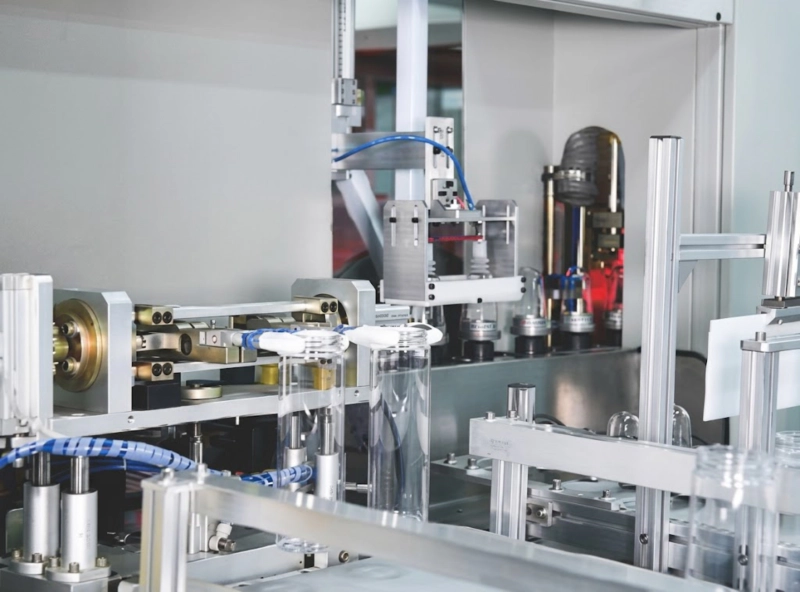
10. Work with a Specialist Manufacturer
With over two decades of dedicated experience in blow molding machine design, manufacturing, and after-sales service, we supply automatic PET beverage bottle and water-barrel blow molding machines to mineral water brands, beverage producers, and water-cooler barrel manufacturers across more than 20 countries. Our production facility operates dedicated CNC machining, mold fabrication, machine assembly, and quality-control departments. Our engineers are available globally for installation, commissioning, and after-sales support.
Whether you are specifying your first beverage blow molder, scaling up from a 2-cavity pilot line to a 6- or 8-cavity production platform, adding a dedicated barrel molder for the water-cooler market, or seeking a cost-effective alternative to an ageing European machine, our technical team will provide a no-obligation specification review and delivered-cost comparison within 48 hours of enquiry.