The neck ring is the single highest-frequency consumable in an ISBM or IBM mold set. It is the only mold component that contacts the bottle neck at every cycle, under both the clamping force of mold closure and the thermal cycling between cold (5–12°C coolant) and hot (250°C injection). Its geometry defines the thread profile and sealing surface that determines whether the bottle passes or fails closure fitment testing. And it is the component most commonly neglected in maintenance planning — because its failure mode is gradual, its replacement is perceived as routine, and its contribution to production quality is only recognised after a batch of bottles has been returned with thread dimensional failures. This guide provides the engineering framework for neck ring management on ISBM lines: the failure mechanisms, the factors that determine service life, the cost difference between steel grades, and the operating practices that extend neck ring life by 30 to 60 percent without capital investment.
1. What the Neck Ring Does and Why It Wears
In the ISBM process, the neck ring is a split steel insert that surrounds the preform neck during the entire cycle — from injection through conditioning, blow and ejection. It performs three simultaneous functions:
- ▶Thread geometry formation: The neck ring inner surface carries the thread profile — the exact negative of the bottle thread. Every dimension of the finished thread (pitch, height, root radius, flank angle) is determined by the neck ring geometry at the moment of injection.
- ▶Neck containment during transfer: The neck ring holds the preform neck precisely during turntable rotation between stations. It prevents the softened neck from deforming under centrifugal and inertial forces during transfer.
- ▶Sealing surface definition: The neck ring top face defines the bottle’s sealing surface — the annular face that contacts the closure liner to prevent leakage. Any wear or dimensional change on this face translates to sealing failures.
The neck ring wears because it is subject to three simultaneous degradation forces at every cycle: mechanical abrasion from polymer flow during injection, thermal fatigue from repeated heating (by hot resin contact) and cooling (by the coolant circuit at 5–12°C), and chemical attack from moisture, resin degradation products and any additives in the polymer. Of these, thermal fatigue is the most important because it accumulates — each cycle adds a small increment of thermal stress to the steel microstructure that is not reversible.
Why neck rings wear faster than other mold components: The cavity block and core pin are cooled uniformly and contact the polymer for the same duration as the neck ring. But the neck ring has a uniquely thin wall between the thread-forming surface and the coolant channel — often as little as 4 to 6mm — which amplifies the thermal gradient at each cycle. This thin wall means the surface heats and cools by 40 to 80°C in under 5 seconds, every cycle. At 3,600 cycles per hour, this produces 21,600 to 28,800 thermal cycles per day — accelerating the fatigue accumulation that other mold components do not experience at the same rate.
2. The Three Failure Modes: Wear, Thermal Fatigue and Corrosion
Neck ring failure is not a sudden event — it is a gradual degradation that produces measurable quality indicators before the ring reaches end-of-life. Understanding which failure mode is active determines the correct intervention:
Mode 1 — Mechanical Wear
Progressive erosion of the thread profile surface by polymer flow during injection. The thread flanks lose their sharp geometry first — rounded flank angles produce bottles where closures can be cross-threaded easily.
Early indicator: Thread OD creep — measured thread OD gradually increases beyond specification as material is removed from the forming surface.
Onset: After 800,000 to 1,500,000 cycles depending on steel grade and resin. PETG and PC are more abrasive than PET due to higher processing viscosity.
Mode 2 — Thermal Fatigue
Micro-crack formation at the thread root and parting line, caused by repeated thermal expansion and contraction. Cracks propagate inward from the surface and eventually produce visible seam lines on the bottle neck.
Early indicator: Fine surface crazing visible under 10x magnification on the thread root radii. May also appear as hairline marks on bottle neck surface before a full-width crack develops.
Onset: Accelerated by rapid temperature changes — mold temperature drops below 5°C or startup from cold without gradual warm-up dramatically reduces thermal fatigue life.
Mode 3 — Corrosion
Surface pitting from moisture condensation on the cold neck ring face, acid attack from degraded PETG or PVC contamination, or coolant quality failure (tap water with high chloride content attacking the cooling channel inner surface).
Early indicator: Orange-brown surface discolouration on the neck ring parting face. Pitting visible on thread-forming surface produces corresponding surface defects on bottle neck.
Prevention: Use stainless steel neck rings (4Cr13 or S136), maintain coolant pH between 7.0 and 8.5, and prevent condensation by limiting coolant temperature drop below the factory dew point temperature.
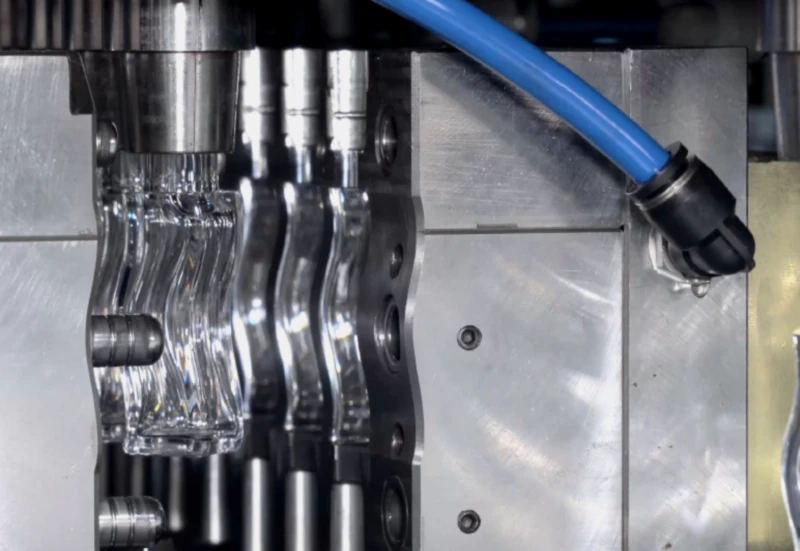
Fig. 1 — ISBM injection mold assembly. The neck ring insert (split component at the mold parting line, surrounding the core pin) is the highest-wear component in the mold set. Its inner surface carries the complete thread geometry that defines the bottle neck for the machine’s operational life. Dimensional wear on this surface accumulates gradually and is invisible to inspection without measurement — making a documented replacement schedule essential.
3. Factors That Determine Neck Ring Service Life
Service life varies significantly between operations — the same neck ring type running the same bottle can achieve 600,000 cycles on one line and 2,500,000 cycles on another. The following factors are the primary determinants:
| Factor | Lower End of Life | Upper End of Life | Multiplier Effect |
|---|---|---|---|
| Steel grade | Standard carbon steel (P20) | 4Cr13 / S136 stainless | 2.0 – 3.5× longer |
| Resin type | PC, Tritan (high temp, high viscosity) | PET (lower viscosity, lower abrasiveness) | 1.5 – 2.0× longer on PET |
| Cavity count | 8 cavities (more clamping events per cycle) | 2 cavities | Wear per cavity similar; total replacement cost scales with count |
| Coolant temperature | Below 5°C (accelerates thermal fatigue) | 8 – 12°C (reduced thermal gradient) | 1.3 – 1.8× at optimal temperature |
| Injection pressure | Over-pressurised (above minimum required) | Minimum effective injection pressure | 1.2 – 1.5× at minimum pressure |
| Cold-start procedure | Immediate full-speed production from cold | Gradual warm-up over 15–20 minutes | 1.2 – 1.4× with proper warm-up |
| Coolant quality | Tap water with high chloride or scale | Treated, pH-balanced coolant | 1.5 – 2.5× with treated coolant |
An operation that uses 4Cr13 stainless neck rings (2.5× vs P20), runs at 10°C coolant instead of 4°C (1.5×), operates at minimum injection pressure (1.3×) and follows a proper warm-up procedure (1.3×) can achieve a combined service life multiplier of up to 6× compared to the same bottle run under poor practice conditions. This is not theoretical — the difference between a 400,000-cycle life and a 2,400,000-cycle life on a 4-cavity 4Cr13 mold represents approximately USD 12,000 to 15,000 in neck ring replacement cost over the machine’s lifetime.
4. Replacement Frequency: How Often Should You Replace?
There is no universal replacement interval — service life is too dependent on the variables above. What can be stated are the typical ranges by application and the measurement-based trigger for replacement:
| Application | Steel Grade | Typical Life (cycles) | At 3,600 BPH / 4-cav |
|---|---|---|---|
| PETG cosmetic, HGY standard | Standard domestic steel | 300,000 – 600,000 | 6 – 13 weeks at 100% OEE |
| PETG cosmetic, HGY standard | 4Cr13 stainless | 800,000 – 1,800,000 | 18 – 42 weeks at 100% OEE |
| PET pharmaceutical, standard | 4Cr13 stainless | 1,500,000 – 3,000,000 | 34 – 68 weeks at 100% OEE |
| PC / Tritan premium cosmetic | S136 tool steel | 500,000 – 1,200,000 | 11 – 27 weeks at 100% OEE |
| ASB-12M molds on HGY machine | Original ASB specification steel | 1,200,000 – 2,500,000 | 27 – 57 weeks at 100% OEE |
The correct trigger for replacement is measurement, not time. Replace neck rings when the measured thread OD exceeds the upper tolerance on your bottle drawing by more than 50% of the total thread OD tolerance band — or when closure torque testing shows first-pass failure rate above 2% in a production sample of 200 bottles. Do not replace on a fixed time schedule; do not wait for visible cracking. Measurement at defined intervals is the only reliable approach.
5. 4Cr13 vs Standard Steel: The Service Life and Cost Difference
The choice of neck ring steel is the highest-leverage decision in neck ring lifecycle management. The difference between standard domestic steel and imported 4Cr13 stainless is not marginal — it changes the economics of the decision entirely.
The cost-per-million-cycles calculation shows that 4Cr13 neck rings are not simply more expensive versions of the same product — they are cheaper to operate per unit of production in all but the worst-case service life scenarios. At average service life, 4Cr13 costs approximately 40 to 55% less per million cycles than standard domestic steel, despite a 2 to 2.5x higher purchase price.
6. Replacement Cost Calculation: What You Are Actually Spending
Total neck ring replacement cost has three components: the parts cost, the labour cost for installation and re-qualification, and the production downtime cost. Most operations account only for parts cost — understating the true cost by a factor of 2 to 3.
Total Annual Neck Ring Cost
Cₐ = (N𝐏 × C𝐏) + (R𝐏 × L𝐏) + (D𝐏 × P𝐏)
N𝐏 = replacements per year | C𝐏 = cost per ring set
R𝐏 = hours per replacement event | L𝐏 = labour cost per hour
D𝐏 = downtime hours per event | P𝐏 = production value lost per hour
Reference calculation for a 4-cavity PETG cosmetic mold on an HGY150-V4-EV, producing at 3,600 BPH, at 7.2 RUB/kWh electricity and 120 RUB/bottle selling price:
Switching from standard domestic steel to 4Cr13 stainless neck rings, the total annual neck ring cost falls from USD 65,618 to USD 25,234 — a saving of USD 40,384. The parts cost actually decreases despite a higher per-ring price, because fewer replacements are needed. The dominant saving (USD 37,584) comes from the 29 fewer downtime events per year. This is the calculation that makes the premium steel decision economically obvious once the full cost picture is considered.
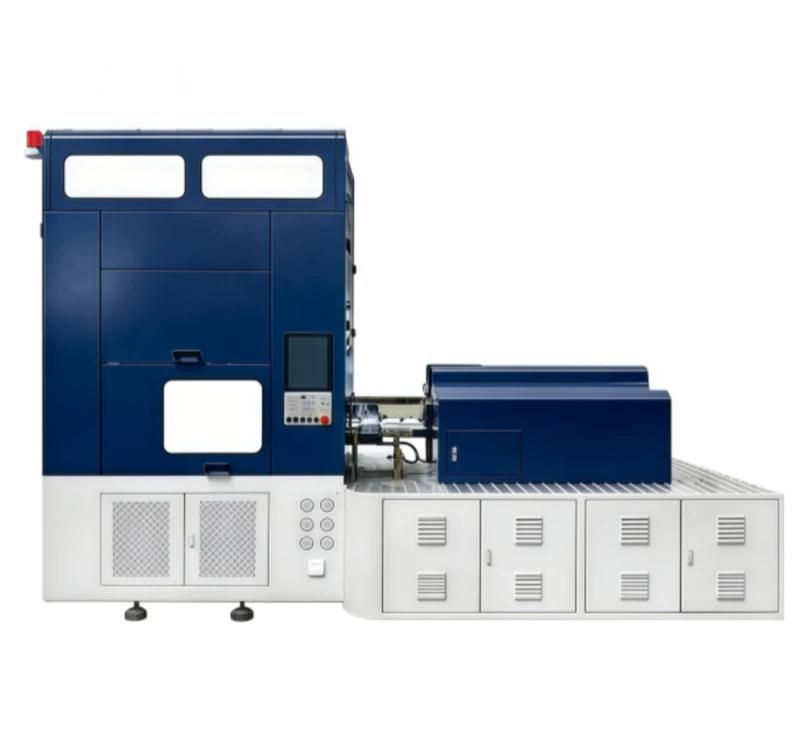
Fig. 2 — The HGY150-V4-EV ISBM machine. Neck ring replacement cost accounts for a larger share of 5-year operating cost than most procurement decisions consider. On a 4-cavity PETG cosmetic mold at industrial production rates, the choice between standard and 4Cr13 steel neck rings drives a USD 40,000+ annual cost difference — predominantly through reduced downtime frequency, not parts cost.
7. ASB Neck Rings on HGY Machines: Compatibility and Supply
Manufacturers migrating from Nissei ASB machines to HGY ISBM machines with ASB-12M compatible molds face a specific question: can they continue using their existing ASB neck ring supply, or do they need HGY-specific neck rings?
- ✓Existing ASB neck rings fit directly. The neck ring carrier bore on the HGY150-V4 and V4-EV is machined to ASB-12M specification. Original Nissei ASB-12M neck rings seat into the HGY turntable carrier without modification. The first replacement after migration can use ASB neck rings sourced from any ASB toolmaker.
- ✓HGY-sourced 4Cr13 neck rings are dimensionally equivalent. We supply replacement neck rings in 4Cr13 stainless for all HGY150-series machines and all ASB-12M compatible configurations. These are machined to the same OD, inner thread profile and locating pin positions as the original ASB tooling.
- ▶Thread profile must be specified when ordering. The neck ring inner thread geometry is product-specific — it matches the bottle neck standard (GPI 20/410, GPI 24/410, PCO-1881, DIN or custom). When ordering replacement neck rings, provide the thread standard and the bottle neck drawing or the worn neck ring for dimensional replication.
- ▶Lead time for replacement neck rings is 3 to 5 weeks from order. For operations in Russia, this means maintaining at minimum one complete spare set (one neck ring set per cavity, fully assembled) on-site at all times. Two spare sets provides the buffer to run through a manufacturing cycle before the replacement order arrives, without emergency shipping costs.
8. Six Operating Practices That Extend Neck Ring Life
These practices require no capital investment and no machine modification. They represent the operating discipline that separates lines that replace neck rings every 8 weeks from lines that replace them every 30 weeks:
-
1Follow the warm-up procedure at every cold startAllow the barrel to reach within 10°C of setpoint temperature and hold for at least 5 minutes before injecting the first shot. Reduce cycle speed to 60% for the first 10 cycles. This allows the neck ring to warm gradually from ambient before the first thermal shock of hot resin contact. Cold-start without warm-up is the single largest contributor to premature thermal fatigue cracking.
-
2Set neck ring coolant temperature at 8–12°C, not colderColder coolant does not cool the neck faster once the thermal gradient between coolant and neck ring surface is below approximately 30°C — it simply increases the thermal gradient and accelerates fatigue. For most PETG and PET applications, 10°C provides adequate neck geometry freeze. Monitor the neck ring coolant outlet temperature — if the outlet is within 1°C of inlet, the flow rate is excessive and should be reduced.
-
3Minimise injection pressure to the effective minimumVerify minimum effective injection pressure by reducing from the current setting in 5% decrements while checking gram weight and fill completeness. Many lines run 15 to 25% above the minimum required pressure — the excess mechanical load accelerates abrasive wear on the thread-forming surfaces. Once minimum effective pressure is identified, add 5% as a safety margin and lock the parameter.
-
4Use treated, pH-balanced coolant — not tap waterRussian tap water in many regions has high chloride content (above 250 mg/l in some areas) and variable pH — both of which accelerate corrosion of the cooling channel inner surfaces. A closed-loop coolant system with demineralised water, corrosion inhibitor and pH maintained between 7.0 and 8.5 extends neck ring cooling circuit life and maintains heat transfer efficiency by preventing scale formation on channel walls.
-
5Apply a light coating of release agent at planned stopsDuring planned production stops of more than 4 hours, apply a thin film of food-grade silicone release agent to the neck ring thread-forming surfaces. This prevents adhesion of any residual polymer and reduces the abrasive polymer contact at the next startup before the barrel reaches full processing temperature. Wipe clean before restarting.
-
6Rotate cavity positions at each replacement eventIf the mold has multiple cavities and the cooling circuit or machine platen introduces any systematic temperature or pressure variation between cavity positions, some neck ring positions will wear faster than others. At each replacement event, rotate rings between cavity positions — move rings from higher-load positions to lower-load positions. This equalises wear across all rings and avoids the situation where one position consistently reaches end-of-life before others.
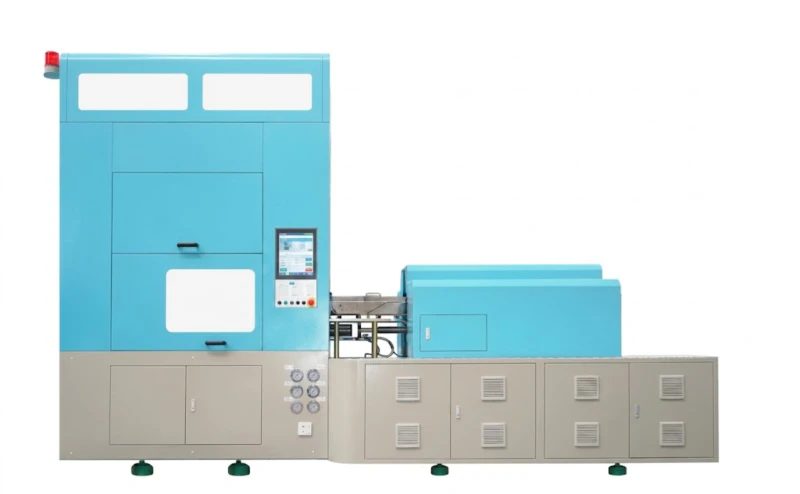
Fig. 3 — The HGY150-V4-EV showing the mold temperature controller (MTC) connections at the lower panel. The neck ring coolant circuit is connected independently from the preform cavity circuit — allowing the neck ring temperature to be maintained at 8–12°C while the preform cavity runs warmer. This independent control is one of the key machine features that enables proper neck ring thermal management and the service life extension it produces.
9. Inspection Protocol: When to Replace Before Failure
Neck ring failure is never acceptable — a failed neck ring produces out-of-specification thread geometry on every bottle until the ring is replaced, and these bottles cannot always be identified visually. The inspection protocol below is designed to trigger replacement before failure, using measurable criteria:
| Inspection Item | Method | Frequency | Replace Trigger |
|---|---|---|---|
| Bottle thread OD | Micrometer on 5 bottles per cavity | Weekly | OD exceeds upper tolerance + 50% of total tolerance band |
| Closure torque test | Production closure hand-tightened on 20 bottles per cavity | Weekly | First-pass failure rate above 2% in sample of 20 |
| Neck ring surface visual | 10x loupe inspection of thread root and parting line | Monthly or at each mold change | Visible crazing, pitting or parting line step above 0.02mm |
| Neck ring OD measurement | Micrometer on neck ring itself (not bottle) | Every 500,000 cycles or quarterly | OD exceeds original drawing + 0.05mm |
| Sealing surface flatness | Surface plate check with engineer’s blue on neck ring top face | Every 500,000 cycles or at annual shutdown | Gap visible under 0.02mm feeler gauge |
10. Spares Stocking Strategy for Russian Operations
The lead time for replacement neck rings sourced from outside Russia is typically 35 to 45 days by sea freight, or 7 to 10 days by air freight at 4 to 6 times the sea freight cost. The stocking strategy must bridge this gap without creating excessive tied-up inventory:
Minimum on-site stock: 1 complete spare neck ring set per mold
One spare set (4 rings for a 4-cavity mold, 8 rings for 8-cavity) allows an immediate replacement when a ring reaches trigger condition, restoring production within 4 hours of the replacement decision. Order a new set immediately after each spare set is consumed — this is the reorder trigger. At average 4Cr13 service life of 1,200,000 cycles, a 4-cavity mold at 3,600 BPH and 80% OEE consumes approximately 1.7 spare sets per year.
Recommended on-site stock: 2 complete spare sets per mold plus inspection tools
Two spare sets provide a full replacement cycle of buffer — a replacement can be performed, a new set ordered, and a second replacement completed before the first order arrives. This eliminates air freight urgency entirely. Also stock on-site: a micrometer (0.001mm resolution), a 10x loupe, a feeler gauge set (0.01–0.20mm), and a supply of pH test strips for coolant monitoring. Total tool cost under USD 200. A stable, correctly sized oil-free air compressor for ISBM also reduces neck ring thermal stress by providing consistent blow pressure that does not require compensating injection parameter increases.
Document every replacement with cycle count, reason and measurement data
Maintain a neck ring logbook recording: date of installation, cavity position, cycle count at replacement, measured thread OD at replacement, and failure mode (wear / fatigue / corrosion). After 3 to 5 replacement cycles, the data produces a reliable service life prediction specific to your operation that eliminates both premature replacement waste and late-replacement quality failures.
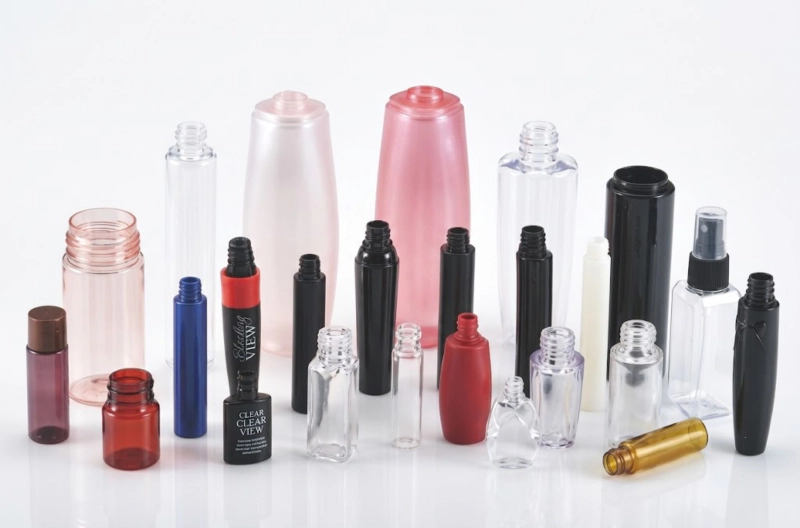
Fig. 4 — Premium PETG cosmetic bottles with consistent thread geometry and zero closure fitment failures. This outcome requires neck rings that are within dimensional specification — which requires either a measurement-based replacement programme or the discovery that the rings were out of specification after customer complaints. The measurement programme costs less than USD 200 in tools and 30 minutes per week. The closure fitment failure alternative costs the entire batch.
1. Neck ring replacement is the most expensive recurring mold cost — but downtime dominates, not parts. On a typical 4-cavity PETG cosmetic line, 85% of the total annual neck ring cost is downtime, not parts. The path to cost reduction is fewer, more predictable replacements — not cheaper rings that need replacing more often.
2. 4Cr13 stainless steel reduces total cost even though the per-ring price is higher. At average service life, 4Cr13 costs 40 to 55% less per million cycles than standard steel. The calculation must include downtime cost — without it, the per-ring price comparison leads to the wrong conclusion.
3. Operating practices can extend service life by 3 to 6 times at zero capital cost. Warm-up procedure, coolant temperature management, minimum injection pressure and treated coolant collectively produce a service life multiplier that dwarfs any steel grade difference.
4. Replacement must be triggered by measurement, not time or visible failure. A failed neck ring produces out-of-specification thread geometry on every bottle — most of which pass visual inspection. Weekly thread OD measurement and monthly surface inspection are the minimum acceptable monitoring programme.
5. For Russian operations, stock 2 spare sets and maintain a replacement logbook. The 35 to 45 day sea freight lead time from supply sources means on-site stock is not optional. Two spare sets eliminate air freight urgency. A logbook produces operation-specific service life data that eliminates both premature replacement and late-replacement quality failures.
Need 4Cr13 Replacement Neck Rings for Your ISBM Mold?
Send us your bottle neck drawing or a worn neck ring for dimensional replication. We manufacture 4Cr13 stainless replacement neck rings for all HGY150-series machines and ASB-12M compatible mold configurations, with delivery in 3 to 5 weeks.