
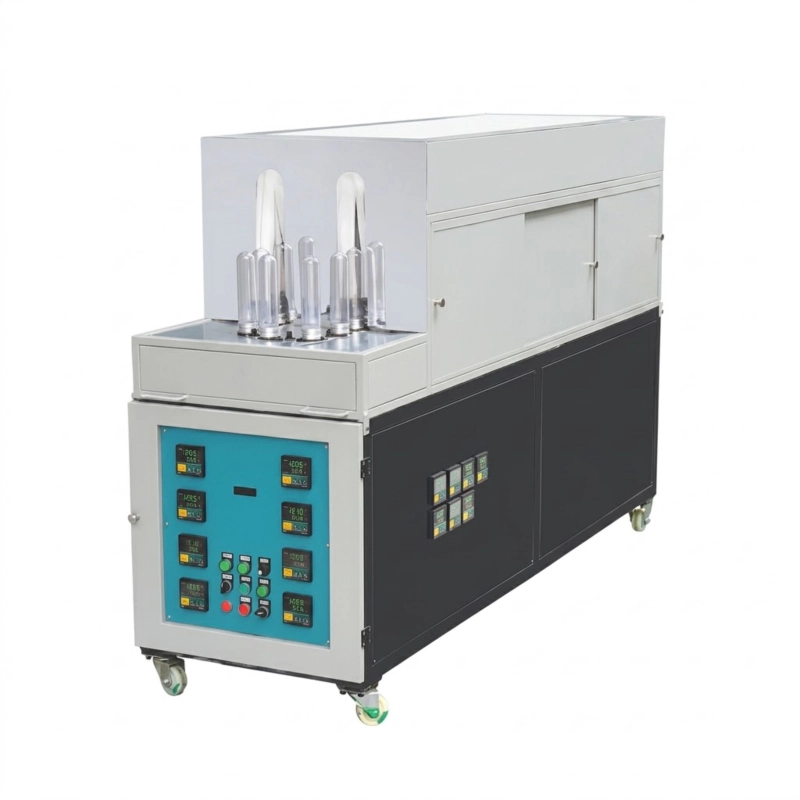
HGS Series Semi-Automatic PET Blow Molding Machines
HGS series semi-automatic PET blow molding machines. 6 models, 1–6 cavities, 400–1,800 bph, up to 3,600 ml. Low CapEx, fast mold changeover, ideal for sampling, R&D & entry-level production.
HGS Series Semi-Automatic
PET Blow Molding Machines — Complete Model Guide
► 600 ml – 3,600 ml
► 400 – 1,800 bph
► Low CapEx Entry Level
► Fast Mold Changeover
► CE Certified
1. Product Overview
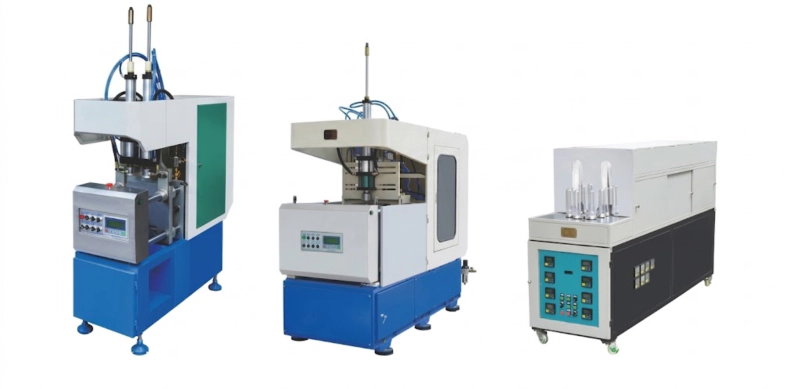
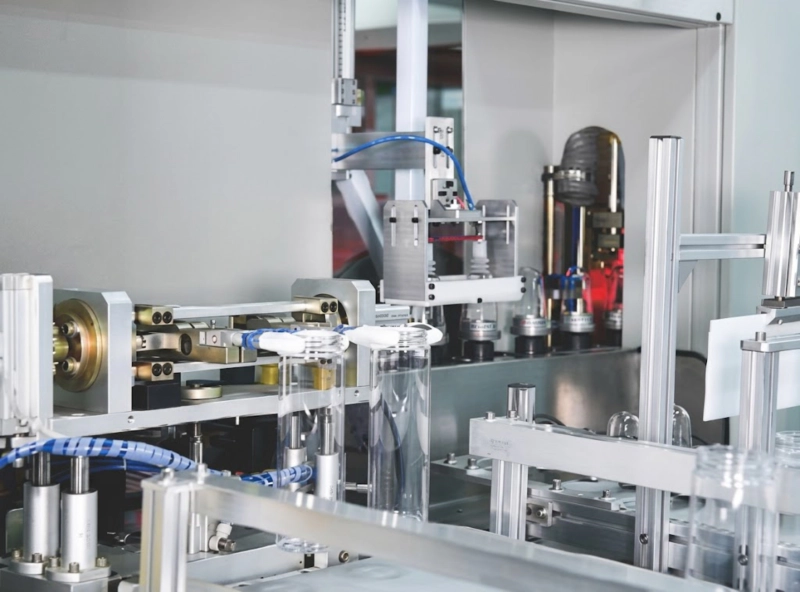
The HGS Series Semi-Automatic PET Blow Molding Machines comprise 6 models — HGS-1 through HGS-6 — offering 1 to 6 cavities and maximum container volumes from 600 ml (HGS-1) to 3,600 ml (HGS-6). The semi-automatic process uses manual operator loading of pre-heated preforms into the blow station, with the machine autonomously performing mold closing, stretch-rod extension, pre-blowing, high-pressure blowing, cooling, and mold opening. The operator removes finished bottles and loads the next preform batch.
This operating mode eliminates the most capital-intensive elements of fully automatic platforms — the multi-zone NIR oven, preform orientation bowl, automatic conveyor system, and preform sorter — reducing machine cost and footprint substantially. A separate infrared preform heating oven (supplied as part of the HGS package or sourced independently) pre-conditions preforms before the operator loads them. The trade-off is lower throughput and higher labour cost per bottle versus fully automatic machines — an acceptable exchange for the applications this series targets.
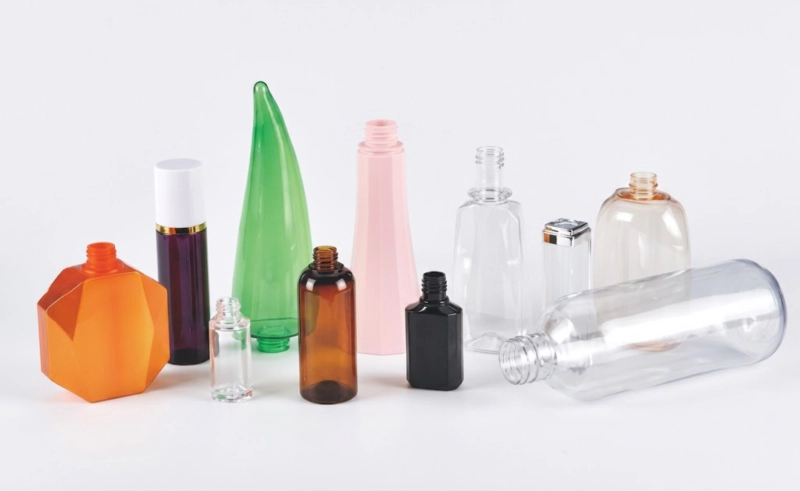
The HGS series is the practical choice for four distinct use cases: product development sampling (producing a small quantity of accurate prototype bottles from a new mold before committing to full automatic production investment); entry-level commercial production (regional beverage or food brands with modest initial volumes that do not justify full-automatic CapEx); multi-format flexibility operations (producers running many different bottle types in small quantities where fast mold changes and low per-mold tooling cost outweigh throughput); and developing-market initial investment where operational experience, market validation, and capital preservation are priorities before scaling to fully automatic platforms.
Applicable Industries & Applications
✓ Food & Condiment Bottles
✓ Product Development Samples
✓ New Bottle Format Trials
✓ Entry-Level Commercial Production
✓ Multi-Format Small-Batch Operations
✓ Regional & Artisan Brand Production
✓ Developing-Market Initial Investment
2. Working Principle
The HGS series uses the two-step stretch blow molding process with manual preform loading. In step one, PET preforms are heated to stretch temperature (typically 100–115°C) in a separate infrared oven unit — either the matched HGS infrared oven or a compatible external oven. Operator loads the heated preforms neck-up into the machine’s blow station — one preform per cavity. The machine then takes over for all remaining production steps automatically.
Step 1 — Preheat (Manual)
Operator loads preforms into infrared oven unit and heats to target stretch temperature.
Step 2 — Load (Manual)
Operator places heated preforms neck-up into the blow station — one per cavity.
Step 3 — Clamp (Auto)
Machine closes mold halves around all preforms simultaneously. Operator steps back.
Step 4 — Stretch & Blow (Auto)
Servo stretch rods extend axially; pre-blow at 7 kg/cm² then high-pressure blow at 30 kg/cm² drives PET against cooled mold wall.
Step 5 — Cool & Open (Auto)
Mold-wall cooling solidifies bottle geometry. Machine opens mold and signals operator for unloading.
Step 6 — Unload (Manual)
Operator removes finished bottles and loads the next preform batch to restart the cycle.
The biaxial molecular orientation achieved during simultaneous axial (stretch rod) and radial (blow air) stretching is identical to that produced by fully automatic machines — finished bottle mechanical properties, clarity, barrier performance, and weight efficiency are equivalent. The only production difference is cycle time and operator involvement, which determine the throughput range of 400–1,800 bph depending on model.
3. Core Advantages
Low CapEx — Lowest Entry Cost into PET
Eliminating the automated oven, conveyor, and preform feed system reduces machine cost dramatically versus fully automatic platforms. For brands and producers where initial production volume does not justify the CapEx of a full-automatic machine, the HGS series provides a commercially viable entry point — with a clear upgrade path to fully automatic ES or AS series machines as volume grows.
Fast Mold Changeover — Multi-Format Flexibility
Without a fixed preform handling system to reconfigure, mold changes on the HGS series take 15–25 minutes versus 45–90 minutes on full-automatic machines. For producers running 5–15 different bottle formats in small quantities, this rapid changeover enables same-day multi-format production that would be uneconomical on dedicated full-automatic lines.
Scalable 1 to 6 Cavities
Six models covering 400 bph (HGS-1, single cavity) to 1,800 bph (HGS-6, six cavities) match every entry-level and small-batch production volume. A producer can start on HGS-1 for sampling and graduate to HGS-4 or HGS-6 for commercial production without changing machine architecture, tooling standards, or operator training.
Full-Quality Bottles — Same Biaxial Orientation
Bottles produced on HGS series machines have identical biaxial molecular orientation, clarity, barrier performance, and mechanical properties to those from fully automatic machines — the stretch-blow process is unchanged. This makes HGS-produced bottles fully suitable for commercial filling, labelling, and distribution without any quality compromise versus automatic-machine output.
Compact Footprint — Minimal Infrastructure
The HGS-1 occupies just 1.2 m × 1.0 m floor area — the smallest PET blow molding machine footprint available. Even the HGS-6 at 4.2 m × 1.0 m fits within production spaces that cannot accommodate full-automatic machines. Low compressed-air consumption versus automatic machines also reduces utility infrastructure requirements.
Simple Operation — Minimal Training
The semi-automatic process requires minimal operator training compared with full-automatic machine setup and maintenance. Basic operators can be trained to load preforms and monitor bottle quality within a single shift. This is a meaningful advantage in markets or facilities where skilled blow molding technicians are scarce or expensive.
4. Technical Specifications
▶ HGS Series — Semi-Automatic Stretch Blow Molding (1 – 6 Cavity, PET)
6 models. Manual preform loading; automatic clamping, stretching, blowing, cooling, and mold opening. All models share the same 38 mm maximum neck diameter, 90 mm maximum body diameter, and 300 mm maximum height envelope — only cavity count, container volume, and throughput scale with model number.
| Parameter / Unit | HGS-1 | HGS-2 | HGS-3 | HGS-4 | HGS-5 | HGS-6 |
|---|---|---|---|---|---|---|
| Cavities | 1 | 2 | 3 | 4 | 5 | 6 |
| Max. Container Volume (ml) | 600 | 1,200 | 1,800 | 2,500 | 3,000 | 3,600 |
| Output (bph) | 400 | 750 | 1,000 | 1,200 | 1,500 | 1,800 |
| Max. Neck Diameter (mm) | 38 | 38 | 38 | 38 | 38 | 38 |
| Max. Body Diameter (mm) | 90 | 90 | 90 | 90 | 90 | 90 |
| Max. Container Height (mm) | 300 | 300 | 300 | 300 | 300 | 300 |
| Max. Heating Power (kW) | 6.75 | 13.5 | 13.5 | 20.25 | 20.25 | 27 |
| Normal Heating Power (kW) | 3 | 6 | 6 | 9 | 9 | 12 |
| Operating Pressure (kg/cm²) | 7 | 7 | 7 | 7 | 7 | 7 |
| LP Air Consumption (L/min) | 400 | 800 | 1,200 | 1,600 | 2,000 | 2,400 |
| Blowing Pressure (kg/cm²) | 30 | 30 | 30 | 30 | 30 | 30 |
| HP Air Consumption (L/min) | 800 | 1,600 | 2,400 | 3,200 | 4,000 | 4,800 |
| Cooling Water Temp. (°C) | 8–10 | 8–10 | 8–10 | 8–10 | 8–10 | 8–10 |
| Cooling Water Flow (L/min) | 20 | 40 | 60 | 80 | 100 | 120 |
| Machine Size L×W×H (mm) | 1200×1000×1600 | 1800×1000×1600 | 2400×1000×1600 | 3000×1000×1600 | 3600×1000×1600 | 4200×1000×1600 |
| Machine Weight (kg) | 500 | 900 | 1,300 | 1,700 | 2,100 | 2,500 |
5. Structure & Material Engineering
🛠 Machine Frame
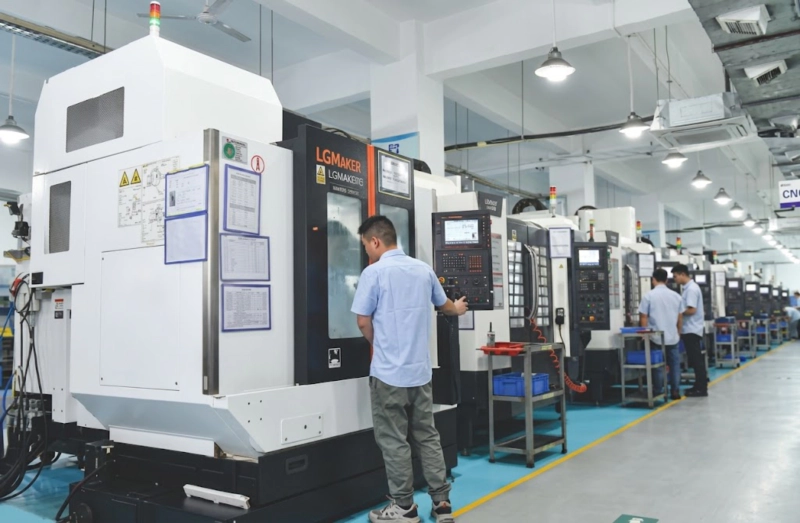
Welded steel frame, stress-relieved, with CNC-machined guide rails and bearing surfaces. The compact 1,000 mm-wide constant footprint across all 6 models means only the machine length extends with cavity count — simplifying factory floor planning. Frame height is constant at 1,600 mm, compatible with standard workshop doorways for easy installation without overhead crane access.
⚙ Blow Station
Toggle-link pneumatic mold clamping — appropriate for the semi-automatic cycle rate — with servo stretch rods providing ±0.1 mm axial positioning accuracy. The 30 kg/cm² blowing pressure (lower than the 35 kg/cm² used on full-automatic platforms) is optimised for the container volume range of this series and reduces compressor operating cost per bottle.
🔓 Blow Mold Tooling
HGS-series blow molds use the same aluminium alloy and conformal-cooling-channel standard as full-automatic machine molds — bottle quality and dimensional accuracy are equivalent. Mold cost for semi-automatic platforms is lower than for automatic machines (no preform mandrel tooling required, simpler oven interface). Changeover between bottle formats requires mold substitution only — 15–25 minutes versus 45–90 minutes on full-automatic lines — making multi-format small-batch production economically viable.
🌡 Separate Infrared Oven
The HGS series is supplied with (or compatible with) a matched infrared preform heating oven. The oven provides adjustable zone temperature control for different preform wall profiles and materials. Preform batch size in the oven matches cavity count — operators develop a workflow rhythm that keeps the oven output synchronised with the machine cycle time. Oven specifications are matched to the HGS model at the time of order.
📱 PLC Control
Siemens or Mitsubishi PLC with colour HMI touchscreen. Stretch rod position, blow pressure, blow duration, and cooling time are all PLC-controlled and stored per bottle format. Format recipe recall eliminates manual parameter setting at mold change — operators simply select the recipe for the new bottle format and begin production immediately after mold substitution.
📈 Scalable from HGS-1 to HGS-6
All six models share common spare parts for the blow station, PLC, and pneumatic system — simplifying maintenance inventory for operators running multiple HGS models. Mold tooling designed for a given neck and container envelope is interchangeable across HGS models of different cavity counts, reducing retooling cost when scaling from a smaller to a larger model.
6. Semi-Automatic vs. Fully Automatic — Which Is Right for You?
This is the most common question buyers ask when considering the HGS series. The answer depends on your production volume, product variety, investment stage, and operational environment. Neither platform is universally superior — each is optimal for specific conditions.
| Factor | HGS Semi-Automatic | ES / AS Fully Automatic |
|---|---|---|
| Capital Investment | Low — entry-level | Higher — full system |
| Throughput | 400–1,800 bph | 1,800–9,200 bph |
| Labour Requirement | 1 operator per machine | 1 operator per 2–4 machines |
| Mold Changeover | 15–25 minutes | 45–90 minutes |
| Mold Tooling Cost | Lower | Higher (incl. mandrel tooling) |
| Bottle Quality | Equivalent to automatic | Equivalent to semi-auto |
| Best For | Sampling, R&D, multi-format, entry-level commercial | Sustained single-format commercial production |
| Machine Footprint | 1.2–4.2 m × 1.0 m | 2.7–5.8 m × 1.5–2.1 m |
Many producers use the HGS series for product development and new bottle trials before investing in full-automatic ES or AS series machines for commercial production — a proven staged investment strategy.
7. Typical Application Scenarios
8. Model Selection Guide
| Your Requirement | Recommended Model |
|---|---|
| Bottle sampling, mold trials, R&D, single-cavity | HGS-1 (1 cavity, 400 bph, max 600 ml) |
| Small commercial production or multi-format flexibility, 2 cavity | HGS-2 (2 cavity, 750 bph, max 1,200 ml) |
| Regional brand entry-level production, 3 cavity | HGS-3 (3 cavity, 1,000 bph, max 1,800 ml) |
| Commercial production, 4 cavity, up to 2,500 ml | HGS-4 (4 cavity, 1,200 bph, max 2,500 ml) |
| Higher-volume semi-auto, 5 cavity, up to 3,000 ml | HGS-5 (5 cavity, 1,500 bph, max 3,000 ml) |
| Maximum semi-auto throughput, 6 cavity, up to 3,600 ml | HGS-6 (6 cavity, 1,800 bph, max 3,600 ml) |
9. Frequently Asked Questions
Ready to move to fully automatic production? Explore our ES and AS series automatic blow molding machines:
► Browse All Blow Molding Machines
✉ Request a Free Quotation
10. Work with a Specialist Manufacturer
With over two decades of experience in blow molding machine design and manufacturing, we supply HGS semi-automatic PET blow molding machines as entry-level, product-development, and multi-format production platforms to packaging converters, beverage brands, food producers, and R&D departments across more than 20 countries. The HGS series is backed by the same mold fabrication capability, spare-parts support, and after-sales engineering team as our full-automatic machine range.
Whether you are producing prototype bottles for a new brand launch, establishing entry-level commercial production for a regional beverage company, adding multi-format flexibility to an existing packaging operation, or building the in-house technical capability to operate full-automatic machines in the future, our team will provide a no-obligation specification review and delivered-cost comparison within 48 hours of enquiry.