A Practical Resin Selection Guide for Injection Blow Molding — Comparing the Three Most Important Container Thermoplastics Across Every Dimension That Matters in Production
Resin selection is the single most consequential decision in container design. It determines which blow molding process is viable, what performance properties the finished bottle will have, which chemical contents it can safely hold, whether it meets regulatory requirements for your market, and — ultimately — what it costs to produce at scale. Choose the wrong resin and you discover the mismatch in production: brittle failures, chemical permeation, regulatory non-compliance, or a process that simply cannot produce the container you specified.
PET, PP, and HDPE are the three resins that collectively dominate injection blow molding container production worldwide. Each has a distinct performance profile, a specific set of applications where it excels, and processing characteristics that determine machine requirements. This guide provides a thorough, technically grounded comparison across every dimension that matters to container designers, packaging engineers, and IBM machine buyers — so you can make the right resin choice before the mould is cut.
1. Quick Reference: Which Resin for Which Application
Before diving into the technical detail, here is the practical answer most buyers need — the dominant resin choice for each major container application in IBM production:
PET
- Water and beverage bottles
- Juice and sports drinks
- Clear cosmetic packaging
- Pharmaceutical PET thick-wall
- Food jars (clear, rigid)
- Edible oil containers
PP
- Pharmaceutical bottles (all types)
- Cosmetics and personal care
- Food condiment containers
- Oral care products
- Syrups and liquid medicines
- Hot-fill food packaging
HDPE
- Agrochemicals (pesticides, herbicides)
- Household cleaning products
- Industrial chemicals
- Motor oil and lubricants
- Bleach and disinfectants
- Agricultural inputs
The most common mistake: Specifying PET for pharmaceutical bottles “because it looks clearer” when PP delivers superior chemical resistance, autoclavability, and lower tooling cost. Or specifying PP for agrochemical containers when HDPE’s superior solvent and chemical barrier is required. Resin selection drives every downstream decision — always start with the application requirements, not the appearance preference.
2. PET (Polyethylene Terephthalate): Properties and IBM Applications
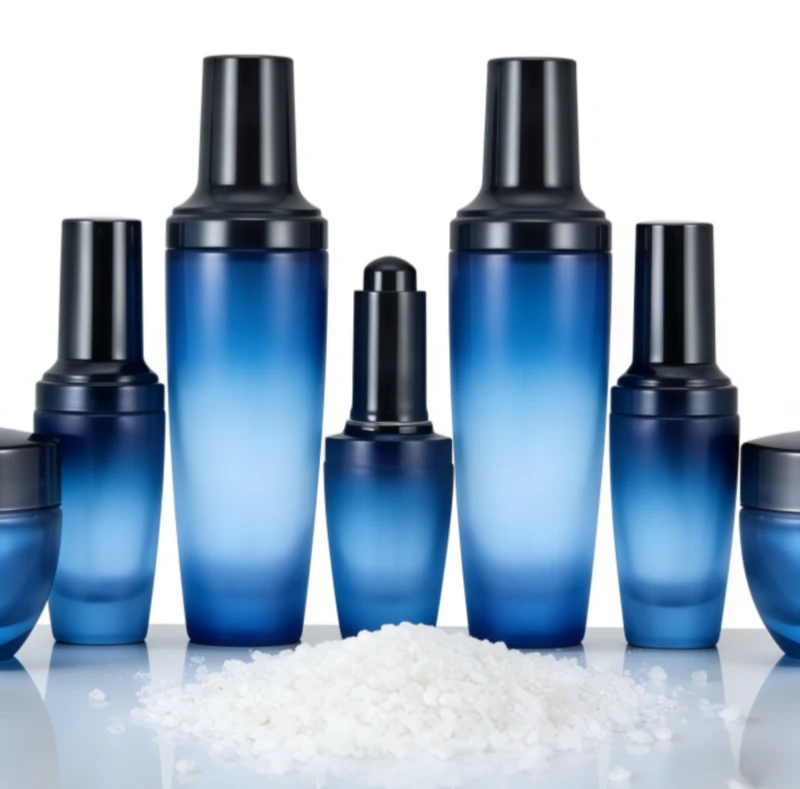
PET (Polyethylene Terephthalate) is the clearest, stiffest, and highest-barrier of the three resins. Its molecular structure — a semi-crystalline aromatic polyester — gives it properties that no commodity polyolefin can match: glass-like optical transparency, excellent CO2 and O2 barrier, high surface gloss, and good chemical resistance to dilute acids, alcohols, and many organic solvents.
Key Physical Properties of PET
1.35
g/cm3 density
250 to 260
degrees C melt point
80
degrees C HDT (amorphous)
Excellent
CO2 and O2 barrier
Water-clear
optical clarity (oriented)
1 rec.
recycle code
When PET Is the Right IBM Choice
- Beverage packaging requiring CO2 barrier — carbonated soft drinks, sparkling water, kombucha
- Clear cosmetic packaging where glass-like transparency is a primary brand requirement
- Food jars and containers where maximum clarity allows product colour display
- Pharmaceutical containers where PET is specified and thick-wall dimensions are required (IBM, not ISBM)
- Containers requiring low moisture vapour transmission — vitamins, supplements, moisture-sensitive products
PET IBM Limitations
- Not autoclavable — amorphous PET softens at 80 degrees C; crystalline PET (CPET) is autoclavable but not standard in IBM
- Poor resistance to strong acids, alkalis, and ketone solvents
- Must be dried before processing (hygroscopic — absorbs moisture that causes hydrolytic degradation at melt temperatures)
- Higher density than PP or HDPE means heavier containers at equivalent wall thickness
3. PP (Polypropylene): Properties and IBM Applications
PP (Polypropylene) is the workhorse resin of pharmaceutical and cosmetic IBM production. Its combination of chemical inertness, autoclavability, clarity (in clarified/nucleated grades), FDA and USP compliance, and excellent processing characteristics make it the dominant resin for injection blow molded bottles in regulated applications worldwide.
PP’s semi-crystalline structure gives it a higher melting point than HDPE (160 to 165 degrees C vs 130 to 135 degrees C) and significantly better stiffness at elevated temperatures. This is why PP is the standard resin for pharmaceutical containers that may undergo steam sterilisation, autoclaving, or hot-fill processes — and why it dominates cosmetic packaging where surface quality, gloss, and resistance to personal care formulations are priorities.
Key Physical Properties of PP
0.90 to 0.91
g/cm3 density (lightest)
160 to 165
degrees C melt point
100 to 120
degrees C HDT
Good
moisture barrier
Good to Excellent
clarity (clarified grades)
5 rec.
recycle code
When PP Is the Right IBM Choice
- Pharmaceutical bottles of every type — PP’s FDA/USP Class VI compliance, inertness, and autoclavability make it the default pharmaceutical IBM resin
- Cosmetic packaging where a premium surface finish, soft touch, or semi-translucent aesthetic is preferred over full transparency
- Hot-fill food containers — PP’s higher HDT allows filling at temperatures that would distort PET
- Oral care products — mouthwash, whitening gel, oral hygiene liquid containers
- Vitamin and supplement bottles — moisture barrier adequate for most dry supplement formats
- Personal care liquids — shampoos, lotions, creams, gels compatible with PP chemistry
PP IBM Limitations
- Lower optical clarity than PET in standard grades (though clarified/nucleated PP approaches PET clarity)
- Poor resistance to aromatic and chlorinated solvents — not suitable for containers holding these chemistries
- Lower CO2 barrier than PET — not suitable for carbonated beverage applications
- Slightly higher shrinkage than PET, requiring more careful mould temperature control for dimensional precision
4. HDPE (High-Density Polyethylene): Properties and IBM Applications
HDPE (High-Density Polyethylene) is the most chemically resistant of the three resins and the only viable IBM resin choice for containers holding concentrated agrochemicals, aromatic solvents, industrial cleaning compounds, and other harsh chemical formulations that would permeate or stress-crack PP or PET. Its highly crystalline structure, low polarity, and excellent solvent resistance make it uniquely suited to applications where chemical barrier and durability under harsh conditions are the primary requirements.
HDPE is opaque in its natural form — the high degree of crystallinity causes light scattering that eliminates transparency. This is not a limitation for most of its applications (agrochemical and industrial chemical containers), but it does mean HDPE is not a viable choice where container transparency is a requirement.
Key Physical Properties of HDPE
0.94 to 0.97
g/cm3 density
130 to 135
degrees C melt point
60 to 85
degrees C HDT
Excellent
solvent and chemical barrier
Opaque
natural colour
2 rec.
recycle code
When HDPE Is the Right IBM Choice
- Agrochemical containers — pesticides, herbicides, fungicides, fertiliser concentrates (HDPE UN certification standard)
- Industrial chemical containers — solvents, acids (dilute), caustic solutions, cleaning compounds
- Household chemicals — bleach, drain cleaners, heavy-duty disinfectants
- Lubricants and motor oils — hydrocarbon resistance superior to PP and PET
- Paint and coating containers — HDPE’s solvent resistance handles most paint chemistry
- Containers requiring UN certification for hazardous materials transport — HDPE is the standard IBM resin for UN-certified containers
HDPE IBM Limitations
- Opaque — not suitable for any application requiring container transparency
- Lower HDT than PP — not suitable for hot-fill applications
- Cannot be ISBM-processed — HDPE does not develop useful bi-axial orientation under stretch conditions
- Higher mould shrinkage than PET — dimensional tolerancing requires attention in precision neck applications
- Limited colour clarity in coloured grades — pigment dispersion is functional but not cosmetic-grade
5. Physical Properties Compared: Full Data Table
| Property | PET | PP | HDPE |
|---|---|---|---|
| Density (g/cm3) | 1.33 to 1.37 | 0.90 to 0.91 (lightest) | 0.94 to 0.97 |
| Melt temperature (degrees C) | 250 to 260 | 160 to 165 | 130 to 135 |
| IBM processing temp (degrees C) | 265 to 285 | 210 to 240 | 170 to 220 |
| HDT at 0.45 MPa (degrees C) | 70 to 80 | 100 to 120 (best) | 60 to 85 |
| Tensile strength (MPa) | 55 to 75 (highest) | 30 to 40 | 20 to 35 |
| Flexural modulus (GPa) | 2.5 to 3.5 (stiffest) | 1.4 to 1.8 | 0.8 to 1.6 |
| Optical clarity | Excellent (water-clear when oriented) | Good to Very Good (clarified grades) | Opaque |
| CO2 barrier | Excellent | Good | Moderate |
| Moisture vapour barrier | Excellent | Good | Excellent |
| Chemical resistance (solvents) | Good (dilute acids, alcohols) | Good (most chemicals) | Excellent (broadest range) |
| Autoclavable (121 degrees C) | No (standard PET) | Yes | No (HDT too low) |
| Hot-fill capability (85 degrees C) | No (standard PET) | Yes | No |
| FDA food contact compliance | Yes | Yes | Yes |
| USP Class VI / pharmaceutical | Yes (specific grades) | Yes (standard) | Yes (selected grades) |
| UN hazmat certification | Limited | Selected applications | Yes (standard for agrochem) |
| Drying required before IBM | Yes (4 to 6 h at 160 to 180 degrees C) | No (non-hygroscopic) | No (non-hygroscopic) |
| ISBM compatible (bi-axial stretch) | Yes (primary ISBM resin) | Limited | No |
| Relative resin cost | Medium to High | Low to Medium | Low to Medium |
| Global recycle infrastructure | Excellent (most recycled plastic) | Developing | Good |
6. Chemical Resistance: Which Resin Holds Which Contents
Chemical compatibility between resin and container contents is non-negotiable. The wrong resin will permeate, stress-crack, swell, or degrade over time — resulting in product loss, regulatory non-compliance, or — in agricultural and pharmaceutical applications — contaminated or ineffective product reaching end users. The following table covers the most common container content categories:
| Content Category | PET | PP | HDPE | Recommended Resin |
|---|---|---|---|---|
| Water (still) | Excellent | Excellent | Excellent | PET (clarity + barrier) |
| Carbonated beverages | Excellent (CO2 barrier) | Moderate | Poor | PET only |
| Juice and acidic drinks | Excellent | Excellent | Good | PET (clarity preferred) |
| Oral pharmaceuticals (liquids) | Good | Excellent | Moderate | PP (standard) |
| Solid pharmaceutical dosage (tablets) | Excellent | Excellent | Good | PP (autoclave option) |
| Eye drops and ophthalmic | Moderate | Excellent | LDPE preferred | PP or LDPE |
| Cosmetics (lotions, creams) | Good | Excellent | Moderate | PP (surface quality) |
| Edible oil and cooking fats | Excellent | Excellent | Good | PET (clarity + barrier) |
| Pesticides and herbicides | Poor | Moderate | Excellent | HDPE only |
| Bleach and hypochlorite | Poor | Moderate | Excellent | HDPE only |
| Aromatic solvents (toluene, xylene) | Poor | Poor | Good | HDPE (or fluorinated) |
| Motor oil and lubricants | Moderate | Moderate | Excellent | HDPE |
| Household cleaning (non-oxidising) | Moderate | Good | Excellent | HDPE preferred |
| Ethanol and alcohols | Good | Good | Good | PP (pharma) / PET (food) |
7. Optical Clarity and Surface Quality
.webp)
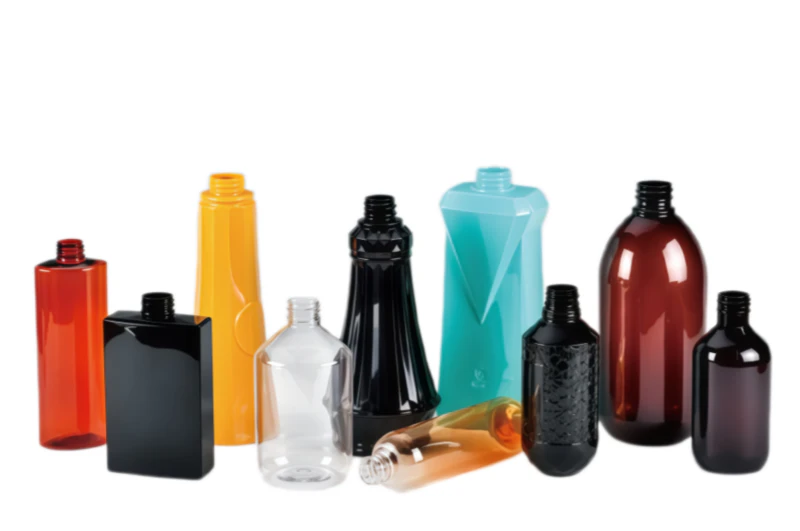
Optical clarity is often the first characteristic buyers notice and discuss — but it should rarely be the primary selection criterion. Chemical compatibility, regulatory compliance, and performance requirements must drive resin selection; clarity is a secondary constraint. That said, clarity differences between PET, PP, and HDPE are significant and commercially important in applications where they matter.
PET Clarity
PET in its bi-axially oriented state (ISBM) achieves true water-clear transparency — the highest optical clarity available from any commodity packaging plastic. Haze values below 2 to 3 percent are standard for ISBM-produced PET. IBM-produced amorphous PET has slightly higher haze than ISBM-produced PET but remains very clear compared to PP. The high refractive index of PET also gives containers a glass-like brilliance under showroom lighting that is commercially valuable in premium beverage and cosmetic applications.
PP Clarity
Standard PP homopolymer is semi-translucent — light transmits through the wall but the view of container contents is hazy and distorted. For applications requiring clear PP, clarified or nucleated PP grades (containing a nucleating and clarifying agent such as millad NX8000 or equivalent) achieve haze values of 3 to 8 percent — approaching PET optical quality in thin-wall sections. Clarified PP is the standard resin for pharmaceutical bottles that must show fill level and cosmetic bottles where a “frosted glass” aesthetic is designed-in.
HDPE Clarity
HDPE is inherently opaque. Its highly crystalline structure scatters light completely — natural HDPE appears milky white. There is no clarity-improving additive that makes HDPE transparent or even semi-translucent in practical container wall thicknesses. HDPE containers are pigmented or remain natural white. If product visibility through the container wall is a commercial requirement, HDPE is not a viable resin choice — PET or PP must be selected regardless of other properties.
8. Regulatory Compliance: Food Contact, Pharmaceutical, and Agrochemical
| Regulatory Requirement | PET | PP | HDPE |
|---|---|---|---|
| FDA 21 CFR food contact | Yes (21 CFR 177.1630) | Yes (21 CFR 177.1520) | Yes (21 CFR 177.1520) |
| EU Regulation 10/2011 food contact | Yes | Yes | Yes |
| USP Class VI (pharmaceutical) | Yes (selected grades) | Yes (standard — most grades) | Yes (selected grades) |
| EP/JP pharmacopeial compliance | Good | Excellent (primary) | Limited |
| UN certification for hazardous goods | Limited | Limited | Yes (standard for Group I/II) |
| FAO/WHO pesticide container standards | Not recommended | Limited applications | Yes (standard) |
| Autoclave / steam sterilisation (121 degrees C) | No (standard PET) | Yes | No (HDT insufficient) |
| Child-resistant closure compatibility | Yes | Yes (standard for pharma CRC) | Yes |
Pharmaceutical resin selection note: PP is the de facto standard resin for pharmaceutical injection blow molded containers globally. It meets USP Class VI in virtually all commercial pharmaceutical-grade PP grades, is autoclavable at 121 degrees C, does not leach plasticisers (unlike PVC), and has an established regulatory track record in most pharmacopoeias including EP, USP, JP, and ChP. Unless a specific pharmaceutical formulation requires PET (moisture-sensitive vitamins, certain liquid formulations) or LDPE (squeeze containers), PP should be the default pharmaceutical IBM resin choice.
9. IBM Processing: How Each Resin Behaves in the Machine
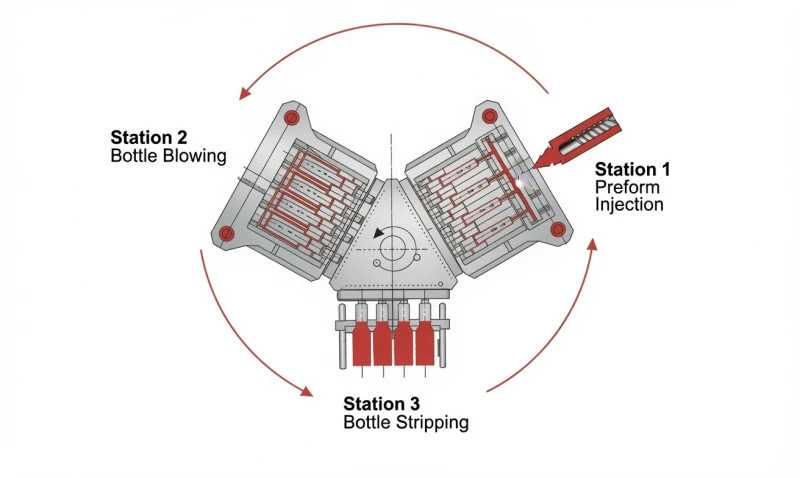
Each resin processes differently in the IBM machine. Understanding these differences guides machine specification, barrel zone temperature setup, and production parameter optimisation:
10. Cost Comparison: Resin Price, Cycle Time, and Total Production Cost
Resin cost is the largest variable operating cost in IBM production — typically 60 to 75 percent of the total variable cost per bottle. The relative resin price positions of PET, PP, and HDPE fluctuate with crude oil and feedstock prices, but their relative order is generally consistent:
PET Resin Cost
PET is typically the most expensive of the three resins, reflecting higher feedstock processing complexity (aromatic polyester vs simple polyolefins). However, PET’s higher density (1.35 vs 0.90 to 0.97 g/cm3) means that a lower wall thickness can sometimes compensate at the per-bottle level. PET also requires a desiccant dryer (capital investment and operating cost) and has a narrower processing window that increases reject rate risk.
Indicative price: 15 to 30 percent premium over PP in typical markets
PP Resin Cost
PP is generally the lowest or near-lowest cost resin of the three per kilogram, while also being the lightest (0.90 to 0.91 g/cm3 density). This combination of low per-kg price and low density translates to the lowest resin cost per container in most IBM pharmaceutical and cosmetic applications. PP also requires no drying, reducing energy and equipment cost versus PET processing.
Indicative price: typically the lowest-cost IBM resin per container
HDPE Resin Cost
HDPE sits close to PP in per-kg price — slightly higher in most markets due to different catalyst and production processes, but significantly lower than PET. HDPE containers for agrochemical applications typically use more resin per container (thicker walls required for chemical permeation resistance and UN certification), partially offsetting the lower per-kg price advantage relative to PP pharmaceutical containers.
Indicative price: 5 to 15 percent premium over PP; 10 to 25 percent below PET
| Total Cost Factor | PET | PP | HDPE |
|---|---|---|---|
| Resin cost per kg (relative) | High | Lowest | Low-Medium |
| Density (weight per container) | Heaviest (1.35 g/cm3) | Lightest (0.90 g/cm3) | Medium (0.95 g/cm3) |
| Drying energy/equipment | Required (desiccant dryer) | None needed | None needed |
| Processing temp (barrel energy) | Highest (265 to 285 degrees C) | Medium (210 to 240 degrees C) | Lowest (170 to 220 degrees C) |
| Typical cycle time (IBM) | Comparable | Comparable | Comparable |
| Overall cost per container (relative) | Highest | Lowest (pharma/cosmetics) | Medium (agrochem applications) |
11. Sustainability and Recyclability
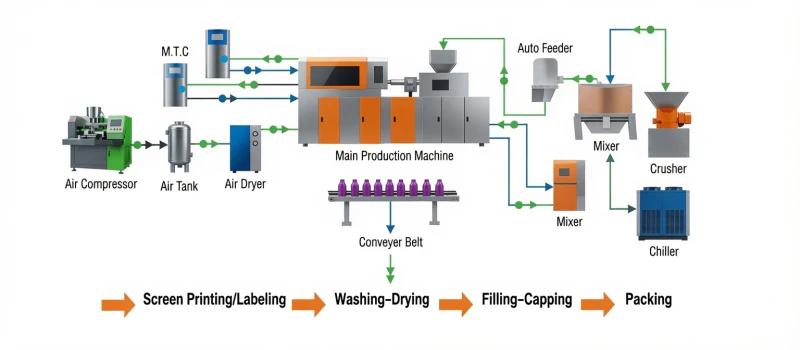
PET Sustainability
PET has the most developed global recycling infrastructure of any packaging plastic. Recycle code 1 (PETE) is accepted in most municipal recycling programmes in Europe, North America, and increasingly in Asia. Mechanical recycling of PET into rPET (recycled PET) is commercially established, and rPET is used in food-contact packaging (with appropriate FDA/EFSA authorisation). Chemical recycling routes (glycolysis, methanolysis) return PET to monomer for truly circular production. The growing rPET content requirements in European packaging legislation make PET’s recyclability a commercial advantage for consumer-facing brands.
PP Sustainability
PP (recycle code 5) has historically lower recycling rates than PET due to lower collection rates and more complex sortation requirements. However, PP recycling infrastructure is growing rapidly in response to extended producer responsibility (EPR) legislation in Europe and single-use plastics directives. rPP grades are increasingly available for non-food-contact container applications. PP’s very low density (0.90 to 0.91 g/cm3) gives it the lowest weight per container and therefore the lowest embedded resin mass — a meaningful sustainability advantage when comparing containers of equivalent volume and performance.
HDPE Sustainability
HDPE (recycle code 2) has good recycling infrastructure in most developed markets — HDPE milk bottles and personal care containers are among the most commonly recycled plastic containers globally. However, HDPE used in agrochemical and industrial chemical containers faces recycling barriers: contamination by residual chemical content, regulatory restrictions on rinsed agrochemical container recycling, and the specialist handling required for hazardous material containers. In many markets, agrochemical HDPE containers are managed through dedicated collection and recycling schemes such as CleanFarming (UK) and CROP LIFE programmes.
IBM process sustainability note: All three resins benefit from IBM’s zero-flash production process. Unlike extrusion blow molding where every container has a bottom pinch-off and potential body flash requiring trimming and grinding, IBM produces finished containers with zero material waste at the machine. Every gram of PET, PP, or HDPE injected becomes a finished container wall — no trim, no regrind, no quality downgrades from recycled flash. This zero-scrap characteristic is one of IBM’s intrinsic sustainability advantages over EBM, independent of resin type.
12. Resin Selection Framework by Application
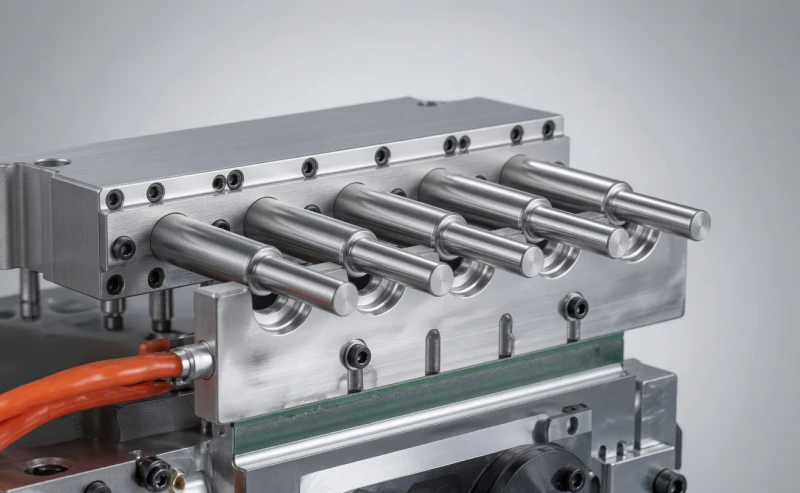
The following decision tree covers the most common resin selection scenarios. Work through the questions relevant to your application:
Pharmaceutical Containers (oral liquids, tablets, eye drops, syrups)
Default choice: PP. PP’s USP Class VI compliance, autoclavability, compatibility with the widest range of pharmaceutical formulations, and lowest cost per container make it the standard pharmaceutical IBM resin. Choose clarified PP for containers requiring transparency. Choose LDPE (squeezable) for eye drops and similar soft-squeeze containers. Use PET only when the formulation specifically requires PET properties (moisture-sensitive vitamins, specific liquid compatibility) and autoclavability is not required.
Cosmetic and Personal Care Packaging (lotions, serums, creams, mouthwash)
For opaque or frosted containers: PP. Premium surface quality, resistance to cosmetic formulations, and low density make PP the standard. For water-clear, glass-like transparent containers: PET (or PETG for maximum optical quality). The resin choice should be made after confirming compatibility between the formulation’s preservative system and the chosen resin — some alcohol-based preservatives may interact differently with PP versus PET. HDPE is not appropriate for cosmetic applications due to opacity.
Agrochemical Containers (pesticides, herbicides, fungicides, fertilisers)
Default choice: HDPE. HDPE’s superior chemical barrier to aromatic solvents and emulsifiable concentrates, UN certification availability, and established regulatory history in FAO/WHO agrochemical packaging standards make it the only viable IBM resin for most agrochemical applications. PP may be acceptable for water-based formulations with confirmed compatibility, but HDPE is the safe default. PET is not appropriate for agrochemical applications.
Food and Beverage Containers (water, juice, condiments, sauces)
For carbonated beverages and juice (transparency + CO2 barrier): PET. No other IBM resin provides the CO2 barrier required for carbonated beverages. For still water and non-carbonated beverages where transparency is desired, PET is standard. For condiments, sauces, honey, and hot-fill food: PP. PP’s hot-fill capability (HDT 100 to 120 degrees C), chemical resistance to acidic sauces, and lower cost make it the choice for non-beverage food containers. HDPE is appropriate for cooking oil if transparency is not required.
Household and Industrial Chemical Containers (bleach, cleaners, solvents, lubricants)
Default choice: HDPE. Oxidising chemicals (bleach, hydrogen peroxide, pool chemicals) and hydrocarbon-based products (motor oil, lubricants, paint thinners) require HDPE’s broad chemical resistance. PP may be acceptable for mild cleaning concentrates with confirmed compatibility. PET should not be specified for household chemical applications where oxidising agents, strong alkalis, or aromatic solvents are present.
13. Frequently Asked Questions
Q: Can the same IBM machine process PET, PP, and HDPE without modification?
Yes. The IBM machine hardware is compatible with all three resins. Switching between resins requires: a barrel purge with the incoming resin (or a purging compound) to remove the previous resin from the barrel and screw, a temperature profile change to the new resin’s processing window, and a recipe recall for the new product. No mechanical modification to the machine, screw, or injection unit is required between standard IBM resins. The mould tooling is optimised for each resin’s shrinkage and processing characteristics, so moulds are typically resin-specific even when the machine is resin-flexible.
Q: Is clarified PP really as clear as PET for pharmaceutical bottles?
Modern clarified PP grades with nucleating agents (such as sorbitol-based or phosphate-ester clarifiers) can achieve haze values of 3 to 8 percent in IBM container wall thicknesses — approaching but not quite equalling the 1 to 3 percent haze of ISBM PET. For pharmaceutical bottles where the regulatory requirement is to see fill level and detect visible particulates, clarified PP provides fully adequate and commercially accepted transparency. For applications where glass-like optical brilliance is a brand requirement (premium cosmetics, premium beverage), PET’s superior clarity is commercially significant. The choice between clarified PP and PET for pharmaceutical applications is typically driven by chemical compatibility, autoclavability requirement, and cost — not by optical performance alone.
Q: Why can’t HDPE be processed by ISBM (injection stretch blow molding)?
ISBM requires the preform to be stretched to 2.5 to 3 times its original length axially (by the stretch rod) and 3 to 4.5 times radially (by air inflation). PET undergoes strain-induced crystallisation during this stretching, which “locks in” the bi-axial molecular orientation and produces the improved properties associated with ISBM PET. HDPE’s molecular structure does not support the same strain-induced crystallisation mechanism under ISBM stretch ratios and temperatures. Under ISBM stretch conditions, HDPE either fails (tears) at excessive stretch ratios, or produces minimal useful molecular orientation that does not improve container properties compared to simple IBM blowing. IBM is the correct and only effective injection blow process for HDPE containers.
Q: How do I confirm chemical compatibility between my formulation and the container resin?
Chemical compatibility testing between the product formulation and the container resin is an essential step before production launch. The standard approach is a fill-and-seal compatibility test: fill the finished container with the actual product formulation, seal it, and store at accelerated aging conditions (typically 40 degrees C / 75 percent RH for 3 to 6 months, equivalent to approximately 1 to 2 years at ambient). Test for: container dimensional change, weight change (permeation), resin stress cracking, change in product pH or active ingredient concentration, and appearance change in both container and product. Our team can advise on compatibility test protocols and share compatibility data for common formulation types with PET, PP, and HDPE IBM containers based on our production experience.
Q: Can recycled resin (rPET, rPP, rHDPE) be used in IBM production?
Recycled resins can be used in IBM production subject to regulatory compliance for the intended application and quality consistency requirements. rPET for food-contact applications requires specific FDA/EFSA authorisation (the HDAS or LOI process) and must have demonstrated consistent IV and contamination levels. rPP and rHDPE can be used in non-food-contact applications (industrial containers, household chemicals) without these authorisation steps, but quality consistency — particularly melt flow rate, contamination level, and colourant carryover — must be verified for each regrind batch. Pharmaceutical applications uniformly require virgin resin with full certificate of analysis; recycled content is not permitted in pharma IBM containers under current pharmacopoeial standards.
14. Conclusion
PET, PP, and HDPE each have a distinct, defensible domain in injection blow molded container production — and choosing correctly between them requires understanding the chemistry of your product, the performance requirements of your container, the regulatory framework of your market, and the processing characteristics of each resin in the IBM machine.
The Three-Line Summary
When clarity, CO2 barrier, and stiffness are primary — beverage, transparent food, clear cosmetic PET. Highest cost, highest optical performance, requires drying.
When pharmaceutical compliance, autoclavability, chemical inertness, and lowest cost per container are required — the default choice for pharmaceutical, cosmetic, and hot-fill food IBM.
When broad chemical resistance, UN certification, or aromatic solvent barrier is required — the only viable choice for agrochemical, industrial chemical, and solvent-based product IBM containers.
If you are unsure which resin is right for your specific container and formulation, our engineering team provides resin selection consultation free of charge — drawing on our experience with PET, PP, HDPE, LDPE, PETG, and PVC IBM production across pharmaceutical, cosmetic, food, agrochemical, and industrial applications worldwide.
Get Free Resin Selection Advice for Your Container Project
Tell us your container application, product formulation category, volume, and any regulatory requirements. Our team will recommend the right resin, the right IBM process, and the right machine — with a factory-direct quote — within 24 hours.