
The Three Most Important Numbers in IBM Machine Selection — and a Step-by-Step Framework for Matching ZQ40, ZQ60, and ZQ80 to Your Container, Cavity Count, and Annual Volume
Selecting the wrong IBM machine model is an expensive mistake in both directions. An underpowered machine — insufficient clamping force, too-small platen, inadequate shot weight — produces containers with quality problems or simply cannot fit the mould. An overspec’d machine — buying a ZQ80 for a 6-cavity 30 ml vial application — wastes capital and floor space while delivering no quality or output benefit over the smaller, correctly-sized model.
IBM machine selection is an engineering calculation, not a preference. The three governing parameters — injection clamping force, platen size, and shot weight — are determined by the container design, cavity count, and resin. Once you calculate these three values, the correct machine model selects itself. This guide walks through the calculation methodology step by step, then applies it to the most common IBM container applications to show exactly why ZQ40, ZQ60, and ZQ80 map to the container categories they do.
1. The Three Governing Parameters of IBM Machine Selection
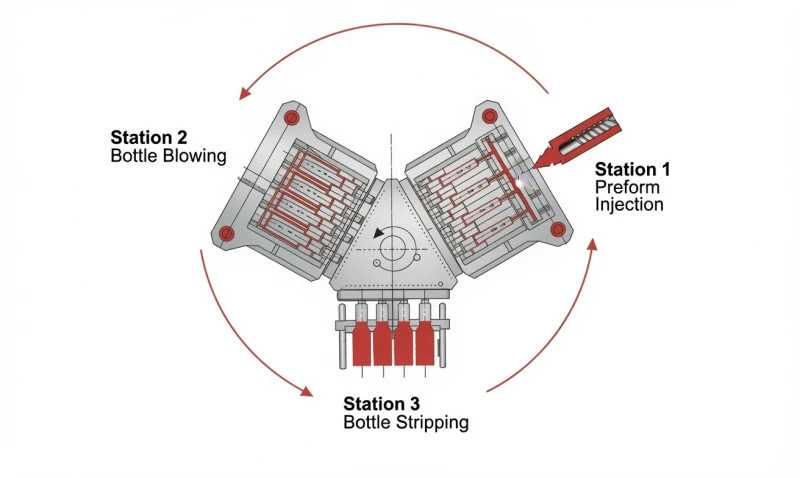
1
Injection Clamping Force
The force required to hold the injection cavity closed against the melt pressure during the injection phase. Calculated from cavity pressure, projected parison area, cavity count, and a safety factor. This is the machine’s rated KN specification and the primary selection driver.
2
Platen Size
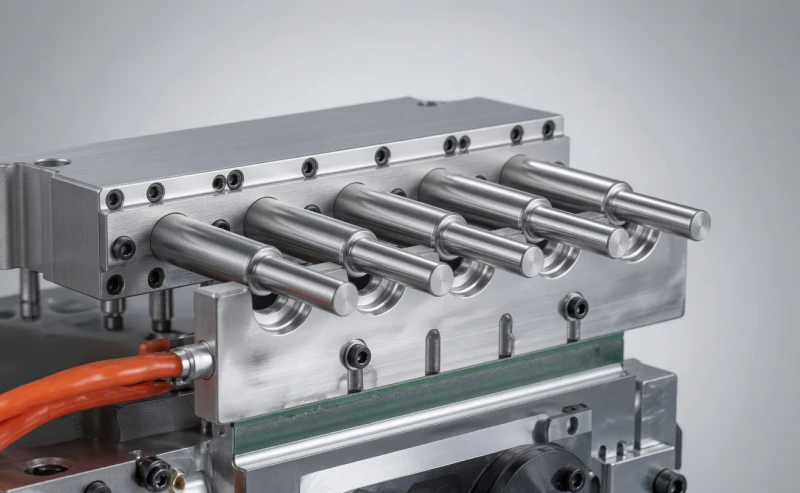
The injection cavity block footprint — the area required to mount all cavities side by side on the machine’s injection platen — must fit within the machine’s rated platen dimensions. As cavity count increases, the cavity block grows; the platen must accommodate it.
3
Shot Weight Capacity
The total weight of all parisons injected per cycle (cavities x parison weight per cavity) must not exceed the machine’s rated maximum shot weight. Exceeding shot weight capacity produces short shots and weight variation across the cavity array.
The selection rule: Calculate the required clamping force, verify the platen fits the mould, and confirm shot weight capacity. The smallest ZQ model whose specifications exceed all three calculated requirements on all three dimensions is the correct selection. Do not select a larger model “for headroom” unless a specific future capacity expansion is planned — oversized machines add capital cost, floor space, and energy consumption without production benefit.
2. Step 1 — Calculate Required Injection Clamping Force
The injection clamping force is the force the machine must exert to hold the injection cavity closed against the internal melt pressure during the injection and hold phases. The calculation formula is:
F (KN) = P x A x N x SF x 0.1
Cavity Pressure by Resin
| Resin | Typical Cavity Pressure (MPa) | Notes |
|---|---|---|
| LDPE | 40 to 65 | Lowest cavity pressure of any IBM resin — low viscosity, easy fill |
| PP | 70 to 100 | Standard pharmaceutical and cosmetic IBM resin — moderate cavity pressure |
| HDPE | 75 to 110 | Higher viscosity than PP; thick-wall agrochemical and drench containers increase projected area |
| PET | 90 to 130 | Highest cavity pressure in IBM — high melt viscosity and fast freeze time require high injection pressure |
Worked Calculation Examples
Example A — 30 ml PP vial, 8 cavities
F = 85 x 1.8 x 8 x 1.3 x 0.1 = 159 KN → ZQ40 (400 KN) is more than adequate
Example B — 100 ml PP syrup bottle, 6 cavities
F = 90 x 4.2 x 6 x 1.3 x 0.1 = 295 KN → ZQ40 (400 KN) adequate; ZQ60 gives more headroom
Example C — 500 ml HDPE agrochemical bottle, 4 cavities
F = 100 x 12.6 x 4 x 1.3 x 0.1 = 655 KN → ZQ80 (800 KN) required; ZQ60 (600 KN) is insufficient
Example D — 10 ml PET cosmetic serum bottle, 12 cavities
F = 110 x 1.2 x 12 x 1.3 x 0.1 = 206 KN → ZQ40 (400 KN) adequate on force; but platen must also be checked (Step 2)
3. Step 2 — Verify Platen Size Fits the Mould Footprint
Even when clamping force calculation points to a smaller machine, the platen area required to mount all cavities side by side may require the next model up. This is the second governing parameter and commonly upgrades the selection from ZQ40 to ZQ60 in high-cavity-count small-format applications.
The injection cavity block footprint is approximately:
Block Width ≈ (Cavity Pitch x N) + Edge Clearance
Where cavity pitch = cavity outer diameter + inter-cavity wall thickness (typically 20 to 40 mm). Block height ≈ single cavity height + manifold depth + cooling connections.
| Container + Cavities | Est. Block Width (mm) | ZQ40 Platen (480 mm) | ZQ60 Platen (600 mm) | ZQ80 Platen (800 mm) |
|---|---|---|---|---|
| 5 ml vial, 8 cavities | ~260 mm | Fits | Fits | Fits |
| 10 ml vial, 12 cavities | ~380 mm | Fits | Fits | Fits |
| 10 ml vial, 16 cavities | ~490 mm | Too small | Fits (ZQ60HE preferred) | Fits |
| 100 ml syrup, 6 cavities | ~420 mm | Fits (marginal) | Fits comfortably | Fits |
| 200 ml lotion bottle, 4 cavities | ~380 mm | Fits | Fits | Fits |
| 500 ml HDPE drench, 4 cavities | ~560 mm | Too small | Too small | Fits |
| 1,000 ml HDPE drench, 2 cavities | ~420 mm | Too small | Marginal | Fits |
The 16-cavity platen upgrade pattern: The most common scenario where platen size — rather than clamping force or shot weight — drives machine selection from ZQ40 to ZQ60 is the 16-cavity 5 to 15 ml small-format pharmaceutical vial. At 16 cavities, the injection cavity block width typically reaches 480 to 520 mm — right at or just beyond the ZQ40’s 480 mm platen. The ZQ60’s 600 mm platen accommodates this without issue. This is why the ZQ60HE (600 x 420 mm platen) is the preferred machine for 12 to 16-cavity small-format pharmaceutical production despite the ZQ40 having adequate clamping force at the calculated injection load.
4. Step 3 — Confirm Shot Weight Capacity
Shot weight capacity is the third check and rarely the binding constraint for small-format IBM, but becomes important when cavity count is high or container parison weight is above average. The calculation is simple:
Total Shot Weight = Parison Weight per Cavity x Number of Cavities + Runner Weight
Total shot weight must be less than 80 percent of the machine’s rated maximum shot weight. Operating at 80 to 90 percent of rated shot weight reduces shot repeatability and increases barrel wear; operating above 90 percent risks shot-to-shot variation and is not recommended for pharmaceutical production.
| Example | Parison Weight | Cavities | Runner Est. | Total Shot | Machine Check |
|---|---|---|---|---|---|
| 5 ml LDPE eye drop, 16 cavities | 2.5 g | 16 | 12 g | 52 g | ZQ40 (190 g max) — fine |
| 100 ml PP syrup, 6 cavities | 18 g | 6 | 15 g | 123 g | ZQ60 (260 g max) — fine |
| 200 ml PP lotion, 4 cavities | 38 g | 4 | 14 g | 166 g | ZQ60 (260 g max) — fine |
| 500 ml HDPE drench, 4 cavities | 95 g | 4 | 20 g | 400 g | ZQ80 (466 g max) — fine |
| 500 ml HDPE drench, 6 cavities | 95 g | 6 | 24 g | 594 g | ZQ80 (466 g max) — EXCEEDS; need ZQ110 |
5. ZQ40, ZQ60, ZQ80 — Full Model Profiles and Design Centres
.webp)
6. Application Mapping: Which Model for Which Container
| Application | Volume | Resin | Cavities | Calc. Force | Model |
|---|---|---|---|---|---|
| Eye drop / ophthalmic | 5 to 15 ml | LDPE | 12 to 16 | 60 to 120 KN | ZQ60HE* |
| Oral drops / pediatric vial | 10 to 30 ml | PP | 8 to 12 | 100 to 200 KN | ZQ40 or ZQ60 |
| Cosmetic serum / fragrance mini | 5 to 30 ml | PET / PP | 8 to 16 | 80 to 210 KN | ZQ40 / ZQ60HE* |
| Companion animal oral solution | 30 to 100 ml | PP | 6 to 10 | 130 to 280 KN | ZQ40 or ZQ60HE |
| Pharmaceutical syrup bottle | 100 to 300 ml | PP | 4 to 6 | 200 to 380 KN | ZQ60 / ZQ60HE |
| Cosmetic lotion / body care | 100 to 300 ml | PP | 2 to 4 | 150 to 320 KN | ZQ60 |
| Small HDPE agrochemical | 100 to 250 ml | HDPE | 4 to 6 | 200 to 430 KN | ZQ60 |
| HDPE agrochemical standard | 500 ml | HDPE | 4 | ~655 KN | ZQ80 |
| Veterinary drench bottle | 500 to 1,000 ml | HDPE | 2 to 4 | 350 to 750 KN | ZQ80 |
| Shampoo / body wash large | 300 to 500 ml | PP | 2 to 4 | 300 to 500 KN | ZQ60 or ZQ80 |
* ZQ60HE selected over ZQ40 for 12 to 16-cavity configurations due to platen size constraint, not clamping force.
7. Where ZQ60HE Fits: All-Electric Upgrade Considerations
The ZQ60HE all-electric is not a separate model category — it is the all-electric variant of the ZQ60 platform. Its specifications overlap with both ZQ40 and ZQ60 in terms of force and shot weight, but it adds three capabilities that neither hydraulic model provides:
Variable Clamping
400 to 800 KN variable, recipe-stored. A single ZQ60HE can run a 5 ml 16-cavity LDPE mould (needing ~80 KN) and a 200 ml 4-cavity PP mould (needing ~350 KN) on the same machine with recipe-driven clamping change. No mechanical adjustment, 2 to 4-hour changeover total.
2.5 s Dry Cycle
37% faster than the 4.0 s hydraulic ZQ60. At small-format thin-wall containers where cooling time is short, the ZQ60HE’s mechanical speed advantage is the largest share of total cycle — delivering 25 to 35% more output per machine per day at equivalent cavity count.
Zero Hydraulic Oil
Mandatory for pharmaceutical GMP clean-room operations. Also eliminates the ongoing hydraulic oil management cost (oil changes, seal inspection, oil sampling, disposal) — estimated at USD 3,000 to 6,000 per machine per year on a maintained pharmaceutical IBM line.
The ZQ60HE selection trigger: If any one of the following is true, specify ZQ60HE over ZQ60 for your project: (1) the operation is in a pharmaceutical GMP environment, (2) the annual container volume exceeds 40 million units per machine, (3) the product mix includes more than 3 container SKUs requiring changeover, or (4) the container is a precision pharmaceutical vial where plus or minus 0.1% shot repeatability improves IPC performance. If none apply — cost-constrained cosmetic contract packaging, single-SKU high-volume standard containers, or non-GMP agrochemical production — the hydraulic ZQ60 is a legitimate and economical selection.
8. When to Consider ZQ110 and ZQ135
ZQ110 and ZQ135 are selected when calculated clamping force exceeds the ZQ80’s 800 KN, or when the mould footprint requires more than the ZQ80’s 800 mm platen width. The specific triggers:
| Model | Clamp (KN) | Shot (g) | Platen (mm) | Select When |
|---|---|---|---|---|
| ZQ110 | 1,100 | 540 g | 1,100 x 460 | 1,000 ml HDPE at 4 to 6 cavities; 500 ml HDPE at 6+ cavities; any application where calculated force is 800 to 1,100 KN |
| ZQ135 | 1,350 | 650 g | 1,300 x 500 | 2,000 ml HDPE at 2 to 4 cavities; maximum output large-format lines; applications where calculated force exceeds 1,100 KN |
The step from ZQ80 to ZQ110 is triggered most commonly by either: (a) the agrochemical producer needing 6 cavities of 500 ml HDPE (calculated force approximately 980 KN, beyond ZQ80’s 800 KN), or (b) the veterinary producer needing 4 cavities of 1,000 ml HDPE (calculated force approximately 880 KN, beyond ZQ80’s 800 KN). Both are common large-scale industrial IBM scenarios that justify the ZQ110’s higher capital cost through proportionally higher output rates.
9. Frequently Asked Questions
Q: Can I run a 500 ml container on a ZQ60 if I reduce cavity count to 2?
It depends on the resin. For a 500 ml PP container (lower cavity pressure than HDPE), 2 cavities may produce a calculated clamping force within the ZQ60’s 600 KN capacity: 500 ml PP at 2 cavities, P = 90 MPa, A = 12.6 cm2, N = 2, SF = 1.3 gives F = 295 KN — well within ZQ60. For a 500 ml HDPE container at 2 cavities: P = 100 MPa, A = 12.6 cm2, N = 2, SF = 1.3 gives F = 328 KN — still within ZQ60. However, the ZQ60 platen (600 mm) may be insufficient for a 500 ml HDPE 2-cavity block, which can have a footprint of 380 to 440 mm width. Verify platen fit before selecting ZQ60 for large-format containers even at low cavity count. If both fit, the ZQ60 is a legitimate selection for 500 ml at 2 cavities in either resin.
Q: Is it ever correct to select a machine with significantly more clamping force than calculated?
Yes, in two specific scenarios: first, when a producer plans to add cavity count to the same container format in the future — specifying ZQ80 for a current 4-cavity 500 ml HDPE application that is planned to expand to 6 cavities in year 2 of operation makes sense. Second, when a producer runs multiple container formats on the same machine and the largest future format requires more clamping than the current containers. Outside these planned expansion cases, selecting oversized machines wastes capital and floor space. A 30 percent clamping force margin above calculated (already included in the SF = 1.3 safety factor) is sufficient for normal process variation.
Q: Can ZQ40 moulds be transferred to a ZQ60 or ZQ60HE if the operation grows?
Yes, with minor interface verification. IBM mould tooling is fundamentally compatible across ZQ machine models because the core pin centre-to-centre distance, injection nozzle contact geometry, and blow air connection are standardised within the ZQ series. A mould designed for ZQ40 will fit on the larger ZQ60 and ZQ60HE platens — the mould simply takes up a smaller portion of the platen. The additional platen area on the larger machine is unused. Some manifold and cooling connection adaptations may be needed depending on the specific mould design, but these are minor compared to the cost of new tooling. This compatibility is an important planning consideration: producers can start with ZQ40 tooling at lower cavity counts and transfer the same tooling to a ZQ60HE for higher output as volume grows.
Q: How much does annual output differ between ZQ40 and ZQ60HE for a 30 ml PP container at equal cavity count?
At equal cavity count (say 8 cavities) for a 30 ml PP oral solution bottle, the ZQ40 (hydraulic, 3.5 s dry cycle) achieves a total cycle of approximately 5.5 seconds; the ZQ60HE (all-electric, 2.5 s dry cycle) achieves approximately 4.5 seconds for the same container. Annual output comparison at 90% uptime over 300 days: ZQ40 at 5.5 s = 8 x (86,400/5.5) x 0.90 x 300 = approximately 33.9 million containers per year. ZQ60HE at 4.5 s = 8 x (86,400/4.5) x 0.90 x 300 = approximately 41.5 million containers per year. The ZQ60HE delivers approximately 22% more annual output at equal cavity count — equivalent to adding approximately 2 cavities’ worth of output without changing the mould. Across the machine’s 8 to 10-year production life, this additional output represents a significant cumulative production advantage that partially offsets the ZQ60HE’s higher capital cost.
10. Conclusion: The Selection Decision Tree
IBM machine selection follows a deterministic process — not intuition, not habit, and not brand preference. Calculate the three governing parameters, then select the smallest model that satisfies all three:
Our engineering team performs this calculation for every new IBM project inquiry. Send us your container specification (volume, resin, target cavity count, annual production volume) and we will return the machine model recommendation with full clamping force calculation, platen fit verification, and shot weight check — along with a factory-direct quotation — within 24 hours.
IBM Machine Selection Consultation
Share your container specification — volume, resin, target cavity count, and annual output. We run the three-parameter selection calculation and return the correct ZQ model recommendation with full engineering justification and factory-direct quotation within 24 hours.