
In the highly competitive world of plastic packaging manufacturing, machine downtime is universally expensive. However, in the Russian Federation, the cost of an unexpected breakdown has escalated from a mere operational headache to a critical financial threat. The days of relying on “Just-in-Time” (JIT) delivery for European or Japanese spare parts via an overnight DHL flight are gone. Today, securing a replacement servo drive or a specialized 40-bar blowing valve involves navigating complex parallel import logistics via third countries, volatile currency exchange controls, and unpredictable EAEU customs delays at the SVH (Temporary Storage Warehouse). A blown PLC that used to take 48 hours to replace can now sideline a multi-million-dollar ISBM or IBM machine for four to six weeks. To survive and remain profitable in this environment, Russian manufacturers must fundamentally rethink their ЗИП (Spare Parts, Tools, and Accessories) strategy. This comprehensive engineering guide dissects exactly what components fail, why they fail under Russian conditions, and the absolute minimum inventory you must keep on-site to guarantee 24/7 production.
1. The Geopolitics of Maintenance: Why JIT Fails in Russia
For decades, global manufacturing relied on the Just-In-Time (JIT) supply chain model. Keep your capital expenditures low by holding minimal inventory, and let global couriers deliver spare parts within 24 to 48 hours. In the current Russian industrial landscape, applying the JIT model is operational suicide.
When a specialized component—such as a Festo proportional valve or a Siemens PLC module—fails, sourcing a direct replacement from Europe or Japan is severely restricted. Procurement managers must utilize parallel import networks (параллельный импорт), routing components through intermediary hubs in Turkey, the UAE, or Central Asia. This multi-leg journey introduces immense friction: bank payment blockages, secondary sanctions checks, and multiple customs borders. What used to be a 2-day air freight operation is now a 3- to 6-week ordeal. If an ISBM machine generating $1,000 of profit per shift sits idle for 30 days, the financial loss eclipses the cost of the spare part by a factor of fifty.
The paradigm has shifted to “Just-in-Case” (JIC). Your factory must act as its own micro-distributor, maintaining a robust ЗИП (Запасные части, инструменты и принадлежности) inventory calculated not on theoretical MTBF (Mean Time Between Failures), but on the harsh realities of EAEU logistics.
2. Tier 1: High-Frequency Consumables (The 3-Month Buffer)
Tier 1 components are items guaranteed to wear out through normal mechanical friction, thermal degradation, or fluid contamination. Because they are relatively inexpensive but utterly critical to operation, you must keep a minimum 3- to 6-month supply on-site.
Filters: The First Line of Defense
Russian factory air and water lines often contain high levels of particulates (rust from old Soviet piping, calcium). The ISBM machine relies on ultra-clean fluids. You must heavily stock Hydraulic Oil Filters (Suction and Return lines), Chilled Water Strainer Meshes, and Pneumatic Coalescing Filter Elements. If a hydraulic filter enters bypass mode because it is clogged and you lack a spare, microscopic metal shavings will circulate through the high-pressure servo-pump, destroying a $5,000 component within hours.
Seals and O-Rings
Temperature extremes accelerate rubber degradation. Stock complete Viton and Teflon O-ring kits for the mold water cooling manifolds, pneumatic cylinder seals, and specifically the high-temperature seals around the injection unit nozzle. Do not rely on local generic O-rings; the 40-bar blowing pressure and 280°C melt temperatures require OEM-grade materials to prevent catastrophic leaks.
3. Tier 2: Pneumatic and Hydraulic Vulnerabilities in Winter
The fluid power systems (hydraulics and pneumatics) on ISBM machines face unique stresses during the Russian winter, primarily due to fluctuations in ambient factory temperature and poor centralized compressed air drying.
If factory air lines run outside, condensed moisture will freeze. Ice crystals shoot into the machine’s SMC or Festo pneumatic manifolds, tearing the internal spool seals. Always keep a complete set of 5/2 and 5/3 way solenoid valves (both the pilot heads and the valve bodies) in stock.
These govern the precise speeds and pressures of mold clamping and injection. They are highly sensitive to oil contamination. Have at least one backup of the main PQ (Pressure/Flow) proportional valve. Without it, the machine loses all closed-loop accuracy.
High-Pressure Hoses: Rubber degrades faster in cold environments. A ruptured hydraulic hose on the clamping unit will spray 160-bar oil across your cleanroom. Keep pre-crimped, OEM-length spare hoses for the highest-flexion areas (e.g., the injection carriage movement lines).
4. Tier 3: The Electronic High-Risk Zone (PLCs and Servos)
The electrical grid in many Russian industrial zones is notorious for voltage spikes, phase imbalances, and harmonic distortion. Despite the best grounding and voltage stabilizers, electronic components remain the highest risk for prolonged downtime because they are the hardest to source quickly under current trade sanctions.
Linear Transducers and Sensors
ISBM machines rely on linear potentiometers (position rulers) to measure the exact location of the clamping toggle and injection screw. If a ruler fails, the machine goes blind and crashes. You must stock at least one spare linear transducer of each length used on the machine. Additionally, keep a surplus of K-type and J-type Thermocouples; these thin wires frequently break during mold changes or burn out from thermal cycling.
Crucial PLC & Servo Warning: Hardware is useless without software. If you invest in a backup PLC CPU module or Servo Drive, ensure that the machine manufacturer has pre-loaded the specific machine parameters and ladder logic onto it before shipping. A blank PLC requires an engineer to fly in with a laptop, defeating the purpose of having the spare part on-site.
Solid State Relays (SSR): The heater bands on the injection barrel are controlled by SSRs flipping on and off thousands of times an hour. They are highly susceptible to voltage spikes. Keep a box of 40A and 60A SSRs; they are cheap, but if one fails open, the barrel will cool down and halt injection.
5. ISBM & IBM Specifics: Hot Runners and 40-Bar Valve Wear
Standard injection molding machines do not experience the aggressive multi-station handoffs and extreme pneumatic pressures characteristic of One-Step ISBM and IBM platforms. Your spare parts list must accommodate these unique stressors.
The 40-Bar Blow Valve Block
To stretch a PET preform, ISBM machines utilize 40-bar (4.0 MPa) high-pressure air. The main blowing valve block endures violent decompression shocks every few seconds. The internal seals and pilot valves on this specific block wear out significantly faster than standard 8-bar pneumatics. A complete rebuild kit (or a full spare block) for the high-pressure blow station is mandatory.
Hot Runner Components
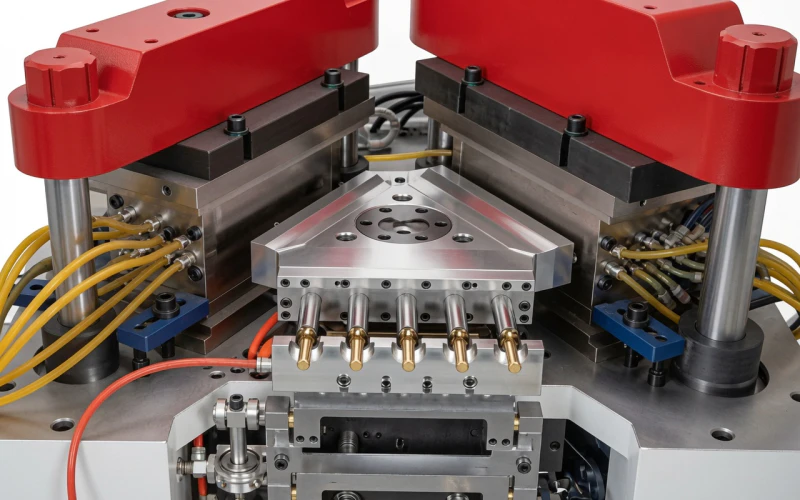
The injection mold relies on a heated manifold to keep the PET or PC molten. The weakest links here are the Nozzle Heater Bands and Valve Gate Pins. If a heater band burns out, that specific cavity will freeze, forcing you to run the machine with a blocked cavity, unbalancing the rotary table. Stocking exact-dimension coil heaters and spare copper nozzle tips allows your maintenance team to fix a cold cavity in two hours rather than two weeks.
6. Sourcing Realities: Parallel Imports vs. Asian Alternatives
Since 2022, major European automation brands (Siemens, Festo, Rexroth, B&R) have restricted direct sales and support to the Russian market. When your machine breaks, you face a critical sourcing decision.
The Parallel Import Route: You can source original European parts via third-party brokers in friendly jurisdictions. However, this carries risks: inflated prices (often +100% to +300% markup), lack of manufacturer warranty, and the danger of counterfeit parts flooding the gray market. Furthermore, if the part contains dual-use microchips, customs clearance at the EAEU border can be inexplicably delayed.
The Asian Alternative (Import Substitution): Forward-thinking Russian manufacturers are increasingly requesting that new ISBM machines be built with high-tier Asian components (e.g., Inovance servos, Mindman pneumatics, Techmation PLCs) rather than European equivalents. These brands offer direct, sanctioned-free supply chains to Russia, meaning spare parts arrive in days rather than months, with full factory warranties intact. When buying a new machine, prioritize ease of maintenance over legacy brand loyalty.
7. Storage Best Practices: Protecting ЗИП from the Elements
A spare part is only useful if it functions when you take it out of the box. Storing delicate automation components in an unheated Russian warehouse (склад) is a costly mistake.
- ✓Climate Control: Electronics (PLCs, HMIs) and rubber seals must be stored in a heated, dry environment (minimum +15°C). Freezing temperatures will embrittle rubber O-rings and can crack the LCD screens of spare touch panels.
- ✓ESD Protection: Printed circuit boards (PCBs) and servo control cards must be kept in their original anti-static packaging. Russian winter air indoors is notoriously dry (due to central heating), creating severe static electricity hazards that can instantly fry a bare PCB during handling.
- ✓Rust Prevention: Spare tie-bars, screws, and metal mold components must be coated in industrial anti-rust grease (such as Cosmoline or specialized VCI sprays) and wrapped in VCI (Volatile Corrosion Inhibitor) paper. High humidity in spring and autumn will otherwise rust bare steel within weeks.
8. The Ultimate “Day-One” Spare Parts Investment Checklist
Do not wait for a breakdown to order parts. The most cost-effective strategy is to order a comprehensive “Day-One” spare parts package concurrently with your new ISBM machine. This allows the parts to ship inside the same container, bypassing secondary customs declarations and separate air-freight fees.
| Component Category | Specific Items to Stock | Recommended Quantity |
|---|---|---|
| Consumables & Seals | Hydraulic filters, O-ring sets, water manifold seals | 2 sets per machine |
| Thermal Components | Heater bands (barrel), hot runner nozzles, thermocouples | 5-10 units of each size |
| Pneumatics (High Risk) | Solenoid valves, 40-bar blowing valve rebuild kit | 1 of each core type |
| Sensors & Electrics | Linear transducers, Solid State Relays (SSR), Proximity switches | 1 complete set |
| Major Automation | Main PLC CPU (Pre-programmed!), 1 primary Servo Drive | 1 unit (Shared across fleet) |
If you operate multiple identical ISBM machines in your Russian facility, the economics of stocking expensive Tier 3 items (like PLCs and Servo Drives) becomes highly favorable, as one spare can act as an insurance policy for the entire fleet.
The Russian manufacturing landscape no longer forgives supply chain optimism. Building a resilient, on-site spare parts inventory is not an added expense—it is a critical hedge against catastrophic geopolitical logistics delays. By understanding the specific weaknesses induced by 40-bar pressures, unstable 380V grids, and extreme winter temperatures, Chief Engineers can strategically stock the exact components necessary to guarantee 24/7 profitability.
Need to Audit Your Spare Parts Inventory?
Our technical teams can evaluate your current ISBM/IBM machinery and generate a custom, sanctioned-compliant “Day-One” spare parts checklist tailored to Russian operating conditions. Secure your production today.