For decades, Polycarbonate (PC) was the undisputed material of choice for high-end reusable water bottles, baby feeding bottles, and premium kitchenware due to its shatterproof durability and glass-like clarity. However, the global regulatory ban on BPA (Bisphenol-A) fundamentally disrupted this market. In response, Eastman Chemical introduced Tritan™—a revolutionary BPA-free copolyester that delivers the impact resistance and dishwasher durability of PC without the health risks. But for process engineers operating One-Step Injection Stretch Blow Molding (ISBM) machines, Tritan presents a highly distinct processing paradigm. It is not PET, and it is not PC. Attempting to process Tritan using legacy parameters will immediately result in catastrophic gate blush, severe internal stress (birefringence), and bottles that craze or shatter after a few cycles in a dishwasher. This comprehensive guide details the exact thermodynamic, drying, and injection-blow parameters required to successfully master Tritan processing.
1. Material Science: Why Tritan Behaves Differently
To set up the ISBM machine correctly, operators must first understand where Tritan sits on the polymer spectrum. Standard PET has a Glass Transition Temperature (Tg) of around 75°C to 80°C, making it easy to stretch but unsuitable for boiling water or dishwashers. Polycarbonate (PC) has a massive Tg of 147°C, making it incredibly tough but very difficult to melt and flow.
Tritan copolyester is engineered to sit exactly in the middle. Depending on the specific grade (e.g., TX1001, TX2001), Tritan has a Tg between 108°C and 115°C. This higher Tg means that Tritan requires significantly more thermal energy to become pliable enough for stretch-blowing than PET. Additionally, Tritan is highly amorphous and shear-sensitive. Forcing the melt through a narrow hot-runner gate too quickly will fracture the polymer chains, resulting in a dull, milky-white haze known as “gate blush.”
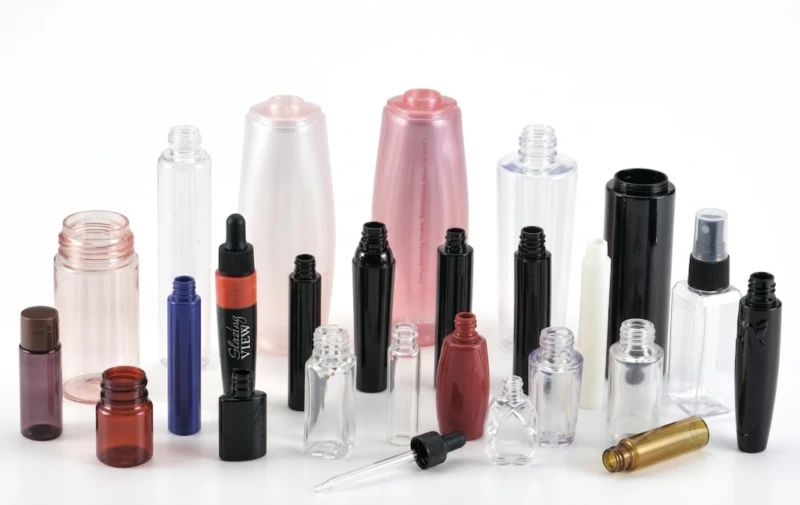
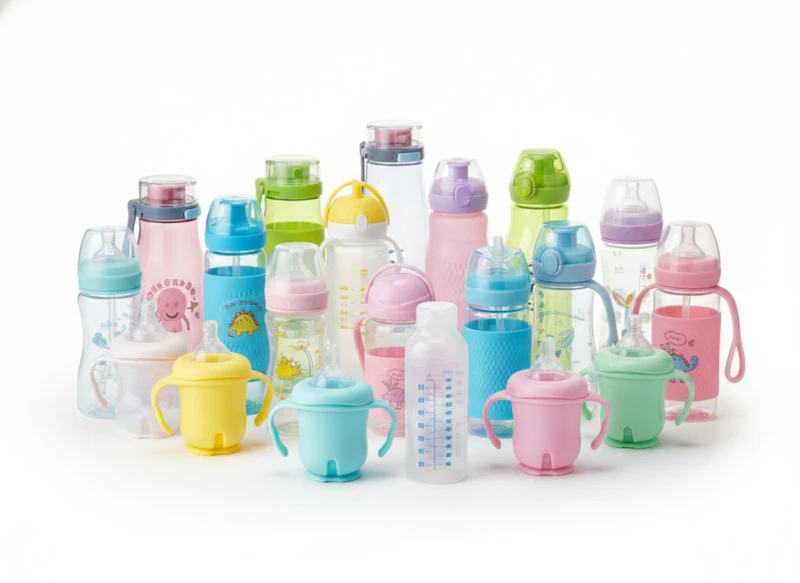 Fig. 1 — Tritan applications. Valued for being 100% BPA-free and dishwasher safe, Tritan has become the mandatory standard for premium sports hydration, infant care, and medical device packaging.
2. Desiccant Drying: The Invisible Barrier to Clarity
Like PET and PC, Tritan is highly hygroscopic—it absorbs moisture directly from the ambient air. If processed with trapped moisture, the polymer undergoes rapid hydrolysis in the injection barrel. The moisture turns into superheated steam, breaking the polymer bonds. This causes silver streaks (splay), severe drop-test failures, and a drastic loss of intrinsic viscosity (IV).
| Resin Type | Drying Temp | Drying Time | Max Moisture Limit | Dew Point Required |
|---|---|---|---|---|
| Standard PET | 160°C – 170°C | 4 – 6 Hours | < 0.005% | -40°C |
| Polycarbonate (PC) | 120°C – 125°C | 3 – 5 Hours | < 0.02% | -40°C |
| Eastman Tritan™ | 88°C – 100°C | 4 – 6 Hours | < 0.03% | -40°C |
Warning: You cannot dry Tritan at PET temperatures (160°C). Because Tritan is amorphous, drying it above 100°C will cause the pellets to soften, melt together, and form a massive block inside your dryer hopper (bridging), shutting down production entirely. You must use a highly efficient desiccant rotor dryer operating strictly at 88°C – 100°C with a verified -40°C dew point.
3. Injection Station: Melt Temperature & Shear Sensitivity
Tritan requires a melt temperature profile that is moderately high, typically ranging from 260°C to 282°C across the barrel. If the barrel is too cold, the melt becomes highly viscous, requiring massive injection pressures that induce internal stress. If the barrel exceeds 285°C for prolonged periods, Tritan will thermally degrade, resulting in a distinct yellowish tint and brittle drop-test behavior.
Multi-Stage Injection Velocity (Avoiding Gate Blush)
The most common defect when processing Tritan is Gate Blush—a cloudy, white ring around the injection point at the base of the bottle. This is not caused by moisture; it is caused by mechanical shear stress. Forcing Tritan through the hot runner gate at high velocity literally fractures the polymer structure.
Set the initial injection speed to a very slow velocity (15% – 25%) for the first 5% of the shot volume. This allows the polymer melt to smoothly clear the restrictive gate geometry without inducing shear friction.
Once the melt front has passed the gate, rapidly ramp the speed up (60% – 80%) to quickly fill the bulk of the preform cavity before the material freezes against the mold walls.
4. Mold Temperature Control: The “Hot Water” Requirement
This is where the majority of ISBM operators fail when transitioning from PET to Tritan. Standard PET preform molds are cooled aggressively using 10°C chilled water. If you inject Tritan into a cold mold, you will lock in massive amounts of internal stress.
Because Tritan has a higher Tg (108°C), it freezes much faster than PET. If it hits a cold mold wall, the skin solidifies instantly while the core remains molten, creating a massive temperature differential. To prevent this, ISBM injection molds running Tritan must be heated.
You must connect the injection mold cavities and cores to a high-temperature water circulating unit (TCU) set between 60°C and 80°C. This keeps the plastic pliable longer as it fills the cavity, dramatically reducing flow stress. Only the neck ring (lip cavity) should remain cooled with standard chilled water to ensure the threads freeze solidly and don’t distort during transfer.
5. Thermal Conditioning and Stretch Blow Dynamics
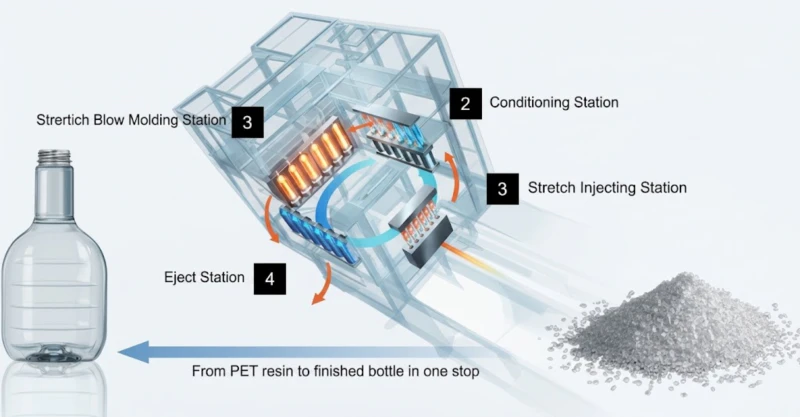
In a One-Step ISBM process, the preform retains residual heat from the injection station as it travels to the blow station. Because Tritan’s optimal orientation temperature is higher than PET’s (typically around 110°C – 120°C), you must carefully manage this thermal window.
If you are using a 4-station machine, the Thermal Conditioning Station allows you to selectively heat or cool the preform body before blowing. If the preform is too hot, it will over-stretch at the base and become dangerously thin. If it is too cold, the stretch rod will puncture the base, or the bottle will exhibit “pearlescence” (a whitish, stretched appearance).
High-Pressure Blow Logistics: To force the thick, high-Tg Tritan against the walls of the blow mold and capture sharp cosmetic details, you need robust high-pressure air. Set the main blow pressure between 3.0 MPa and 4.0 MPa (30-40 bar). To achieve this reliably without oil contamination, pairing the machine with a dedicated, matched 40-bar oil-free compressor is an absolute requirement for FDA and EFSA compliance.
6. Addressing Internal Stress: Preventing Dishwasher Crazing
The primary selling point of a Tritan bottle is its claim to be “Dishwasher Safe” (capable of surviving hundreds of high-heat wash cycles without turning cloudy or cracking). However, this is only true if the bottle is molded without residual internal stress.
If you use high holding pressures during injection, inject into a cold mold, or blow the bottle when the preform is too cold, you lock massive mechanical stress into the polymer network. The bottle may look crystal clear initially, but the moment it is exposed to the harsh alkaline detergents and 80°C hot water inside a commercial dishwasher, that internal stress violently releases. This phenomenon causes micro-cracking, known as “crazing.”
Quality Control (Birefringence Testing): To verify your parameters are stress-free, place the molded Tritan bottle between two cross-polarized light filters. If the bottle glows with intense, tight rainbow-colored bands (especially at the gate or the shoulder), the internal stress is critically high. A properly molded Tritan bottle will show only faint, broad color gradients under polarized light.
7. Auxiliary Setup and Tritan Regrind Policies
The ISBM auxiliary equipment surrounding the machine dictates the quality of the final Tritan product.
The Regrind Question: Can you recycle rejected Tritan bottles and mix them back into virgin material? Yes, but with strict limitations. Because Tritan undergoes minor thermal degradation during the initial melting process, reusing the material lowers its IV (Intrinsic Viscosity) and impact strength. As a strict engineering rule for premium food-contact applications, regrind should never exceed 10% to 15% of the total hopper mix. Furthermore, the regrind must be painstakingly dusted and dried alongside the virgin material. Adding dusty, wet regrind into the hopper will instantly cause black specks (carbonized dust) and massive splay defects.
8. Troubleshooting Common Tritan Defects (Parameter Matrix)
When switching an ISBM machine from PET to Tritan, operators will inevitably encounter defects. Use this diagnostic matrix to isolate and resolve parameter faults:
- Defect: White Haze at the Base (Gate Blush).
Cause: Shear stress at the hot runner gate. Solution: Reduce Stage 1 injection speed. Increase the hot runner nozzle temperature slightly to lower viscosity. - Defect: Silver Streaks (Splay) on the Bottle Surface.
Cause: Hydrolysis due to moisture. Solution: Verify the desiccant dryer dew point is -40°C. Check for condensation on the feed throat cooling block. Ensure drying time is at least 4 hours at 95°C. - Defect: Yellowing or Brown Tints.
Cause: Thermal degradation. Solution: The melt temperature is too high, or the residence time in the barrel is too long. Lower barrel temperatures by 3-5°C and reduce screw RPM to minimize shear heating. - Defect: Bottle Crazing After Washing.
Cause: High internal residual stress. Solution: Increase the injection mold water temperature to 70°C. Decrease holding pressure and holding time to the absolute minimum required to prevent sink marks. - Defect: Pearlescence (White Stretching).
Cause: Stretching the preform while it is too cold (below Tg). Solution: Increase the thermal conditioning station temperature, or decrease the injection mold cooling time to retain more residual heat.
Mastering Eastman Tritan™ on an ISBM platform requires breaking away from standard PET habits. By embracing hot injection molds, precise multi-stage injection profiles, and meticulous desiccant drying, processors can unlock the full potential of this high-margin, BPA-free polymer, delivering premium products that dominate the consumer market.
Struggling with Tritan Processing or Stress Cracking?
Tritan is an unforgiving material that requires immense processing expertise. Our senior process engineers can remotely audit your ISBM machine parameters or provide on-site training to eliminate haze, manage internal stress, and perfect your premium BPA-free packaging.