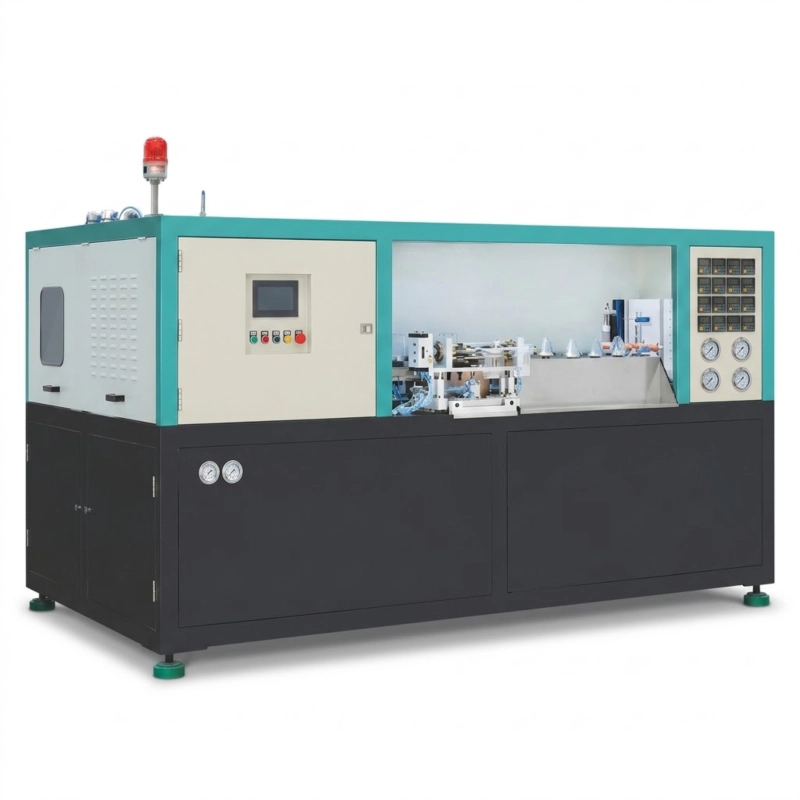
Baby Bottle & PP Bottle Series Blow Molding Machines
Automatic PET & PP baby bottle blow molding machines. 7 models, 1–4 cavities, 114.3 mm wide-neck, 300–2,000 bph. BPA-free, no-hand-contact, GMP compatible. PET/PP dual-material. CE certified.
Baby Bottle & PP Bottle Series
Blow Molding Machines — Complete Model Guide
► Up to 350 ml
► 300 – 2,000 bph
► 114.3 mm Wide Neck
► PET / PP Compatible
► CE Certified
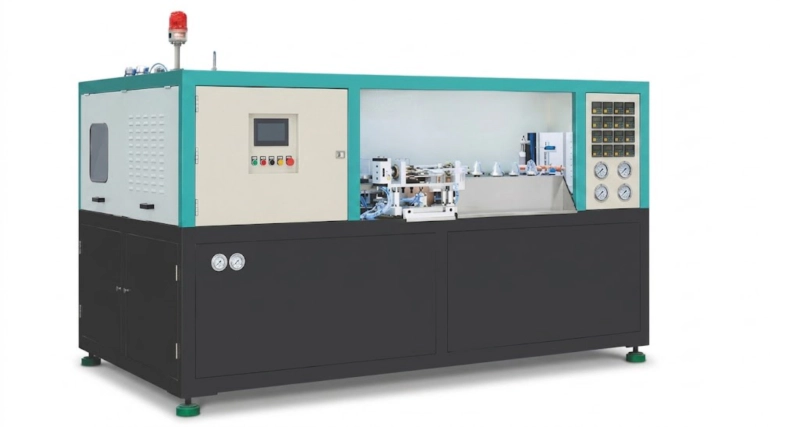
1. Product Overview
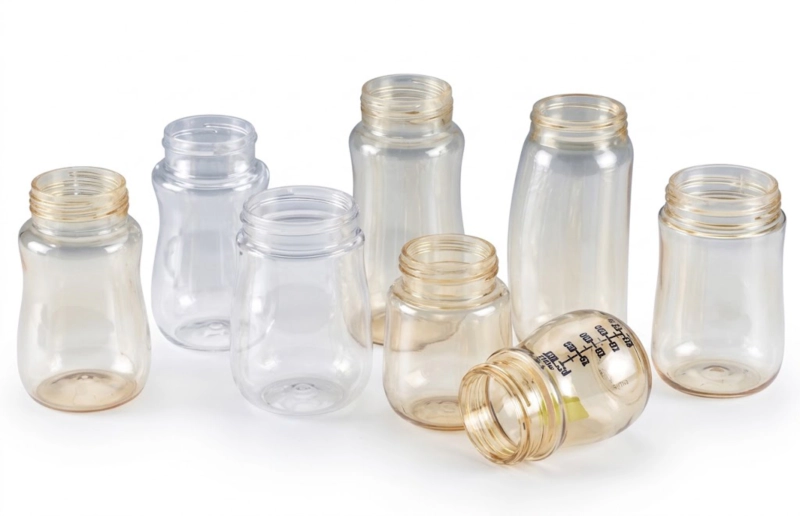
The Baby Bottle & PP Bottle Series Blow Molding Machines comprise 7 models across the AS, FS, and JS sub-series, purpose-built for the highly demanding dimensional accuracy, material safety, and surface quality requirements of infant feeding bottle production. All models produce wide-neck containers with the industry-standard 114.3 mm neck diameter used across the global baby bottle market — compatible with the universal teat-collar systems of major infant feeding brands — as well as narrower 76.2 mm formats for smaller-capacity feeding accessories.
The series spans three architectures targeting distinct aspects of the baby bottle market. The AS series (1, 2, and 4 cavity) processes both PET and PP on the same machine — enabling manufacturers to run crystal-clear PET bottles for retail visibility alongside heat-sterilisation-resistant PP bottles for clinical and premium segments without investing in separate machines. The FS series (PP-only) provides dedicated PP baby bottle production with a standard format (FS-1C114.3) and a wide-neck neck-protection variant (FS-1CG114.3). The JS series (PP-only) offers an alternative PP platform with 1-cavity and 2-cavity configurations.
All models prioritise no-hand-contact production and AS-grade servo precision — the two requirements that make baby bottle production technically distinct from standard packaging blow molding. Infant feeding bottles must maintain teat-collar seating geometry within tolerances tighter than most adult packaging closures, and must be produced without contamination risk to the inner surface, which contacts formula or expressed milk directly.
Applicable Industries & Applications
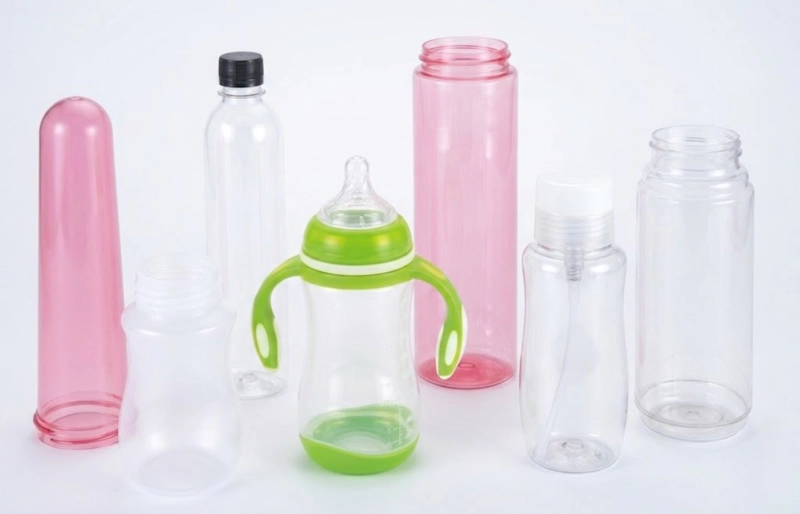
✓ Wide-Neck Baby Bottles (114.3 mm)
✓ PP Heat-Sterilisable Bottles
✓ Toddler Sippy Cups & Training Bottles
✓ Breast Milk Storage Bottles
✓ Wide-Neck PP Food-Contact Containers
✓ Premium PP Packaging (Cosmetic / Pharma)
✓ BPA-Free Infant & Toddler Drinkware
2. Working Principle
All models operate on the two-step reheat stretch blow molding (RSBM) process. Wide-neck infant bottle preforms — significantly heavier and thicker than equivalent-volume beverage preforms, with a 114.3 mm neck ring accounting for a high proportion of total preform weight — are automatically fed from a gravity hopper, oriented neck-up, and conveyed through a multi-zone NIR oven on dedicated wide-neck mandrel holders without hand contact at any stage.
PP processing introduces specific challenges compared with PET. PP has a narrower process window — the temperature range between insufficient orientation and stress whitening is tighter than PET — requiring more precise zone-by-zone NIR control and faster transfer from oven to blow station to prevent temperature loss in the critical pre-blow window. All FS and JS series models, and the PP-mode operation of AS series models, incorporate PP-optimised oven zone configurations, transfer timing, and blowing pressure profiles as stored PLC recipes.
At the blow station, servo stretch rods extend axially per cavity simultaneously with low-pressure air pre-blowing, followed by a 35 kg/cm² high-pressure blast that drives PET or PP against the cooled mold wall. The 114.3 mm wide neck demands a larger mold-platen opening than standard narrow-neck machines — all models in this series have clamping and mold-open distances specifically sized for the 114.3 mm neck geometry.
Key structural components: AS-grade servo-electric clamping • per-cavity servo stretch rod • multi-zone NIR oven with wide-neck 114.3 mm neck-protection cooling collar • no-hand-contact automatic wide-neck preform feeder • Siemens/Mitsubishi PLC with PET/PP dual-mode recipes • inline dimensional rejection system.
3. Core Advantages
PET & PP on One Machine (AS Series)
AS-series models process both PET and PP without hardware modification — switching between resins requires only a preform change and PLC recipe selection. Baby bottle producers serving both the clear-PET retail segment and the PP clinical/premium segment can run both formats on a single machine, reducing capital investment and floor space requirements.
114.3 mm Wide-Neck Precision
All models maintain neck-finish diameter variation within ±0.15 mm for the 114.3 mm wide-neck format — the tolerance required for consistent teat-collar engagement torque and airtight seal across all bottles in a production batch. Tighter than standard packaging requirements, this precision eliminates feeding leakage from inconsistent teat-collar seating that causes returns and brand damage.
BPA-Free — PET & PP
Both PET and PP are inherently BPA-free and globally approved for infant food contact under FDA 21 CFR, EU Regulation 10/2011, and equivalent national infant safety regulations. No plasticisers, no bisphenol compounds, no phthalates. PET offers superior clarity; PP offers superior heat-sterilisation resistance (120°C autoclave compatible) and microwave safety.
No-Hand-Contact — Infant Safety Standard
Fully automated production from preform feed to bottle discharge with no operator hand contact with preform or bottle interior at any stage — satisfying the fundamental infant product manufacturing safety requirement and supporting compliance submissions under EN 14350 (infant drinking equipment) and equivalent national standards.
300 to 2,000 bph — Precision Over Speed
Baby bottle blow molding is a precision-first application — throughput is secondary to dimensional consistency. The series range of 300–2,000 bph reflects the extended cycle times required for wide-neck preform conditioning and the reduced cavity counts justified by premium bottle values. Even at 300 bph, per-bottle economics are commercially strong in the premium infant feeding market.
Complete Turnkey Supply
We supply baby bottle blow molds (114.3 mm and 76.2 mm wide-neck tooling), PET and PP preform injection molds, industrial chillers, and oil-free compressor packages from a single source — ensuring food-grade and infant-contact-grade compressed air compliance and simplifying procurement for infant product brand owners and packaging converters.
4. Technical Specifications
▶ AS Series — PET & PP Dual-Material Baby Bottle (1 / 2 / 4 Cavity)
3 models. Higher-grade AS servo motors for maximum neck-finish precision on 114.3 mm and 76.2 mm wide-neck infant bottles. Processes both PET and PP from stored dual-mode PLC recipes — no hardware modification required between resins.
| Parameter / Unit | AS-1C114.3 | AS-2C114.3 | AS-4C76.2 |
|---|---|---|---|
| Material | PET / PP | PET / PP | PET / PP |
| Cavities | 1 | 2 | 4 |
| Max. Container Volume (ml) | 350 | 350 | 250 |
| Output (bph) | 500 | 900 | 2,000 |
| Max. Neck Diameter (mm) | 114.3 | 114.3 | 76.2 |
| Max. Body Diameter (mm) | 80 | 80 | 65 |
| Max. Container Height (mm) | 235 | 235 | 235 |
| Clamping Stroke (mm) | 122 | 122 | 100 |
| Mold-Open Distance (mm) | 302 | 302 | 280 |
| Stretching Stroke (mm) | 400 | 400 | 350 |
| Preform Holder | 24 | 48 | 96 |
| Max. Heating Power (kW) | 20 | 30 | 33 |
| Normal Heating Power (kW) | 8 | 15 | 17 |
| Blowing Pressure (kg/cm²) | 35 | 35 | 35 |
| HP Air Consumption (L/min) | 500 | 1,000 | 4,000 |
| Cooling Water Flow (L/min) | 30 | 30 | 40 |
| Machine Size L×W×H (mm) | 2150×1660×2150 | 2660×1660×2150 | 3370×1850×2100 |
| Machine Weight (kg) | 1,500 | 2,600 | 4,000 |
▶ FS Series — PP-Only Dedicated Baby Bottle (1 Cavity)
2 models. Purpose-built PP-only platforms for dedicated baby bottle production. FS-1C114.3: standard wide-neck PP bottle. FS-1CG114.3: wide-neck format with enhanced neck-protection system for bottles requiring additional collar-zone thermal isolation during oven conditioning.
| Parameter / Unit | FS-1C114.3 | FS-1CG114.3 |
|---|---|---|
| Material | PP | PP |
| Cavities | 1 | 1 |
| Special Feature | Standard PP wide-neck | Enhanced neck-protection system |
| Max. Container Volume (ml) | 350 | 350 |
| Output (bph) | 300 | 300 |
| Max. Neck Diameter (mm) | 114.3 | 114.3 |
| Max. Body Diameter (mm) | 80 | 80 |
| Max. Container Height (mm) | 235 | 235 |
| Clamping Stroke (mm) | 139 | 139 |
| Stretching Stroke (mm) | 400 | 400 |
| Max. Heating Power (kW) | 22 | 22 |
| Normal Heating Power (kW) | 10 | 10 |
| HP Air Consumption (L/min) | 500 | 500 |
| Cooling Water Flow (L/min) | 30 | 30 |
| Machine Size L×W×H (mm) | 2150×1660×2150 | 2550×1660×2150 |
| Machine Weight (kg) | 1,800 | 1,800 |
▶ JS Series — PP-Only Baby Bottle Platform (1 & 2 Cavity)
2 models. PP-only platforms for single-cavity development and 2-cavity scaled production. JS-1C114.3 for pilot or premium low-volume PP baby bottle runs; JS-2C114.3 for commercial-scale PP bottle production at 600 bph.
| Parameter / Unit | JS-1C114.3 | JS-2C114.3 |
|---|---|---|
| Material | PP | PP |
| Cavities | 1 | 2 |
| Max. Container Volume (ml) | 350 | 350 |
| Output (bph) | 300 | 600 |
| Max. Neck Diameter (mm) | 114.3 | 114.3 |
| Max. Body Diameter (mm) | 80 | 80 |
| Max. Container Height (mm) | 235 | 235 |
| Clamping Stroke (mm) | 139 | 139 |
| Stretching Stroke (mm) | 400 | 400 |
| Max. Heating Power (kW) | 22 | 36 |
| Normal Heating Power (kW) | 10 | 20 |
| HP Air Consumption (L/min) | 500 | 1,000 |
| Cooling Water Flow (L/min) | 30 | 30 |
| Machine Size L×W×H (mm) | 2150×1660×2150 | 2660×1660×2150 |
| Machine Weight (kg) | 1,800 | 2,600 |
5. Structure & Material Engineering
🛠 Wide-Neck Clamping Architecture
The 114.3 mm wide-neck format requires a substantially wider mold-platen opening than standard narrow-neck machines — all models have clamping and mold-open dimensions sized for this geometry. The FS and JS series use a 139 mm clamping stroke versus 100–122 mm in standard machines, providing the necessary clearance for wide-neck baby bottle mold access without mechanical interference during bottle extraction.
⚙ AS-Grade Servo Clamping
Toggle-link servo-electric clamping with higher-specification AS-grade servo motors in the AS series — delivering ±0.15 mm neck-finish repeatability for teat-collar seating. FS and JS series use equivalent servo-electric clamping with no hydraulic fluid, eliminating contamination risk in infant product manufacturing environments.
🌡 PP-Optimised NIR Oven
PP has a narrower process window than PET — the temperature band between under-heated (insufficient orientation, stress whitening) and over-heated (surface burning, crystallisation) is approximately 5°C versus 15°C for PET. All PP-mode oven configurations use tighter zone control, faster preform transfer from oven exit to blow station, and PP-specific blowing pressure profiles stored as dedicated PLC recipes. The AS-series dual-mode recipe system allows rapid switching between PET and PP configurations without manual oven adjustments.
🔓 Baby Bottle Mold Materials
Blow mold cavities machined from high-strength aluminium alloy with conformal cooling channels optimised for the thick-base geometry of infant bottles. All mold surfaces in contact with the bottle exterior are polished to food-contact surface finish standards. Baby bottle preform injection molds use 2316 food-grade stainless mold steel, CNC-machined with ±0.01 mm on teat-collar seating geometry.
🔓 Wide-Neck Preform Mandrel System
Wide-neck 114.3 mm preforms are significantly larger and heavier than standard beverage preforms — requiring wider-bore mandrel holders, stronger orientation bowl air jets for correct neck-up orientation, and higher-capacity inclined feeder tracks. All models are equipped with 114.3 mm-specific preform handling hardware as standard, eliminating the adaptation failures that occur when standard beverage machines are incorrectly adapted for baby bottle preforms.
📱 PLC & Dual-Material Recipes
Siemens or Mitsubishi PLC with colour HMI. Up to 50 recipes on-board — including separate PET-mode and PP-mode recipe sets for each bottle format on the AS series. Production batch logging supports infant product traceability requirements. Format changeover between PET and PP requires only preform substitution and recipe selection — oven zone power, transfer timing, and blow pressure are all managed automatically by the stored recipe.
6. Typical Application Scenarios
7. Our Machines vs. European Brand Platforms — Objective Comparison
| Comparison Item | Sidel SBO Series | Krones Contiform | SMI Smiflexi | Sipa SFR EVO | Our Series |
|---|---|---|---|---|---|
| Origin | France | Germany | Italy | Italy | Asia |
| Baby Bottle / Wide-Neck Focus | Beverage-primary | Beverage-primary | General purpose | General purpose | Dedicated series |
| PET + PP on Same Machine | Selected models | Selected models | Limited | Limited | AS series — standard |
| 114.3 mm Neck Capability | Selected models | Selected models | Limited | Limited | All 7 models |
| Approx. Entry CapEx (1-cav.) | USD 120K – 200K | USD 110K – 180K | USD 90K – 160K | USD 100K – 170K | Significantly lower — direct |
| Spare Parts Lead Time | 4–12 weeks | 4–10 weeks | 4–10 weeks | 4–10 weeks | 3–7 days (stocked) |
| After-Sales Service | Regional agents | Regional agents | Regional agents | Regional agents | Direct + remote video |
| CE Certification | Yes | Yes | Yes | Yes | Yes |
CapEx figures are indicative market estimates. Our pricing is provided by confirmed quotation only.
8. Model Selection Guide
| Your Requirement | Recommended Model |
|---|---|
| Pilot / premium PET or PP baby bottle, 1 cavity, 500 bph | AS-1C114.3 (PET/PP dual-material) |
| Commercial PET or PP baby bottle, 2 cavity, 900 bph | AS-2C114.3 (PET/PP dual-material) |
| High-volume BPA-free bottle, 4 cavity, 2,000 bph, 76.2 mm neck | AS-4C76.2 (PET/PP dual-material) |
| Dedicated PP baby bottle, standard format, 1 cavity | FS-1C114.3 (PP-only, 300 bph) |
| Dedicated PP baby bottle, enhanced neck-protection, 1 cavity | FS-1CG114.3 (PP-only, 300 bph) |
| PP-only platform, low-volume or R&D, single cavity | JS-1C114.3 (PP-only, 300 bph) |
| PP-only platform, scaled commercial production, 2 cavity, 600 bph | JS-2C114.3 (PP-only, 600 bph) |
9. Frequently Asked Questions
Explore our full range of two-step and one-step blow molding machines for infant, medical, food, and industrial packaging:
► Browse All Blow Molding Machines
✉ Request a Free Quotation
10. Work with a Specialist Manufacturer
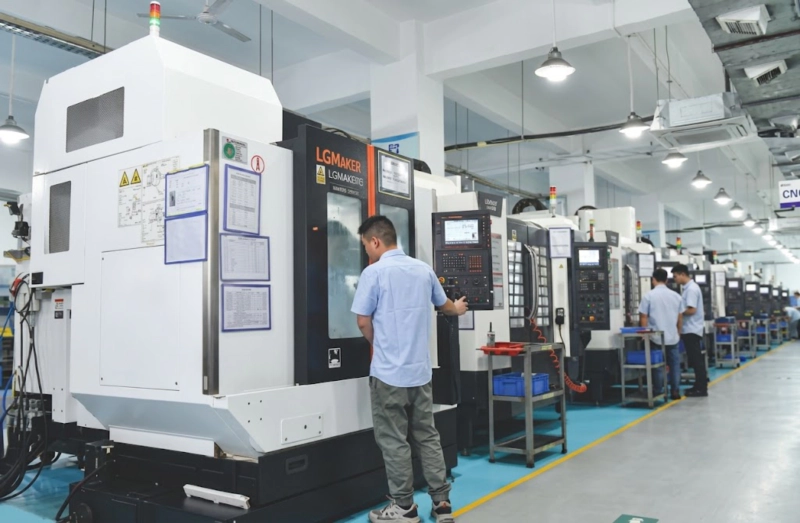
With over two decades of dedicated experience in blow molding machine design, manufacturing, and after-sales service, we supply automatic PET and PP baby bottle blow molding machines to infant feeding brands, healthcare packaging producers, and contract packaging organisations across more than 20 countries. Our production facility operates dedicated CNC machining, precision wide-neck mold fabrication, machine assembly, and quality-control departments. Our engineers are available globally for installation, commissioning, and after-sales support.
Whether you are launching a new infant feeding bottle brand, expanding from PET-only to dual-material PET/PP production, scaling from a pilot 1-cavity machine to multi-cavity commercial output, or replacing an ageing European baby bottle blow molder, our technical team will provide a no-obligation specification review and delivered-cost comparison within 48 hours of enquiry.